🎵 Harp String Calculator
Calculate string tension, gauge, and frequency for any harp scale length and tuning
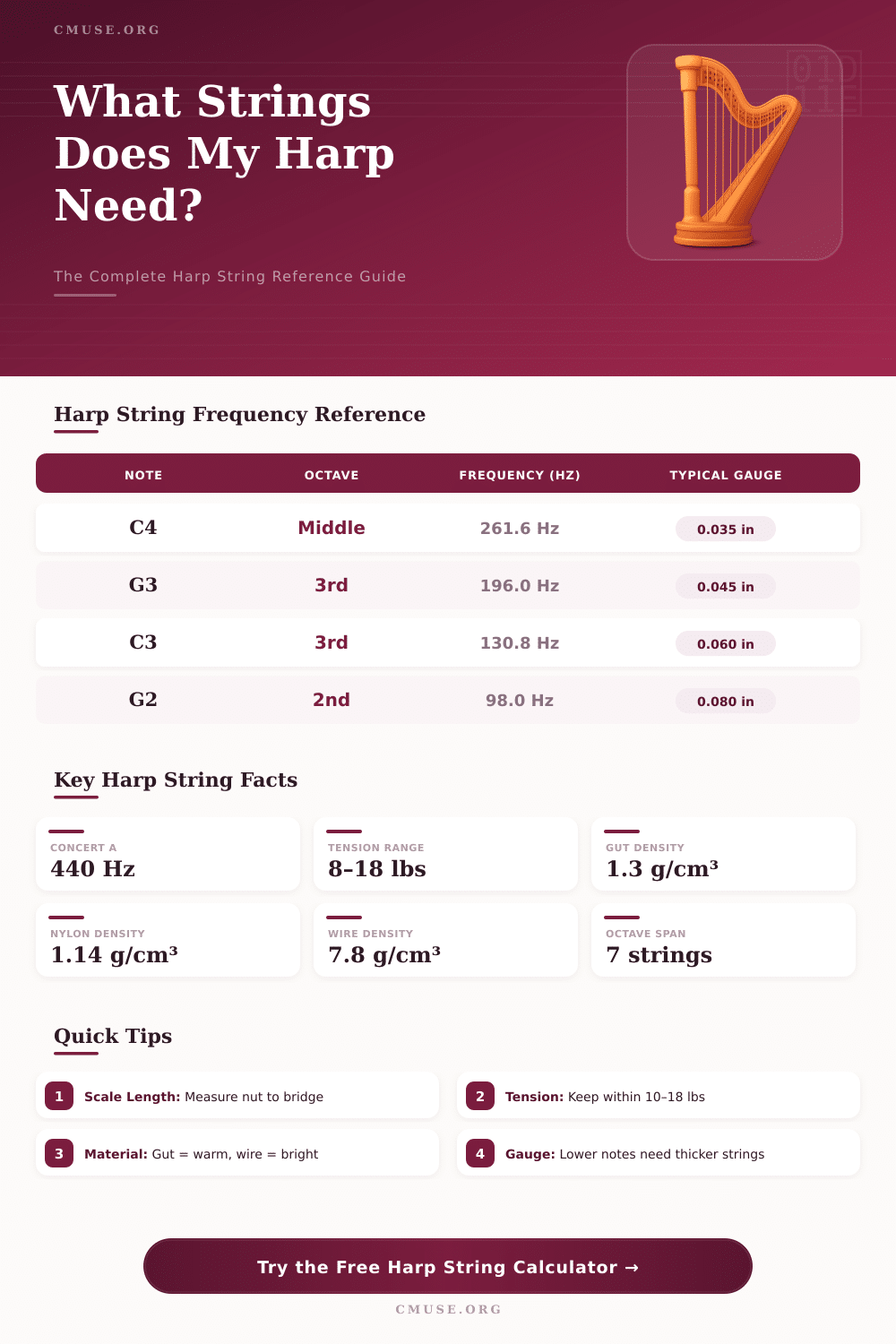
| Note | Frequency (Hz) | Typical Scale (in) | Recommended Gauge (in) |
|---|---|---|---|
| G2 | 98.00 | 72–80 | 0.070–0.085 |
| C3 | 130.81 | 58–68 | 0.055–0.070 |
| G3 | 196.00 | 48–58 | 0.042–0.055 |
| C4 (Middle C) | 261.63 | 38–48 | 0.032–0.045 |
| G4 | 392.00 | 28–38 | 0.022–0.032 |
| C5 | 523.25 | 20–28 | 0.016–0.024 |
| A4 (Concert) | 440.00 | 25–32 | 0.018–0.026 |
| E5 | 659.26 | 14–20 | 0.012–0.018 |
| Scale Length (in) | Scale Length (cm) | Approx. Tension (lbs) | Tension Rating |
|---|---|---|---|
| 34 | 86.4 | 7.3 | Very Light |
| 40 | 101.6 | 10.1 | Light |
| 47 | 119.4 | 13.9 | Medium |
| 55 | 139.7 | 19.0 | Heavy |
| 60 | 152.4 | 22.7 | Very Heavy |
| 67 | 170.2 | 28.3 | Concert (typical gut) |
| Gauge (in) | Gauge (mm) | Approx. Linear Mass (gut, g/m) | Typical Range |
|---|---|---|---|
| 0.018 | 0.46 | 0.22 | High treble |
| 0.025 | 0.64 | 0.42 | Upper mid |
| 0.032 | 0.81 | 0.69 | Mid treble |
| 0.040 | 1.02 | 1.07 | Middle octave |
| 0.050 | 1.27 | 1.67 | Lower mid |
| 0.065 | 1.65 | 2.83 | Bass register |
| 0.080 | 2.03 | 4.29 | Deep bass |
| 0.095 | 2.41 | 6.05 | Sub bass |
Harp String tension in short words deals with how much force one needs to pull the string. Harps with higher tension have strings that are hard to pull, while those with lower tension play more freely. Even so here is something subtle.
For harpists the tension relates to how much trouble to pull the strings, not to the real physical reason. A harp that fits well can seem to have less tension although the actual distance between the tuning pin and soundboard stays the same.
Harp String Tension: How It Affects Sound and Playing
Unlike violins or guitars, harps do not have a fixed standard for the length and tension of strings. With violins there are world rules about the f-holes, that all makers follow. Guitars are like that.
Harps simply did not reach such shared agreement.
Most harps use tension of 15 to 60 pounds for every Harp String. The frame of the harp must handle that force. Tension of a harp usually reaches 50 to 60 percent of the breaking point for the strings.
A denser string needs bigger tension to sound in the same pitch, and if the density rises too much, the string will brake. On the other hand, if a string is not dense enough, it will not sound all notes.
Nylon strings have an interesting trait: the breaking length stays the same no matter the thickness. The designer of a harp can choose thicker strings to give some of them more force, because thick strings carry more energy to move the soundboard. Even so a change of thickness can create an illusion about different sound, while actually thewhole harp reacts differently.
So that the harp sounds equal through everything, the ratio between tension and length should be almost the same for every Harp String. Because the vibrating lengths differ for almost each of them, one must figure different tensions for every case. So the same thickness of string on one harp will not always work on another.
It is always best to follow the advice of the maker about the strings for every note.
Tension really affects the sound and the way you play. Gut strings with concert tension give a warmer, less bright tone with shorter duration. A lever harp that sounds almost like a pedal harp needs strong tension of strings and weighs more.
A harp with light tension sounds like a guitar, but an octave higher.
When one restrings a harp, do that one string at a time. Harps do not like when one removes all tension at once. Some even will collapse.
Heat also causes changes. Molecules of nylon take more curved forms during warming, which raises the tension and makes the strings go sharp. Switching between harps with different tensions is possible, but it takes around ten to fifteen minutes to adapt.