Harmony Part Count Calculator
Estimate written harmony parts, section allocation, octave doublings, and voicing density for choir, band, and vocal arrangements.
🎼Arrangement Presets
🎤Harmony Inputs
Harmony Part Plan
📊Computed Arrangement Markers
🎶Harmony Target Table
| Harmony target | Core part count | Usually doubled | Best use |
|---|---|---|---|
| Two-note shell | 2 parts | Root and third or third and seventh | Lean backing vocals, brass stabs, chant support |
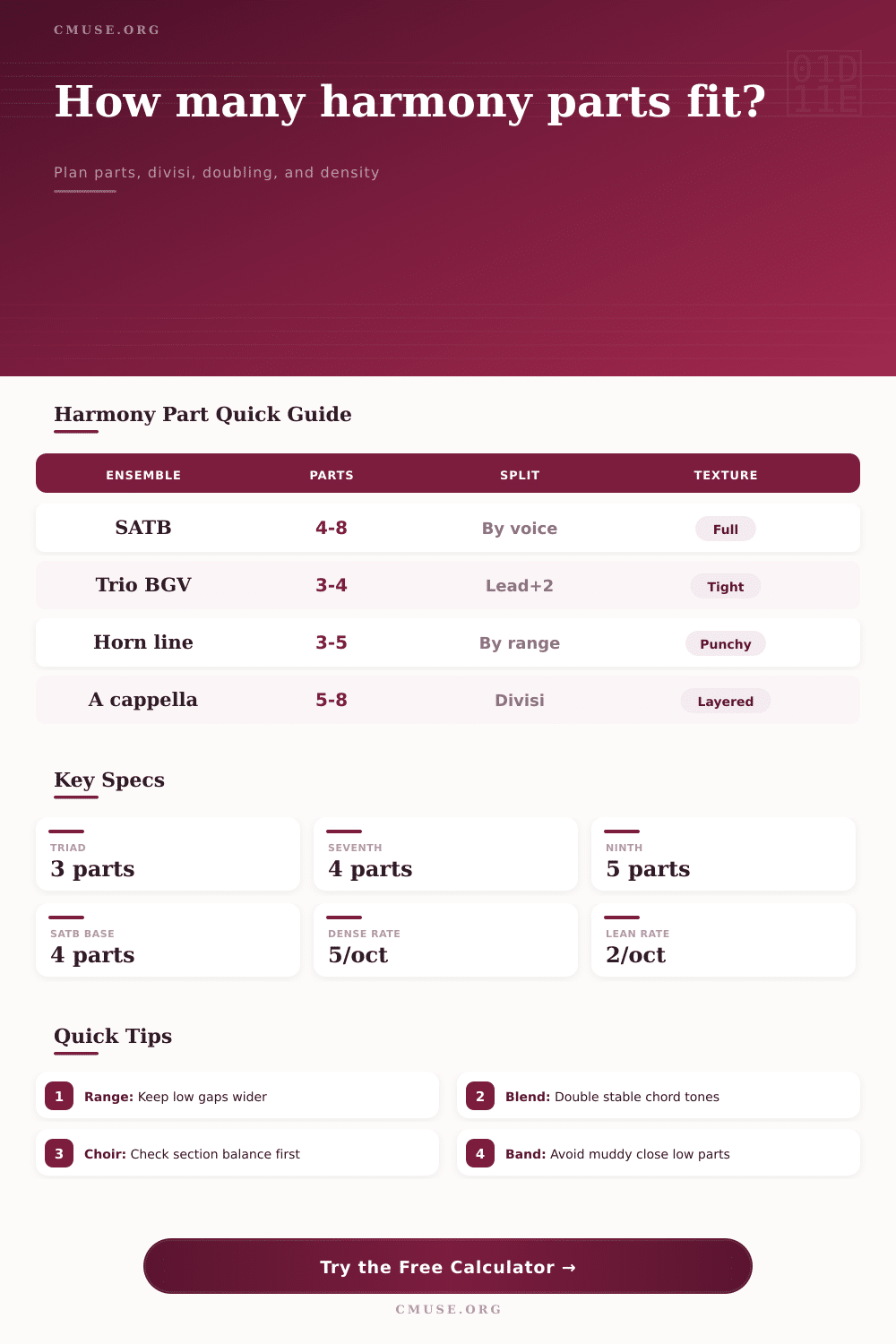
| Triadic harmony | 3 parts | Root or melody octave | Folk trio, hymn reduction, guitar-friendly vocals |
| Seventh chord | 4 parts | Root in bass, third in upper voices | SATB, close jazz voicing, horn soli writing |
| Ninth or sixth color | 5 parts | Stable chord tones before tensions | Gospel, big band, a cappella color chords |
| Altered extension stack | 6 or more parts | Guide tones kept clear | Dense jazz choir, shout chorus, cinematic pads |
🎙Voice Range Reference
| Part | Comfort zone | Useful harmony role | Allocation note |
|---|---|---|---|
| Soprano or lead treble | C4 to G5 | Melody, upper color, octave lift | Protect from constant high divisi |
| Alto or mid treble | G3 to D5 | Thirds, sevenths, inner pads | Often carries the blend center |
| Tenor or high horn | C3 to G4 | Counterline, guide tones, close lead support | Watch tessitura on active writing |
| Bass or low instrument | E2 to C4 | Roots, fifths, octave foundation | Give low notes wider spacing |
📐Voicing Density Table
| Density rate | Sounding lines | Spacing character | Risk to check |
|---|---|---|---|
| Under 2 per octave | Open | Transparent, orchestral, spacious | May feel under-harmonized |
| 2 to 3.5 per octave | Balanced | Clear chord identity with room for text | Inner lines need steady intonation |
| 3.6 to 5 per octave | Thick | Rich gospel, jazz, or cinematic stack | Low register mud and vowel spread |
| Above 5 per octave | Clustered | Dense shimmer, suspense, or crunch | Needs careful range and tuning control |
🧭Octave Doubling Guide
| Doubling plan | Added lines | Chord tones to double | When it helps |
|---|---|---|---|
| No octave doubling | 0 | None unless required by range | Small groups, tight BGV, transparent pads |
| Top line support | 1 | Melody, fifth, or color tone | Chorus lift without rewriting inner voices |
| Bass plus lead doubled | 2 | Root or fifth below, melody above | Choir with firm foundation and bright top |
| Full octave reinforcement | About half the parts | Roots, guide tones, stable extensions | Big chorus, big band, large ensemble pads |
👥Ensemble Comparison Grid
SATB Choir
Four natural sections, strong at 4 to 8 written parts when divisi is balanced across voices.
SSAA Choir
Bright upper blend; dense seconds work best when the lowest alto line has enough space.
TTBB Choir
Powerful low-mid sonority; open spacing keeps thirds and sevenths from getting cloudy.
Pop BGV Trio
Usually 2 or 3 harmony notes plus lead; octave doubles should be deliberate and sparse.
A Cappella Six
Can cover bass, lead, and four harmony tones if percussion or effects are not stealing voices.
Horn Section
Three to five parts read clearly; keep guide tones central and avoid crowded low brass.
Big Band
Five-part sax writing can expand with brass doubles for shout chorus mass and color.
String Pad
Octave layering is common; density can rise when bow changes and range are controlled.
Small Vocal Group
Limit the part count when everyone must sing text, move together, and tune exposed intervals.
💡Voicing Tips
So you start with a solitary melody line. On its own it feels isolated. In your mind’s ear you have a solid idea of how you want to sing the song; you know you shouldn’t just double the tune at the octave, but it can be a secret weapon if used strategicly, so what next?
The question is never realy about adding noise. It is more about determining exactly how many distinct part are needed to fill harmony while not obscuring the words, nor smearing bottom end too much. The part count comes into play here perhaps more than anywhere else, well ahead of sitting down with notation software or handing out sheets.
How to Choose the Right Number of Parts
People guess their way around this issue as most arrangers does. “SATB is standard so I’ll write four parts.” Or, “It’s supposed to sound big so I’m going to put six voices on this pop tune.” The calculator (above) do all the math for you when you input how many performers there are and at what density you want them to sit. It removes your need to rely solely on your gut feeling. Instead, it makes you clearly say what “full” look like for your particular group of performer.
Three different pitches make a triad harmonically stable. There are forty singers with only three different notes to sing. It is not a complex arrangement, but a block chord with thick reinforcement. This shift greatly changes how that ensemble blend and breathes together onstage.
All these options appear as technical input fields, but they relate directy to the physical world of what actually happens in the room. If you choose an Ensemble Type, you’re accepting the limits of instruments or voices. String pads has sustain and attack characteristics different than a horn section. Textures style matters too. You want those homophonic block chords to be clearly spaced out without anyone treading on someone else’s toes. More independent counterline layers need closer intonation from your players.
All this is why the recommended number of parts are adjusted by the tool. Put sixteen singers into eight slim lines and it becomes a brittle sound, collapsing under its own weight. Keep them in four solid lines and it becomes a wall of tone that holds.
The calculator also asks if you are going to be doubling the octaves. And here’s where your secret weapon is for sounding like more then you have. Doubling the top line makes it brighter but doesn’t complicate the harmony. Doubling the bass give it weight without muddying up the midrange, which is where our ears are the most sensitive. And the table on that page spells all this out clearly in a way that shows how a simple triad can become luxurius with just one strategic double.
Counting heads isn’t the point. It’s about putting those heads where they make the biggest acoustic impact while spending the least amount of time rehearsing blend.
Another idea that catches people out frequently is density. More parts equals better, right? Well no; it can overlook spacing issue in the lower notes. Because the wavelengths are physically longer, and they overlap, close-packed groups of notes below middle C will tend to smear together into a sort of murky wash. The calculator tell you when the density rating rises too high given the span of your selected range. It will advise lowering the number of tension notes sounding at any one time or opening the intervals out. This preserves the perceived fullness of the textural picture without compromising clarity of the harmony.
The other factor is the human side of things. A dozen singers will struggle singing divisi in three parts even if the spreadsheet tells you otherwise. You’ll be able to see where you’ve watered down your section too much by looking at the allocation per part. When there’s just one voice on each line of writing then any slight intonation slip stand out like a sore thumb for all to hear.
Where you want some redundancy here is with your critical chord tones, particularly the sevenths and thirds which give the harmony its character.
Arranging is all about managing constraints. There are only so many people who play instruments and each one has their own strengths. There are only so many breaths. There is also only so much frequency spectrum. Your objective isn’t to make things as complex as possible, but to find the right blend. The right number of parts. You must make sure that there’s never a line that goes missing amidst the fray and that each voice has something to do. Something more than just notes piled on top of each other. Something that becomes a well-constructed architectural element within overall sound.
Maybe you begin with that solitary melody, but by the time you’re done you’ve created something that sounds intended and resonates from every corner. It’s mostly a matter of knowing what you’re measuring. You need to know exactly how many different colors you require versus how many reinforcements you could of justified. Once you know that, the arrangement writes itself. You stop trying to fight against the sound, and you start crafting it. Every second you spend planning on paper prior to your first rehearsal makes this clear, and it’s worth every second.