Practice Hours to Learn Harmonica Calculator
Estimate realistic harmonica practice time from single-hole control through bends, breathing, tongue blocking, positions, blues riffs, and chromatic button work.
Estimated Harmonica Practice Plan
| Skill target | Typical hours | Main bottleneck | Useful check |
|---|---|---|---|
| Clean single notes | 12 to 35 | Mouth shape and hole isolation | Play holes 4, 5, 6 without neighbor reeds |
| Simple 1st-position melodies | 25 to 70 | Breath direction and note map | Keep melody tempo steady without gasping |
| Draw bends on 4 and 6 | 45 to 95 | Tongue arch and pitch memory | Land the bend with a tuner three times in a row |
| 2-hole and 3-hole bend control | 90 to 180 | Multiple bend floors on one hole | Move between half-step bends without scooping |
| Tongue-block octaves | 80 to 160 | Split spacing and relaxed embouchure | Hold clean 1-4, 2-5, and 3-6 octaves |
| 12-bar blues soloing | 150 to 300 | Phrasing, bends, and timing | Answer a two-bar phrase over a backing track |
| Chromatic button fluency | 180 to 420 | Slide timing and breath changes | Play a chromatic scale evenly in two octaves |
| Overblow or overdraw use | 260 to 600 | Reed response and exact oral cavity shape | Hit the note cleanly inside a musical phrase |
| Instrument | Learning feel | Hardest early skill | Practice emphasis |
|---|---|---|---|
| 10-hole diatonic | Small layout, deep technique | Bends and position thinking | Hole map, draw bends, blues phrasing |
| Low-tuned diatonic | Breath-heavy and slower response | Clean low bends | Air economy and relaxed attack |
| Natural minor diatonic | Faster access to minor color | Adapting familiar tabs | Position awareness and ear checks |
| Tremolo harmonica | Melody-first and less bend-centered | Stable breath across paired reeds | Songs, tone, and rhythmic breathing |
| 12-hole chromatic | Complete scale with slide button | Button timing | Scales, intervals, and clean note starts |
| 16-hole chromatic | Wider range and more air demand | Range navigation | Octave shifts and breath planning |
| Position | Common use | Key skill | Hour impact |
|---|---|---|---|
| 1st position | Folk melodies, straight harp, upper-register blues | Blow-draw map and clean holes | Baseline path |
| 2nd position | Cross-harp blues, rock, country licks | Draw bends on holes 2, 3, 4, and 6 | Adds moderate hours |
| 3rd position | Minor blues and modal lines | Draw-note phrasing and 1-hole control | Adds focused hours |
| 12-bar riffing | Call and response soloing | Timing, repetition, and release notes | Needs weekly repetition |
| Turnarounds | End of blues chorus phrases | Resolution and bend pitch | Adds vocabulary time |
| Amplified phrasing | Chicago-style blues tone | Cupping, dynamics, and controlled attack | Adds expression time |
| Weekly plan | Weekly hours | Best for | Calculator effect |
|---|---|---|---|
| 15 minutes x 4 days | 1.0 | First notes and casual melody work | Long calendar, low fatigue |
| 20 minutes x 5 days | 1.7 | Clean holes and steady breath | Reliable beginner progress |
| 30 minutes x 5 days | 2.5 | Bends, 2nd position, and blues riffs | Balanced technique gains |
| 45 minutes x 5 days | 3.8 | Tongue blocking and chromatic scales | Faster if structure is strong |
| 60 minutes x 6 days | 6.0 | Advanced goals and performance prep | Fastest with rest and review |
Most beginners have a similar experience with a harmonica: you buy one, put it in your mouth, blow into the hole and hear something sounding like a dying goose. It’s small enough to go in your pocket but it needs control of your body in ways that initially feel awkward. Very few people get beyond this as most give up due to poor breath control and an inability to play a single note cleanly.
Building muscle memory doesn’t happen overnight so knowing how long it might take can help keep motivation high during times when things seem to slow down. After entering in your starting skill level and desired end result, it calculates out for you how many hours will be required. In other words, you don’t have to guess at whether 200 or 20 is reasonable.
How Long It Takes to Learn the Harmonica
Then it chunks up the work into manageable components: chromatic button work, positions, blues riffs, bends, hole accuracy, tongue blocking, and breath control. For each one, you’re looking at a different challenge on a physical level.
There is no open space like blowing across a lip for breath control. You will need to use your diaphragm to produce a full tone, even with speedy finger action. That is why it is listed first. A common failing for beginner players is that they are not accurate enough at a single hole. They need to blow through just one hole and shape their mouth around it so they don’t make the nearby reeds vibrate.
It takes some getting used to because it feels awkward at first despite appearing easy. Most of us think this is something you have to be talented at, rather than repeat often. However, the lips and jaw has a muscle response to the way you practice. Practice makes perfect…quality practice does too! There will be less improvement if you play casually then if you drill focused on specific areas. Capture your performance then listen and adjust.
Beyond that is the addition of bending notes. Here’s where you alter the shape of your mouth as you continue to blow air to lower the note. It’s akin to drinking through a straw and whistling simultaneously. Mastering whole-step and half-step bends on certain holes requires hundreds of repetitions. That’s what the calculator accounts for in terms of additional time needed to achieve bending goals.
Your tongue learns millimeter precision adjustments and your ear trains itself to detect even slight pitch shifts. Position playing shifts the mental load entirely. Blues music relies heavily on second position which places the player outside of the natural scale of the harmonica. This means that you must locate the root note using draw bends and phrase around an alternative key.
Third position allows for the exploration of minor keys but demands tighter control over breath as many notes can only be accessed with draws. Each new position adds hours to the timeline (refer to the table). It’s not simply about acquiring new notes. It’s about rewiring how you perceive musical relationships.
To complicate things further, we have the chromatic harmonica which includes a slide button that allows you to add the required flats and sharps. On one hand, it sounds simpler as you can play in any key without needing to purchase several different instruments. It’s tricky coordinating your thumb and breath though. It has to be timed perfectly. Too early, too late and you’re either clashing notes, or getting a squeak. Interval practice takes more time to learn than just learning a melody from a song, so the calculator bumps up the hour count for fluency on a chromatic.
More difficult to achieve than the lip purr is the tongue block which provides a fuller sound but requires more control over your embouchure. This involves raising up parts of your tongue to produce individual notes or chord shapes whilst covering other holes with your tongue. Percussive effects such as slaps and pulls become part of the texture in traditional blues, folk etc. It effectively doubles your initial learning time because you have to coordinate a larger area of your mouth. This makes it feel clunky at first before it clicks into place.
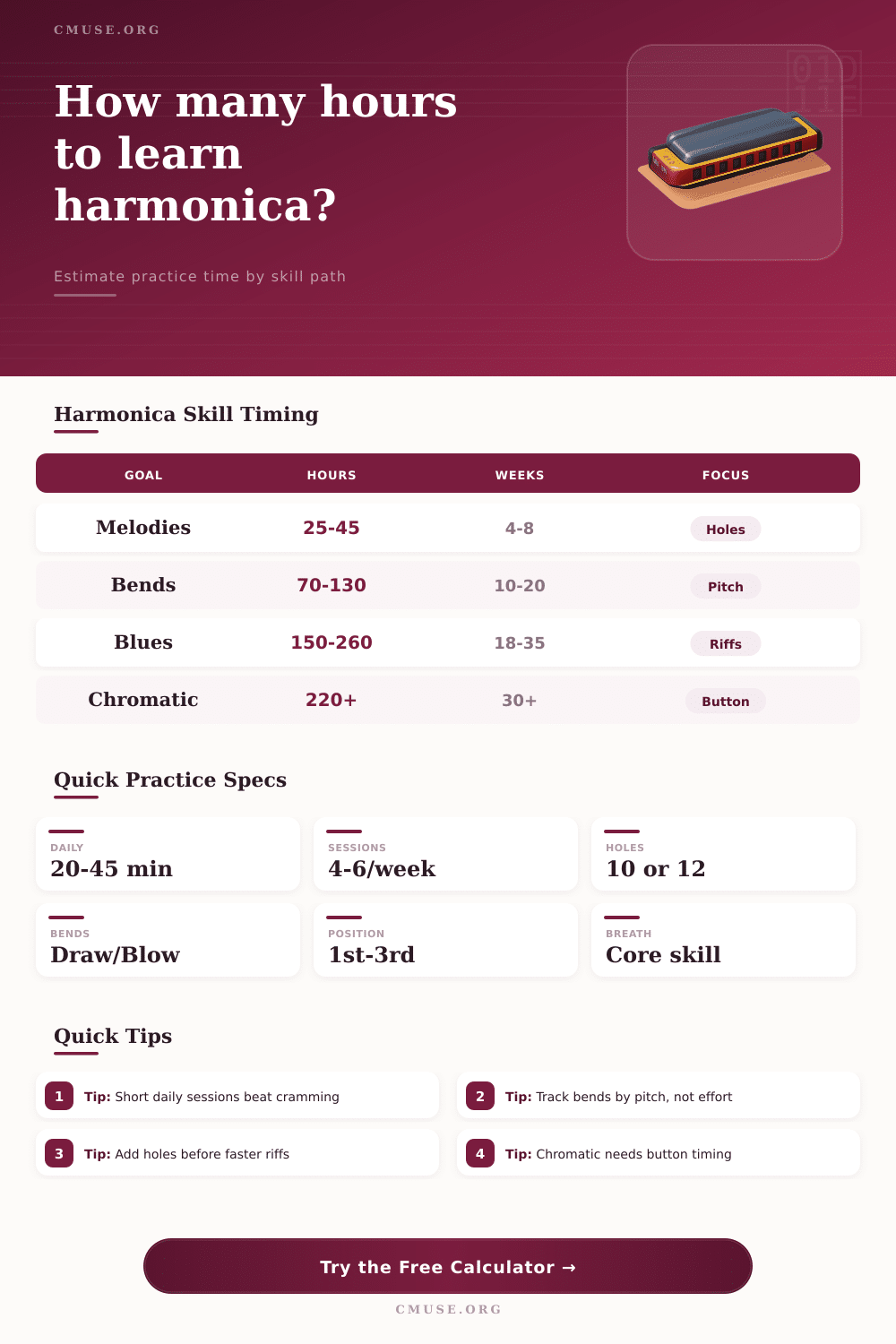
To put these into perspective, the reference tables provide a breakdown of typical hour ranges for certain skills. For example, they indicate that learning to play expressive blues solos can range from 150-300 hours whereas cleaning single notes may be as little as 12-35 hours. This isn’t intended as a hard and fast rule, but as an estimate based on how fast the average student progresses. It’s there to give you a realistic expectation, so you aren’t disappointed if your ability to control bends doesn’t come easy.
Intensity is fine, but consistency always wins out. Better to spend 20-minutes a day practicing than 2-hours one night a week. Why? It’s because muscle memory has to be built while you’re asleep. Also, the human ear benefits from hearing subtle variations of pitch over and over. The calculator takes your session length and practice days per week into account. If your schedule is balanced, it will facilitate gradual improvement (without burning yourself out).
Begin slowly. Concentrate on clear tones. Don’t try to run through every hole at once. Work on each bend individually. Record yourself and measure your progress. Don’t rely only on how it feels. You’ll notice the timeline reducing and the figures moving in the right direction. But remember, this isn’t about the clock; the pleasure is in the notes themselves. Practice until it sounds better.