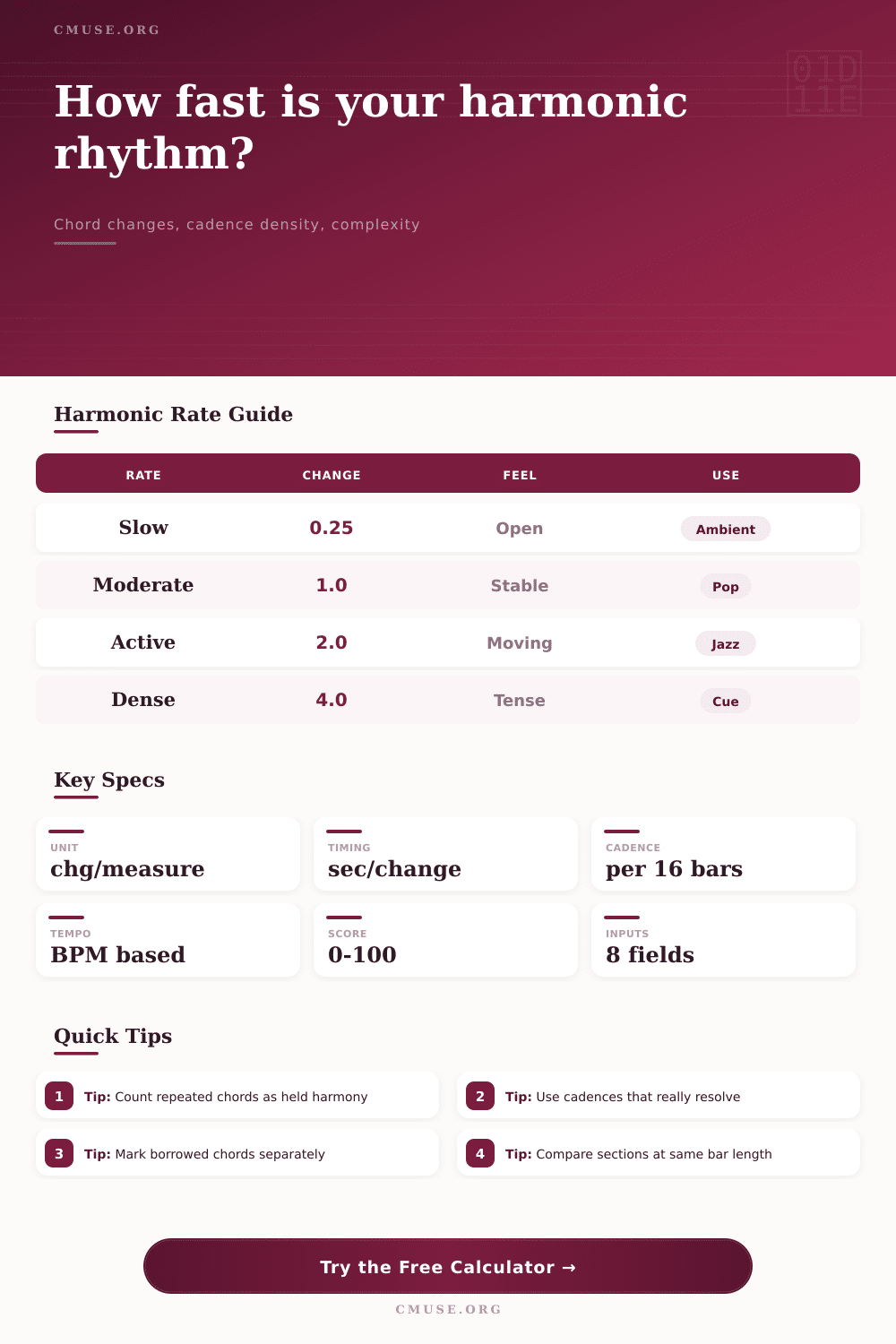
Harmonic Rhythm Rate Calculator
Measure chord-change speed across measures, beats, BPM, cadence placement, non-diatonic motion, and harmonic complexity.
The calculator treats harmonic rhythm as the rate of meaningful harmony events, not the number of chord symbols printed above every beat.
Harmonic rhythm results
| Band | Changes per measure | Typical feeling | Common setting |
|---|---|---|---|
| Pedal or static | 0.00–0.25 | Open, suspended, spacious | Drone, modal vamp, ambient cue |
| Slow | 0.25–0.75 | Stable with broad harmonic pillars | Ballad, anthem verse, underscore bed |
| Moderate | 0.75–1.25 | One main harmony per bar | Pop, folk, hymn, simple theme |
| Active | 1.25–2.25 | Frequent functional motion | Jazz standard, bossa nova, chorale phrase |
| Dense | 2.25–4.00 | Constant harmonic steering | Turnaround, reharmonization, film transition |
| Very dense | 4.00+ | Rapid color shifts or tension stack | Modern jazz tag, chase cue, chromatic sequence |
| Meter and BPM | One change per bar | Two changes per bar | Four changes per bar |
|---|---|---|---|
| 4/4 at 60 BPM | 4.00 sec/change | 2.00 sec/change | 1.00 sec/change |
| 4/4 at 120 BPM | 2.00 sec/change | 1.00 sec/change | 0.50 sec/change |
| 3/4 at 90 BPM | 2.00 sec/change | 1.00 sec/change | 0.50 sec/change |
| 6/8 at 72 dotted BPM | 5.00 sec/change | 2.50 sec/change | 1.25 sec/change |
| 7/8 at 140 BPM | 3.00 sec/change | 1.50 sec/change | 0.75 sec/change |
| Cadences per 16 bars | Phrase effect | Use with | Watch for |
|---|---|---|---|
| 0–1 | Continuous or suspended | Vamps, drones, cue beds | Weak arrival points |
| 2 | Long phrase arcs | Eight-bar phrases | Overlong loops |
| 4 | Balanced periodic closure | Four-bar phrases | Predictable cadences |
| 6–8 | Frequent resolution points | Chorales, cadential studies | Phrase fragmentation |
| 9+ | Highly punctuated motion | Comedy hits, tags, transitions | Loss of forward pull |
| Scenario | Measures | Chord changes | Likely reading |
|---|---|---|---|
| Pop verse with I–V–vi–IV | 8 | 8 | Moderate and memorable |
| 12-bar blues chorus | 12 | 9 | Slow-to-moderate with form landmarks |
| Jazz turnaround phrase | 4 | 10 | Dense functional direction |
| Chorale phrase | 8 | 18 | Active with cadential gravity |
| Film cue pedal swell | 16 | 4 | Static with coloristic motion |
| Metal riff cycle | 8 | 20 | Dense when chord roots shift often |
Next is concept of harmonic rhythm. Harmonic rhythm refer to the rate at which song’s underlying chord shifts. If you listen to a track whose pace remains constant but it seems as though nothing is happening, chances are the chord changes is occurring far too slow. On the other hand, if chords seem to change too quick, you’ll likely be subject to a jarring sense of tension.
More times than not, melodic and rhythmic issues aren’t the problem. It almost always has to do with the pace of harmony. When this aspect of a piece are in balance, what you hear is music that feels alive. When it isn’t, the music sound stuck.
What Is Harmonic Rhythm?
Tempo is an area most musicians will know about. Can they identify whether a song is fast or slow? Harmonic rhythm is less easy to comprehend as it is in vertical plane of music. What does this mean? The harmonic rhythm concerns how far apart chords is spaced.
At a moderately paced pop song tempo, one could place a chord change on each bar, resulting in a solid forward-moving feel. A chord change every two bars would create a more ambient, spacious feel. Moving the chord changes twice per bar put you right into jazz territory. This creates a constant sense of motion that holds the listener’s attention by being complex.
The above calculator does the maths for the rates and converts your chord numbers into something we can measure in seconds and beats. This way you can see exactly what’s going on. A common error by many writers are to take each symbol they write down as a change. So their data is over-inflated and does not match the actual experience in music. They may have a melody moving around while a C major chord is held for four bars. That’s still one harmonic event.
The question asked by tool requires you to identify separate harmony events. It compels you to think beyond notation towards function. You are gauging the weight of the pillars supporting your melody, not the bricks themselves. How much density without change has no forward pull. A dense texture of static harmony feel like a wall. A sparse texture with regular changes can feel like a journey.
Cadence placement also adds to this. If you have a fast harmonic rhythm with a relaxation about it then it likely has predictable cadential places at the end of phrases. Conversely if those quick shifts occurs without obvious points of rest then you will feel tense. This is the tension that film composers employ. In a chase sequence, for example, they pile in the chord changes until your heart rate rises as an audience member. Often they hold back solid cadences right until the final bars of the cue.
Pop music tends not to want that. We wish to be satisfied and that requires a sense of resolution. The table I’ve included on the page makes all of this quite clear. What is evident from the table is how slow rates work for ballads while more active rates propel jazz standards. This adds another layer of complexity. An extended seventh chord that changes on each beat sounds quite different than a simple triad that does the same thing. The heavier the harmony, the more space it require. Using tritone substitutions and chromatic mediants will allow fewer changes before they overpower the listener’s ear.
These choices of vocabulary are factored into the calculator which gives a weighted score. It allows you to hear if the progression might be attempting to do too much at any one time. Too often what fixes a muddy section isn’t adding more chords but removing some. Sometimes stopping completely is most powerful move. Let a single pedal tone breathe with melody to carry the energy.
As you’re building your new song, look at each part and figure out what it’s trying to feel like. Is the verse supposed to settle? If so, make space between your harmonies bigger. Let a single chord sustain across two bars or even four bars.
Is the chorus meant to lift? If so, tighten up the rhythm. Go straight to changes every bar or bring in some syncopated moves that land early on the weak beat. This will create dynamics that you simply cannot get through turning up volume. You can write a quiet section that sounds huge because the harmony is changing fast. Or you can write a loud section that sounds open because the chords are static.
So in summary, the rate at which you change harmony through a piece of music determine the pace of your journey for your listener. How often do they have to adjust their ears? If too frequently they will get lost, if not enough, they’ll drift off. What we’re trying to achieve is finding that sweet spot of when the change occurs just when the ear expects it. Or you throw the change just a tiny bit earlier to catch them out by surprise.
And whether you’re writing a metal riff, a worship song, or scoring a film cue, knowing this rate puts the power of controlling the emotional arc into your hands. It takes the abstract feeling of something rushing or dragging, and makes it a tangible musical decision. Count the number of changes you make, give the space between a place of honor, and allow harmony some air to breathe. That’s where the music truly springs to life.