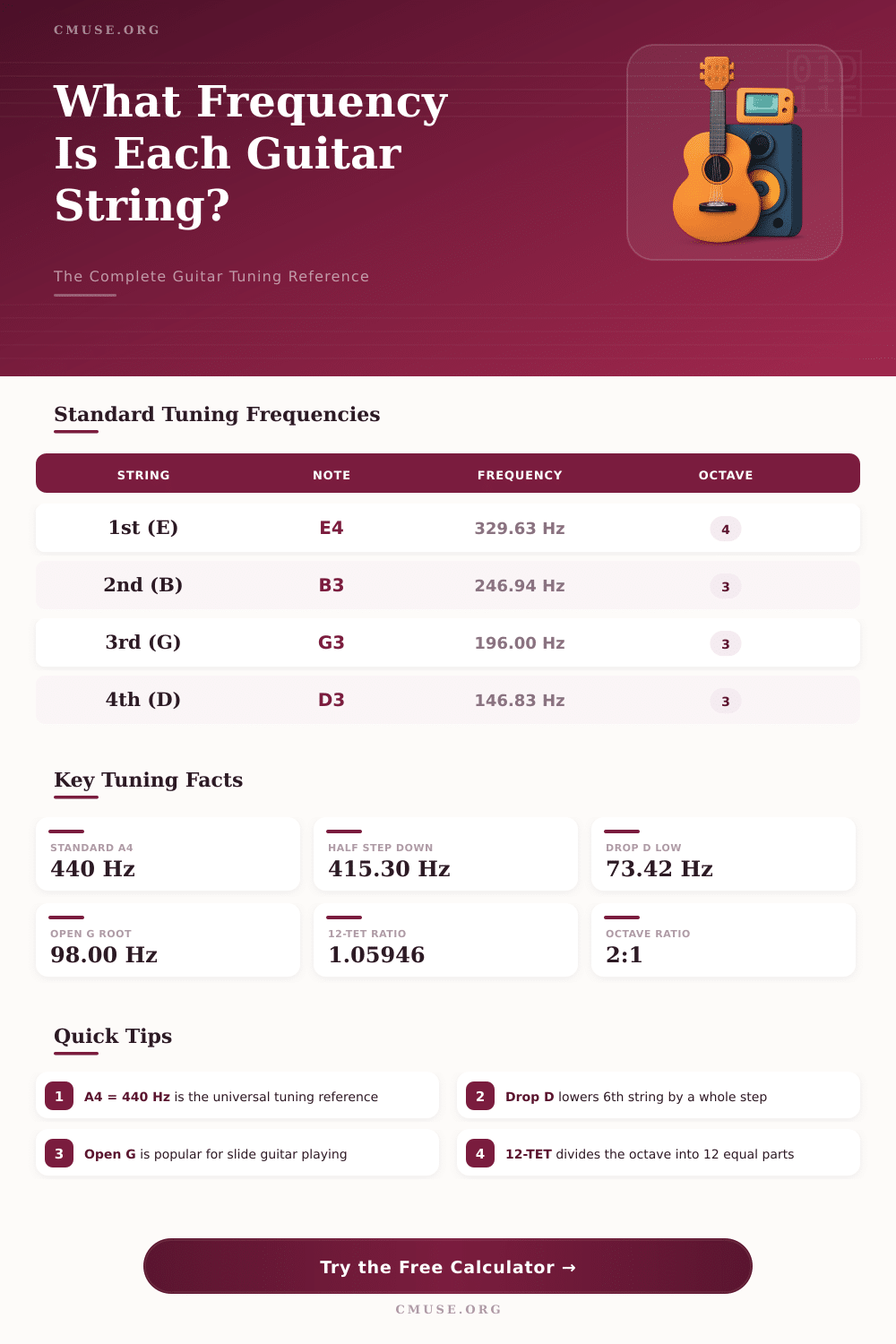
🎸 Guitar Tuning Calculator
Calculate exact string frequencies, alternate tunings & semitone intervals for any guitar
| Tuning Name | String Notes (1→6) | 6th String (Hz) | Genre / Use |
|---|---|---|---|
| Standard | E B G D A E | 82.41 | All genres |
| Drop D | E B G D A D | 73.42 | Rock, Metal |
| Eb (Half Step Down) | Eb Bb Gb Db Ab Eb | 77.78 | Rock, Blues |
| D Standard | D A F C G D | 73.42 | Metal, Grunge |
| Open G | D B G D G D | 73.42 | Slide, Blues |
| Open D | D A F# D A D | 73.42 | Folk, Slide |
| Open E | E B G# E B E | 82.41 | Blues, Folk |
| DADGAD | D A G D A D | 73.42 | Celtic, Folk |
| Fret | Note | Frequency (440 Hz ref) | Semitones from Open |
|---|---|---|---|
| Open | E2 | 82.41 Hz | 0 |
| 1 | F2 | 87.31 Hz | +1 |
| 2 | F#2 / Gb2 | 92.50 Hz | +2 |
| 3 | G2 | 98.00 Hz | +3 |
| 4 | G#2 / Ab2 | 103.83 Hz | +4 |
| 5 | A2 | 110.00 Hz | +5 |
| 7 | B2 | 123.47 Hz | +7 |
| 12 | E3 | 164.81 Hz | +12 |
| Note | Octave 2 (Hz) | Octave 3 (Hz) | Octave 4 (Hz) |
|---|---|---|---|
| C | 65.41 | 130.81 | 261.63 |
| C# / Db | 69.30 | 138.59 | 277.18 |
| D | 73.42 | 146.83 | 293.66 |
| D# / Eb | 77.78 | 155.56 | 311.13 |
| E | 82.41 | 164.81 | 329.63 |
| F | 87.31 | 174.61 | 349.23 |
| F# / Gb | 92.50 | 185.00 | 369.99 |
| G | 98.00 | 196.00 | 392.00 |
| G# / Ab | 103.83 | 207.65 | 415.30 |
| A | 110.00 | 220.00 | 440.00 |
| A# / Bb | 116.54 | 233.08 | 466.16 |
| B | 123.47 | 246.94 | 493.88 |
Guitar Tuning is the process for setting the tones of the open strings on guitar. That counts for classical, acoustic and electric guitars. One describes the tuning by means of separate notes from western music.
It is good to get right tuning tools, because without them the strings lack harmony and make nasty sounds that come out, like singing that goes off the tone.
How to Tune a Guitar
Standard tuning is the most common tuning. In it the guitar has its strings set from the lowest to the highest: E, A, D, G, B, E. When one starts the most many beginners learn first the chords and scales in standard tuning. Usually one lists Guitar Tuning from the low to the high.
There are many online tuners for guitar, that allow players to set acoustic, electric or bass guitars. They offer standard tuning, more than twelve other tunings or even custom choices. Many of them work by means of a built-in microphone in the device, without need of outside tools.
The quality of tuning depends much on the frequency response of the microhpone and on outside noise. In cases when the microphone fails, some tuning websites include sounds of the strings, so that the players can set by means of hearing alone.
Guitars require regular tuning. The strings and parts of the guitar easily stretch and shrink, so it matters to set before every playing session. Strong bend of strings can require new tuning in five to ten minutes.
Light play on acoustic guitar, on the other hand, can keep the tuning for a weak, if one keeps it in the same room. At classical guitars the strings are especially unstable at first.
Besides the standard tuning there are many other modes. In open tunings the open strings sound as separate chords. Loose tunings keep the same gaps between strings, but lower everything by some number of half steps, usually between one and five.
In drop tunings one keeps the standard gaps for all strings except the sixth, that drops to form a perfect fifth with the fifth string. Drop D and Drop C rank among popular. Every tuning has its pros and cons (any tuning eases some plays), but blocks others.
For recording or precise shows, it is good to set to a fixed tone standard like A 440 Hz. Also checking the pitch across the fretboard before recording helps. The method of the fifth fret is one common way to set by means of hearing, although there are many other ways.
Guitar Tuning by means of hearing using harmonics can make a string a bit too low. If the harmonic of the seventh fret of the A-string matches the harmonic of the fifth fret of the low E-string, the A-string ends at 109.88 Hz instead of the right 110.0 Hz.
Strobe tuners are the standard among pros. Behind the scene at big concerts, the specialists commonly use a strobe tuner. Peterson strobe tuners and the Sonic Research Turbo Tuner are well known for their accuracy andfast response.
Chromatic tuner is the most common and simplest choice for beginners.