🎸 Guitar Transpose Calculator
Instantly find transposed chords & capo positions across all 12 keys
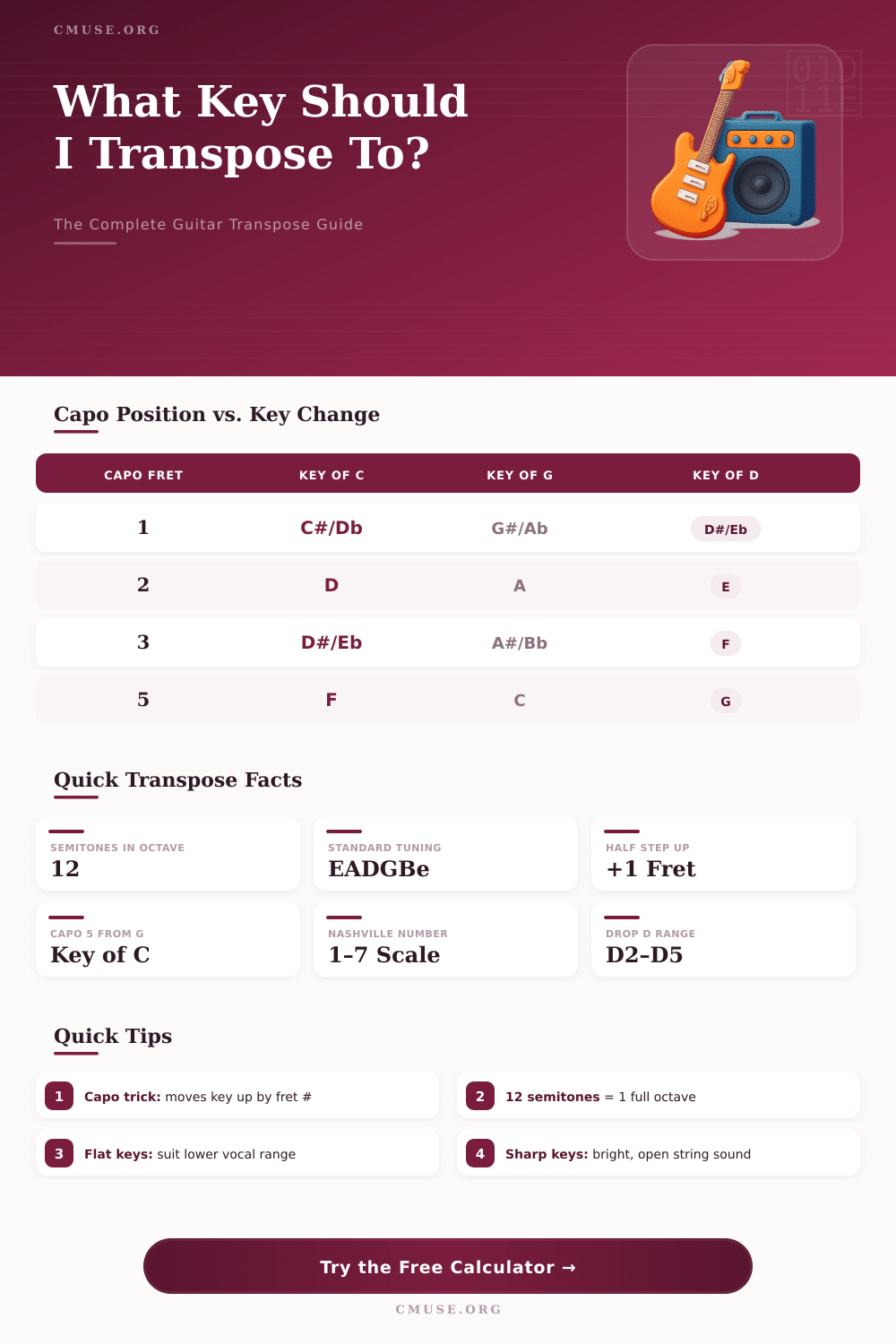
| Capo Fret | Playing C → Sounds | Playing G → Sounds | Playing D → Sounds | Playing A → Sounds | Playing E → Sounds |
|---|---|---|---|---|---|
| 1 | C# / Db | G# / Ab | D# / Eb | A# / Bb | F |
| 2 | D | A | E | B | F# / Gb |
| 3 | D# / Eb | A# / Bb | F | C | G |
| 4 | E | B | F# / Gb | C# / Db | G# / Ab |
| 5 | F | C | G | D | A |
| 6 | F# / Gb | C# / Db | G# / Ab | D# / Eb | A# / Bb |
| 7 | G | D | A | E | B |
| Original Key | Semitones Up 1 | Semitones Up 2 | Semitones Up 3 | Semitones Up 5 | Semitones Up 7 |
|---|---|---|---|---|---|
| C | C# / Db | D | Eb | F | G |
| D | Eb | E | F | G | A |
| E | F | F# | G | A | B |
| F | F# | G | Ab | Bb | C |
| G | Ab | A | Bb | C | D |
| A | Bb | B | C | D | E |
| B | C | C# | D | E | F# |
| Tuning Name | String 6–1 | Semitone Shift | Common Style |
|---|---|---|---|
| Standard | E A D G B e | 0 | All genres |
| Drop D | D A D G B e | -2 (string 6) | Rock, Metal |
| Half Step Down | Eb Ab Db Gb Bb eb | -1 all strings | Rock, Blues |
| Full Step Down | D G C F A d | -2 all strings | Metal, Grunge |
| Open G | D G D G B d | Open chord G | Blues, Slide |
| Open D | D A D F# A d | Open chord D | Folk, Slide |
| DADGAD | D A D G A d | Dsus4 open | Celtic, Fingerstyle |
Guitar Transpose on guitar are made up of to change the key of a song so that it suits the player or singer. The idea itself is very basic. In the new key the strings must keep the same relation between themselves, similar to that in the original key.
Like this the song sounds correct, although the height of the sound is adjusted.
How to Change the Key on a Guitar
Using a capo, one can easily Guitar Transpose on guitar. Guitarists usually play the same forms of strings, when they lay a capo. So only the capo changes the key.
For example to raise a song in seven half steps, the player lays a capo on the seventh fret and uses the usual chord forms. Laying a capo on the third fret allows to play in the comfortable key of G, while the sound is heard in Bb, which is not natural for guitar. For a song in Eb, one lays a capo on the first fret and plays D-forms of strings, which makes the music truly sound in Eb.
It is much more simple than struggling wiht difficult Eb-strings.
One half step matches to one fret on the guitar. So to Guitar Transpose a set amount of half steps, one moves the strings up or down by the right number of frets. For instance, if a song is in G-major with strings C, D, Em and G, then moving up a hole tone to A-major requires playing D, E, F#m and A. The melody follows the same principle, where every note moves up by two frets.
One can also tune the guitar differently. Tuning down a whole tone changes E A D G B e to D G C F A D. Then the known strings give different sounds. Even so tuning up by more than one tone can break strings or put too much strain on the neck.
The number system of Nashville helps to quickly Guitar Transpose. In it, one does not think about particular names of strings, but gives every string a number based on its place in the scale. A pattern like 1, 4, 1, 5 stays the same, no matter what key the song is in.
The numbers do not change during Guitar Transpose, which is useful forfast changes of key in studios.
The guitar technically is an instrument that needs transposing. The actual sound is an octave lower than what is written. The notes are written an octave higher, to avoid using two clefs.
Guitarists that read guitar parts even so do not need to transpose, because a written C sounds as C, only an octave below. Guitar is a C-instrument, so the player reads C, plays C and all hear C.
There are also apps and online tools that quickly switch strings. Some allow you to enter strings and lyrics, change the key and save the result for use offline. Guitar Transpose is key knowledge for every musician, and the fretboard of the guitar works well for that.