🎸 Guitar Tone Stack Calculator
Calculate resistor & capacitor values for Fender, Marshall, Vox & James passive tone stacks
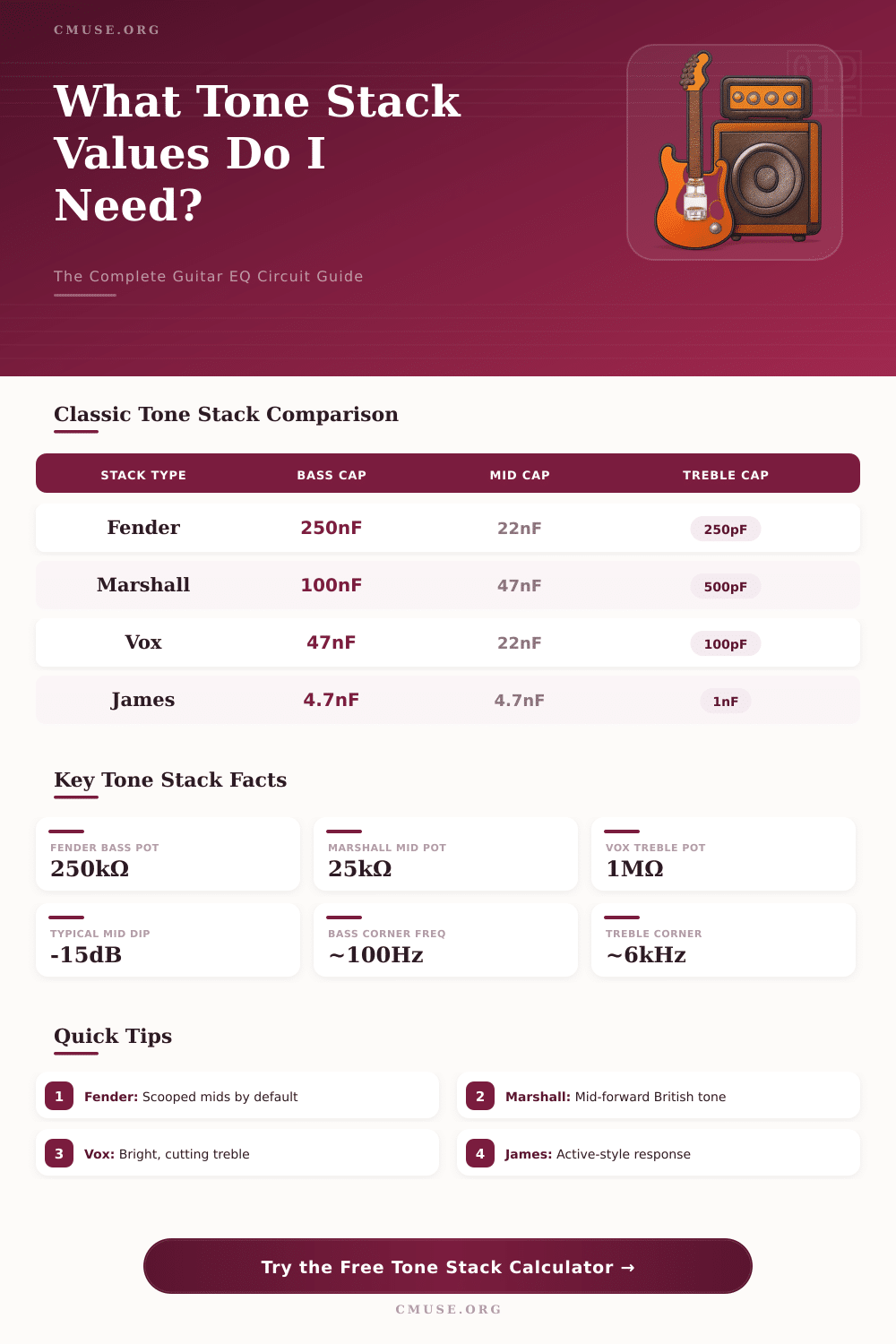
| Stack Type | Bass Corner | Mid Notch | Treble Corner | Typical Mid Dip |
|---|---|---|---|---|
| Fender Tweed | ~80 Hz | ~650 Hz | ~5.5 kHz | -10 to -14 dB |
| Fender Blackface | ~100 Hz | ~700 Hz | ~6 kHz | -12 to -16 dB |
| Marshall Plexi | ~120 Hz | ~400 Hz | ~5 kHz | -8 to -12 dB |
| Marshall JCM800 | ~150 Hz | ~500 Hz | ~5.5 kHz | -10 to -15 dB |
| Vox AC30 | N/A | N/A | ~3.5 kHz | Treble-cut only |
| James | ~100 Hz | ~1 kHz | ~5 kHz | -6 to -10 dB |
| Cap Value | With 250kΩ | With 100kΩ | With 25kΩ | Common Use |
|---|---|---|---|---|
| 100 pF | 6.4 kHz | 15.9 kHz | 63.7 kHz | Treble bypass |
| 250 pF | 2.5 kHz | 6.4 kHz | 25.5 kHz | Fender treble |
| 500 pF | 1.3 kHz | 3.2 kHz | 12.7 kHz | Marshall treble |
| 4.7 nF | 135 Hz | 339 Hz | 1.35 kHz | James mid |
| 22 nF | 28.9 Hz | 72.3 Hz | 289 Hz | Mid coupling |
| 47 nF | 13.5 Hz | 33.9 Hz | 135 Hz | Bass cap |
| 100 nF | 6.4 Hz | 15.9 Hz | 63.7 Hz | Bass/coupling |
| 250 nF | 2.5 Hz | 6.4 Hz | 25.5 Hz | Fender bass |
| Amp Model | Bass Pot | Mid Pot | Treble Pot | Taper |
|---|---|---|---|---|
| Fender 5E3 Tweed | 250kΩ | 250kΩ | 250kΩ | Audio |
| Fender Blackface | 250kΩ | 250kΩ | 250kΩ | Audio |
| Fender Bassman | 250kΩ | 250kΩ | 250kΩ | Audio |
| Marshall Plexi 1959 | 250kΩ | 25kΩ | 250kΩ | Audio |
| Marshall JCM800 | 250kΩ | 25kΩ | 250kΩ | Audio |
| Vox AC30 | N/A | N/A | 1MΩ | Linear |
| Soldano SLO-100 | 250kΩ | 25kΩ | 250kΩ | Audio |
| Mesa Boogie Mk II | 250kΩ | 25kΩ | 250kΩ | Audio |
The guitar tone stack is just a nice name for the equalizer on a guitar amplifier. It forms a special audio filter, that is built into the circuit of the amplifier to change the frequency of the sound. The sounds from guitars go from 80 Hz to 10 kHz and those guitar tone stack circuits help to shape that range to reach various sounds.
The most used guitar tone stack is that of Fender, Marshall and Vox. It is also called the TMB guitar tone stack, which means Treble, Mid and Bass. Fender launched this circuit in 1957 with the 5F6 Bassman amplifier.
What is the guitar tone stack?
When Marshall almost copied the Fender Bassman to create the JTM45, the guitar tone stack followed with it. After that, Vox and many other makers of guitar amplifiers used the same base.
The name “stack” comes from the shape of teh circuit on the schematic. The mid sits below, the bass is over it, and the treble ends up top. It is a simple passive RC network, that exists for a long time.
The interesting thing about the Fender guitar tone stack is, that it is not parametric. The three controls depend one on the other. If you turn one knob, it changes the frequency range of the others.
The flattest response through frequencies happens usually, when bass and treble are fully down, while mid is fully up. The guitar tone stack does not really give full flat sound. It only works to remove frequency, not boost them.
The bass and treble controls almost work as boost-only knobs, because of the way they act on the mid. The mid knob acts a bit as a volume control four the whole equalizer part.
There is a program called Duncan Tone Stack Calculator, that allows folks to research the designs and response curves of various guitar tone stack circuits in famous guitar amplifiers. There also exists a version for the web, with even more options to play with guitar tone stack circuits. It is meant for amp technicians, hobbyists and students.
The guitar tone stack was originally created, because the pickups of guitars were so mid-focused, that they lacked bass and treble. The Bassman-typical guitar tone stack does two tasks. It makes up for the loss of treble and bass, that happens in every stage of the amplification.
It also allows the musician to change the frequency response with the controls of bass, middle and treble. Passive guitar tone stack circuits usually sit between the gainstages of the circuit, not directly with the pickups. The place of the guitar tone stack in the signal chain commonly decides the difference between various tone amplifiers.