🔊 Guitar Speaker Wattage Calculator
Match your amp output to the right speaker power handling — avoid damage and get the best tone
| Amp Watts (RMS) | Min Speaker RMS (No Buffer) | Recommended RMS (25%) | Safe RMS (50%) | Ideal Use Case |
|---|---|---|---|---|
| 5W | 5W | 6.25W | 7.5W | Bedroom / home recording |
| 15W | 15W | 18.75W | 22.5W | Small venues / club gigs |
| 30W | 30W | 37.5W | 45W | Rehearsal rooms |
| 50W | 50W | 62.5W | 75W | Mid-size stage use |
| 100W | 100W | 125W | 150W | Full stage / large venues |
| 200W | 200W | 250W | 300W | Arena / touring rig |
| Configuration | Speakers | Each Speaker Ohms | Total Impedance | Notes |
|---|---|---|---|---|
| Series | 2 | 8Ω | 16Ω | Higher impedance, less power draw |
| Parallel | 2 | 8Ω | 4Ω | Lower impedance, more power draw |
| Series/Parallel | 4 | 8Ω | 8Ω | Standard 4x12 wiring |
| Series/Parallel | 4 | 16Ω | 16Ω | High-Z 4x12 variant |
| Parallel | 4 | 8Ω | 2Ω | Very low Z — check amp rating! |
| Series | 4 | 8Ω | 32Ω | Very high Z — rare in practice |
| Parallel | 1 | 8Ω | 8Ω | Single speaker combo |
| Parallel | 2 | 16Ω | 8Ω | Common 2x12 variation |
| Sensitivity (dB/W/m) | Volume at 1W | Volume at 10W | Volume at 100W | Speaker Type |
|---|---|---|---|---|
| 92 dB | 92 dB | 102 dB | 112 dB | Budget combo speaker |
| 96 dB | 96 dB | 106 dB | 116 dB | Mid-range guitar speaker |
| 98 dB | 98 dB | 108 dB | 118 dB | Most guitar speakers (avg) |
| 100 dB | 100 dB | 110 dB | 120 dB | High-efficiency guitar cab |
| 102 dB | 102 dB | 112 dB | 122 dB | Pro stage / PA speaker |
| 104 dB | 104 dB | 114 dB | 124 dB | High-output neo driver |
The power of a speaker in watts shows how much electrical energy it can process and convert into sound. Watt is key for measuring power, and for speakers, it shows how much energy an amplifier can deliver and how a speaker can receive before starting to twist or receive damage. Although one commonly links it with loudness, it affects also the impact, the reliability, the cleaning of sound and the lasting of reliability.
An important thing to recall is this The ratings about power for speakers and amplifiers point to different parts. The rating of an amplifier deals with its output energy, while for a speaker it relates to the input. A speaker is planned to operate in a certain range, for instance from 10 to 100 watts.
What Guitar Speaker Wattage Means
Really, the Guitar Speaker Wattage concerns whether a speaker can take energy from an amplifier without twisting the sound or destroying itself because of too much heat or movement above its natural limits.
Speakers with bigger wattage sound more strongly. They create more intense waves of sound, so standing too near to such high speakers is not wise. Around 60 watts is enough for a party.
For typical musical events and average speakers, 50 to 150 real watts work well. Home sound systems maybe reqiure bigger power.
Only the Guitar Speaker Wattage does not describe everything. It does not have direct link with the sound quality. It simply shows how much energy one can send to speakers at a certain sensitivity.
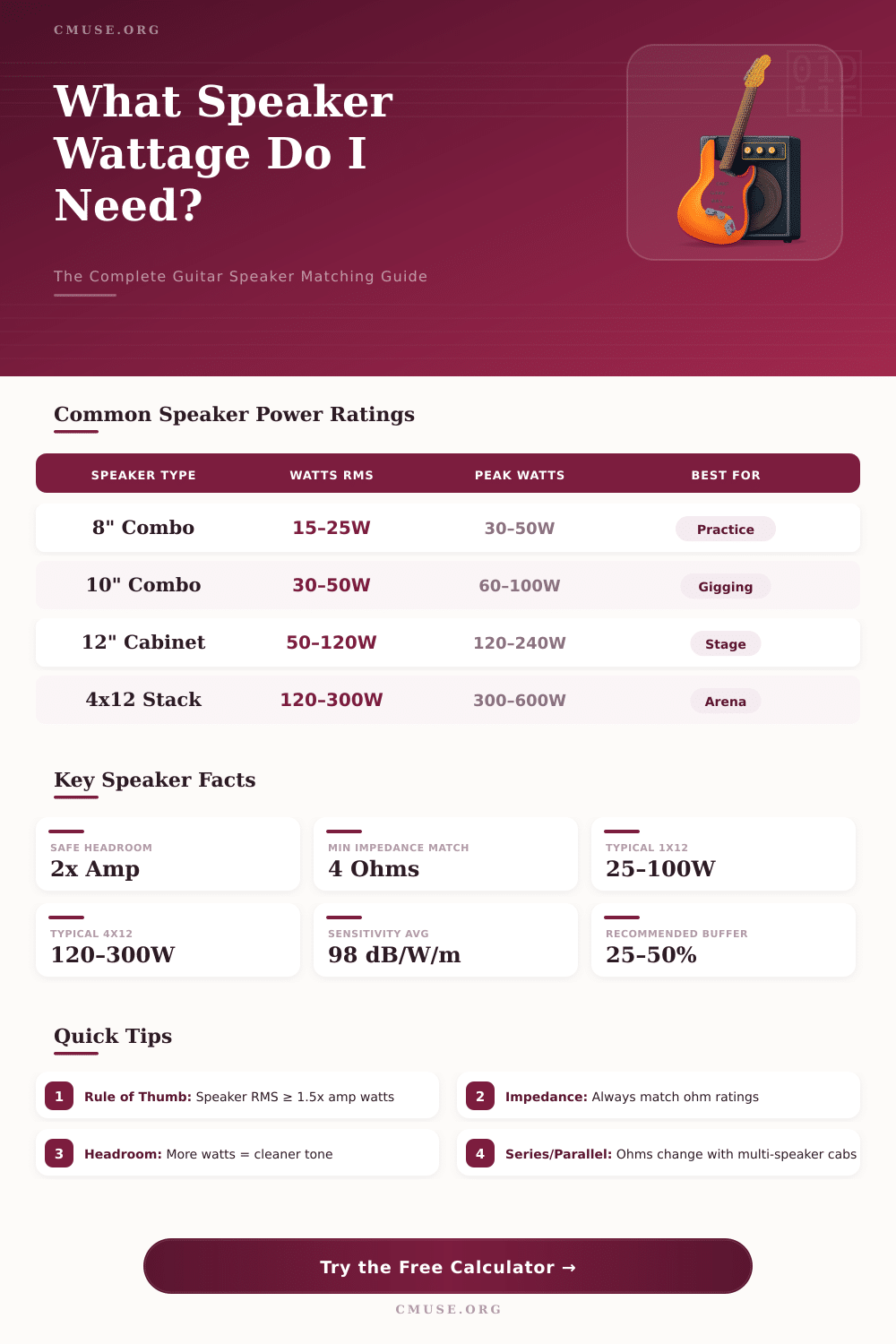
The sensitivity measures how loud a speaker becomes from one watt at one metre of distance. Bigger sensitivity requires less energy. A speaker with 98 dB sensitivity will sound more strongly then another with 94 dB, if both receive equal power.
A well planned 25 watt amplifier can beat a bad done 50 watt one in sound cleaning and control. So one should not consider only the Guitar Speaker Wattage, but also the build quality and also how the amplifier works with speakers. In home use, the quality of speaker and amplifier matters more than the power rating.
About speakers one looks at resistance and sensitivity, not only the power.
There are no real standard ways for measuring the Guitar Speaker Wattage of a speaker. Speakers have different ratings, like RMS, program and peak, and those different terms confuse. If a speaker is rated for 300 watts steady and one pushes into it around 350 watts during some minutes, probably the voice coil will burn and the cone will fail.
Speakers with high wattage do not work as well as low, because their cone, voice coil and magnet are heavy and stiff. A small amplifier will work with a high wattage speaker, but a bit of good energy is lost because of the low efficiency. Having extra Guitar Speaker Wattage inreserve is useful, because it gives more space and less distortion at low levels.