Guitar Solo Length Calculator
Plan a guitar solo by bars, BPM, time signature, song share, phrase pacing, sustain, and available arrangement space before committing to a take or edit.
Full Solo Planning Breakdown
8 bars
Chord Cycle Anchor
8-14%
Typical Song Share
2 bars
Target Phrase Size
2-4 sec
Common Tail Space
| Solo Role | Common Length | Song Share | Best Use |
|---|---|---|---|
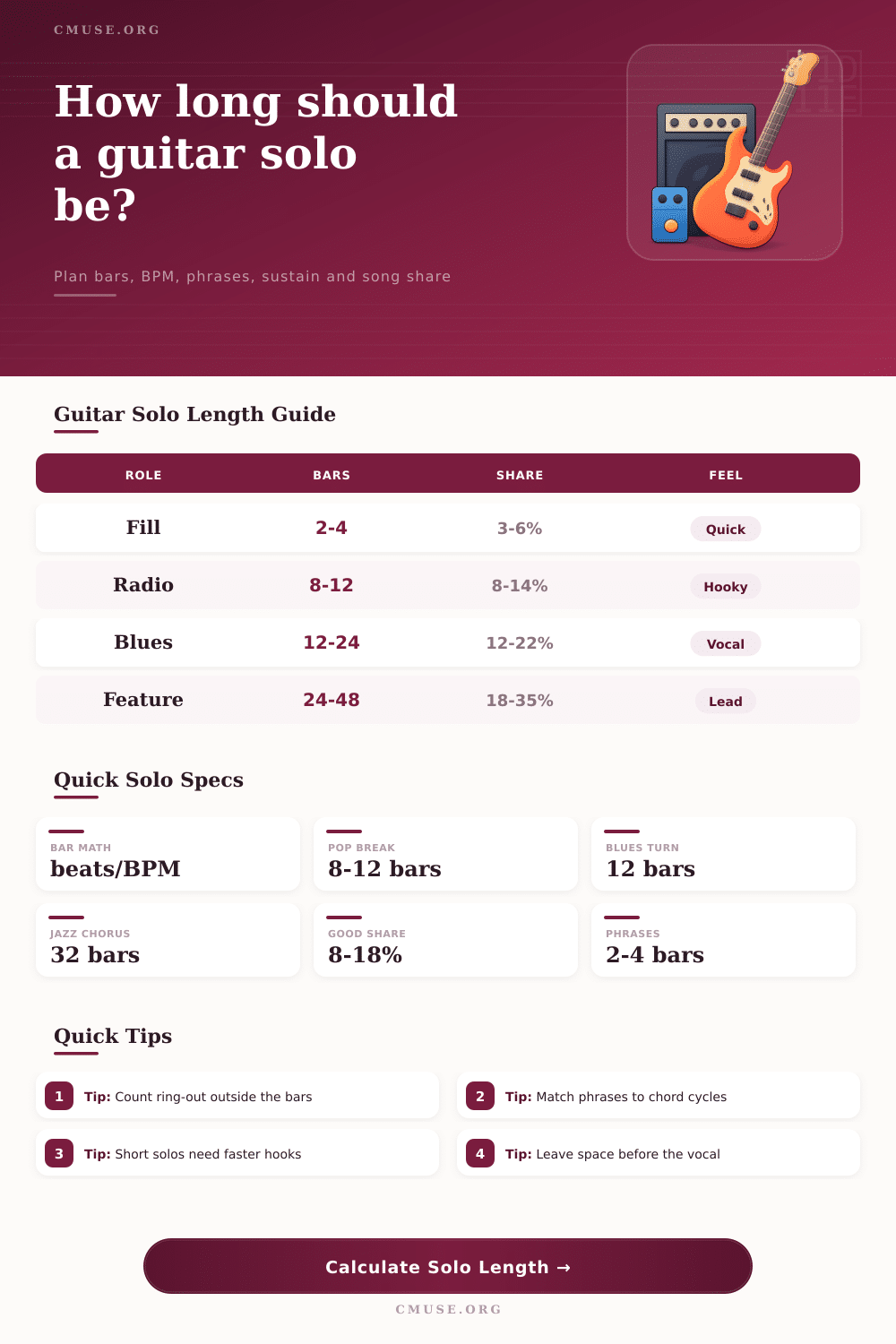
| Fill Micro solo | 2-4 bars, often 3-8 seconds | 3-6% | Verse answer, transition, or hook repeat without stopping the vocal flow. |
| Standard Radio lead | 8-12 bars, usually 12-28 seconds | 8-14% | Rock, pop, country, and indie arrangements needing one clear lead moment. |
| Chorus Cycle solo | 12-32 bars, often one blues or jazz form | 12-24% | Improvised sections where the chord form defines the solo boundary. |
| Feature Extended lead | 24-64 bars, with development or key change | 20-40% | Instrumental bridge, live feature, prog section, or outro build. |
| Style | Cycle | Phrase Shape | Planning Note |
|---|---|---|---|
| Radio rock lead break | 8-bar or 16-bar sections | 2-bar motifs with a final bend | Keep the hook obvious; the solo often replaces one vocal phrase. |
| Blues chorus solo | 12-bar form | Call, response, turnaround | Two choruses usually feel complete without becoming a jam. |
| Country pickin break | 4-bar or 8-bar break | Fast answer licks | Shorter slots work when the attack is clear and rhythm stays tight. |
| Jazz chorus improvisation | 16-bar or 32-bar form | Longer lines across changes | One chorus is the cleanest unit; add choruses only when the arrangement supports it. |
| Ambient texture solo | Open 8-bar swells | Held notes and delayed repeats | Sustain counts heavily, so leave room after the measured bars. |
| Metal shred feature | 8-bar ramps and 16-bar peaks | Sequences, runs, held apex | Dense phrases need fewer bars before listener fatigue appears. |
| BPM | 8 Bars | 12 Bars | 16 Bars |
|---|---|---|---|
| 80 BPM | 24.0 sec | 36.0 sec | 48.0 sec |
| 100 BPM | 19.2 sec | 28.8 sec | 38.4 sec |
| 120 BPM | 16.0 sec | 24.0 sec | 32.0 sec |
| 140 BPM | 13.7 sec | 20.6 sec | 27.4 sec |
| 180 BPM | 10.7 sec | 16.0 sec | 21.3 sec |
| Project | Typical Inputs | Primary Result | Secondary Check |
|---|---|---|---|
| Single edit | 8 bars at 120 BPM, 4/4 | About 16 seconds plus tail | Usually under 10% of a 3:30 song. |
| Blues club take | 24 bars at 96 BPM, 4/4 | About 60 seconds | Works when the band leaves a full two-chorus space. |
| Metal bridge | 16 bars at 170 BPM, 4/4 | About 23 seconds | Phrase density matters more than raw bar count. |
| Jazz chorus | 32 bars at 140 BPM, 4/4 | About 55 seconds | Fits one full standard-form chorus. |
| Ambient outro | 16 bars at 72 BPM, 4/4 | About 53 seconds plus decay | Ring-out may add another phrase worth of time. |
It’s not just about finger speed; it’s about where you choose to end the solo. Too often, length is an after-thoght for most players who continue until someone (usually the drummer) signals discomfort or the singer coughs into the microphone. That typically produce a bloated solo that seem disconnected from how music feels.
Use the guitar solo length calculator to plan where the solo goes in a song. You can plan for bars, BPM, phrase pacing, sustain, and how it fits the arrangement. This ensures a lead break drop in at a musical spot before you hit record. It makes you think more like an arranger instead of simple performing.
How to Plan Your Guitar Solo Length
On the surface, it’s just some straightforward math masquerading as musical intuition: Put in your tempo, how many beats per measure, and the specific bar count you’ve assigned to the solo; bam! But then it gets interesting in the margins. How long does the tail of sustain from the last note ring out? How many notes do you pick up to get into the phrase? These seconds aren’t visible on a typical chart, but they can be critical when mixed in.
Plan for a solo at 120BPM over eight bars without a couple second added for a ring-out and chances are your solo is going to bump up against whatever comes next. The calculator figures out the total length of time (including pickups and tails) and checks it against any space left open in your mix. You instanty know if there’s enough air between lick or if something needs to get trimmed back.
It’s not just about how many notes are played. Consider the context. You may have a hook-replacing radio-rock break which has to grab attention quickly and hold it briefly. In a blues feature, you could span two sets of twelve-bar choruses simply because that’s where form stops.
The tool contains tables that clarifies these variations. It illustrates how a full lead section can use up to thirty-five percent of the overall track length, while a fill fills only three-to-six percent. This is key, as listeners don’t perceive absolute time in the same way they perceive proportion. Ten seconds on a brief verse sound enormous. Yet in a seven-minute progressive epic, it passes unnoticed.
Most amateur solos break down during phrase planning. Phrase density refers to the number of different musical ideas you can fit into an eight bar passage. If you stretch them out too thin, it feels like you are filling space with noise. Too many and you become a run without direction. You want to try and keep phrases aligned to the change of chords in your cycle. Even if listeners can’t consciously follow the harmony, it creates a subconscious feeling of resolution. It is a conversation rather then a series of notes.
Feedback and sustain tails don’t always get attention until post-production, either when they mask following vocals or clip into other material. If you enter an approximate amount of ring out, you’ll see how much of your remaining space will be taken up by silence instead of note duration. For instance, if you’ve got a high-gain texture or something similar with a long decay, it can eat into your available space enormously. What you thought was a tight four bar idea become much more spread out after you factor in those three seconds of reverb tail.
Finally, this all comes down to respecting the structure of the song. The solo should complement the song, not steal it away. Knowing how many bars you’re going to play beforehand would of helped keep you back on time whether you’re jamming out live or recording in the studio. Once you input your variables into the calculator (above), it do the math for you.
This means you don’t have to worry about guessing, so you can concentrate on feel and tone rather than keeping an eye on the clock. When you know exactly where the road ends, you’ll be able to play with confidence. Knowing the difference between a defining moment and a filler part provide clarity.