🎸 Guitar Pickup Calculator
Estimate coil turns, DC resistance, inductance & output level for any pickup type
🎸 Pickup Calculation Results
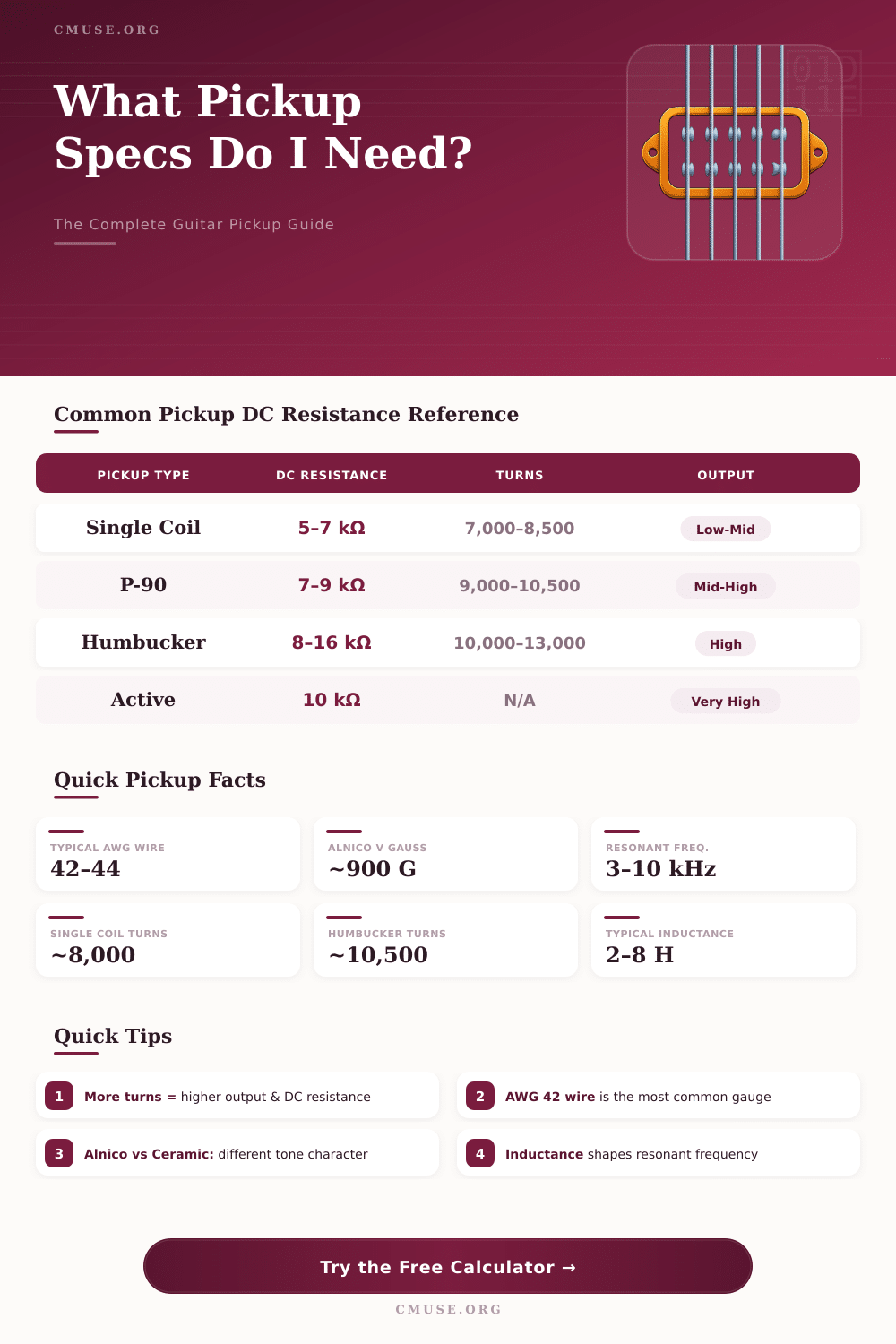
| AWG | Diameter (mm) | Resistance / 1000ft (Ω) | Turns / Layer (typical) | Common Use |
|---|---|---|---|---|
| 40 | 0.0799 | 1049 | ~250 | Bass, thick coils |
| 41 | 0.0711 | 1323 | ~280 | Low-output single coils |
| 42 | 0.0635 | 1659 | ~310 | Standard singles & humbuckers |
| 43 | 0.0566 | 2143 | ~350 | Hot pickups, overwound |
| 44 | 0.0508 | 2593 | ~390 | Active, mini humbuckers |
| Magnet | Approx. Gauss | Tone Character | Typical Use | Output Level |
|---|---|---|---|---|
| Alnico II | ~700 | Warm, soft highs | Neck humbuckers | Low–Medium |
| Alnico III | ~600 | Glassy, balanced | Vintage Strats | Low |
| Alnico IV | ~800 | Balanced, articulate | PAF-style | Medium |
| Alnico V | ~900 | Bright, clear | Most pickups | Medium–High |
| Alnico VIII | ~1050 | Tight, punchy | High-output | High |
| Ceramic | ~1200 | Aggressive, cutting | Metal, active | Very High |
| Neodymium | ~1400 | Ultra-clear, tight | Active designs | Very High |
| Turns (AWG 42) | Est. DC Resistance (Ω) | Est. Inductance (H) | Output Level | Resonant Freq. (kHz) |
|---|---|---|---|---|
| 6,000 | ~4,500 | ~1.5 | Vintage Low | 9–10 |
| 7,500 | ~5,500 | ~2.5 | Low–Medium | 7–9 |
| 8,500 | ~6,500 | ~3.5 | Medium | 6–8 |
| 10,000 | ~8,000 | ~4.5 | Medium–High | 5–7 |
| 12,000 | ~10,000 | ~6.5 | High | 4–6 |
| 14,000 | ~12,000 | ~8.5 | Very High | 3–5 |
| Pickup Type | Width (in) | Length (in) | Wind Height (in) | Pole Spacing (in) |
|---|---|---|---|---|
| Strat Single Coil | 2.68 | 0.65 | 0.60 | 2.00 |
| Tele Bridge | 2.68 | 0.70 | 0.60 | 2.06 |
| P-90 Soapbar | 3.60 | 1.19 | 0.67 | 1.94 |
| Humbucker | 2.75 | 1.50 | 0.50 | 1.90 |
| Mini Humbucker | 2.26 | 0.87 | 0.46 | 1.73 |
| P-Bass Split Coil | 2.92 | 0.94 | 0.72 | 2.18 |
A Guitar Pickup is made up of electronic parts that turn the mechanical vibrations of the strings into electrical signal. Later that signal passes through amplifier or whole sound system to strengthen it. Without a Guitar Pickup one can not electronically expand the guitar.
Even so if the musician never intends to connect to amplifier or PA system, then a Guitar Pickup is not necessarily required on every guitar.
What Guitar Pickups Are and How They Work
At its core Guitar Pickups are magnets with wires wrapped around them. When the guitar string moves, it changes the magnetic fields of those magnets, and that change creates the electrical flow. Those magnets attract the metal strings, and the plucking makes them vibrate to create the sound.
One finds three main kinds of Guitar Pickups. Those with one single coil around magnets tend to give clear and bright tone. Double coil ones, commonly called humbuckers, deliver thick, strong sound in the middle range with stronger deep impact.
There also exist piezoelectric Guitar Pickups that most commonly help amplify the natural sound of acoustic guitar and remove unwanted noise.
Guitar Pickups play a big role in shaping the guitar sound. Also the mix of Guitar Pickups on the instrument matters a lot. For instance, a guitar with three single coil Guitar Pickups sounds different than one with a humbucker and two single coils.
Also one model of single coil Guitar Pickup of one brand will sound differently than another model of another brand.
The position of a Guitar Pickup on the guitar affects the tone. Usually the bridge Guitar Pickup gives brighter sound with focus on high frequencies, while the neck version has deeper and warmer tone. The middle Guitar Pickup sits between those two.
Many guitars allow you to mix two Guitar Pickups at the same time for a middle position. In some Fender documents one calls the neck Guitar Pickup rhythmic and the bridge one lead.
One can indeed use Guitar Pickups also in bass guitars. Fender and others applied them on basses for more then 40 years. Guitar Pickups with magnets in style of blade best work for precise string-to-string response in bass.
One must avoid mainly those with too narrow distance between poles for the strings and too warm Guitar Pickups, that can sound too muddy on bass.
For acoustic guitars, systems with several sources of Guitar Pickups commonly combine tiny microphone inside the body with a piezo Guitar Pickup under the bridge piece. K&K pickups form a popular option. Some Guitar Pickups set themselves up on the guitar beside the bridge and lead a cable too the output at the connection.
Installing a Guitar Pickup in acoustic guitar can cost a lot, so buying a new electric acoustic guitar sometimes makesmore sense, depending on the price level.
New Guitar Pickups will not change the sustain of the guitar sound. It depends on other things, like the weight of the instrument itself.