🎸 Guitar Neck Angle Calculator
Calculate the ideal neck pitch, bridge height, and geometry for acoustic, electric & archtop guitars
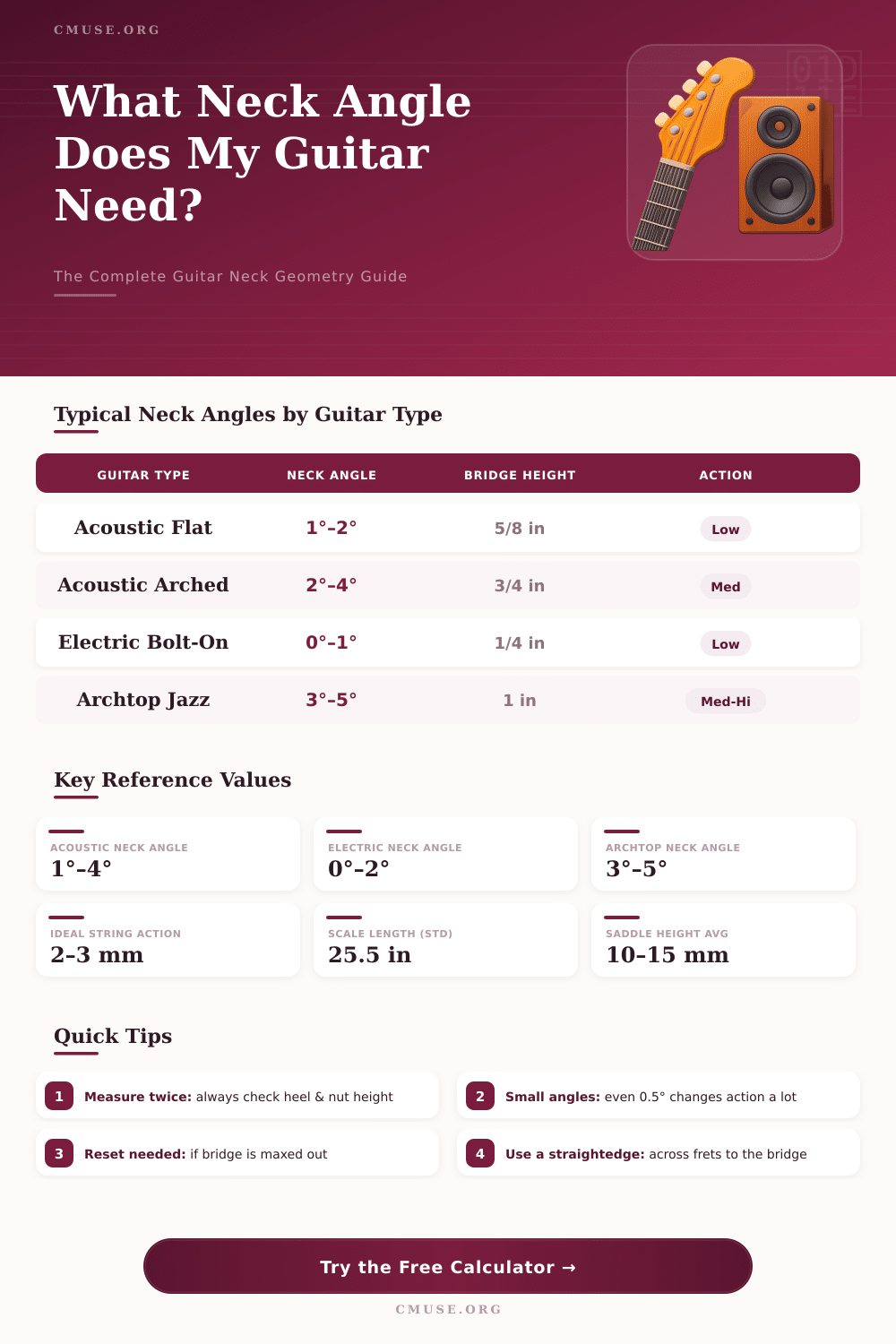
| Neck Angle | Approx. Saddle Rise (in) | Approx. Saddle Rise (mm) | Typical Application |
|---|---|---|---|
| 0° | 0.000 | 0.0 mm | Electric bolt-on, classical flat setup |
| 0.5° | 0.111 | 2.8 mm | Electric set-neck, bass guitar |
| 1° | 0.222 | 5.6 mm | Acoustic flat top (light bracing) |
| 1.5° | 0.333 | 8.5 mm | Acoustic flat top (standard) |
| 2° | 0.445 | 11.3 mm | Acoustic flat top (heavy bracing) |
| 2.5° | 0.556 | 14.1 mm | 12-string acoustic, resonator |
| 3° | 0.667 | 16.9 mm | Archtop semi-hollow, 12-string |
| 4° | 0.890 | 22.6 mm | Archtop jazz, deep-body resonator |
| 5° | 1.113 | 28.3 mm | Deep archtop, tall bridge setup |
| Guitar / Brand Reference | Scale Length (in) | Scale Length (mm) | Guitar Type |
|---|---|---|---|
| Fender Stratocaster / Telecaster | 25.5 in | 647.7 mm | Electric Bolt-On |
| Gibson Les Paul / SG | 24.75 in | 628.7 mm | Electric Set-Neck |
| PRS Standard | 25.0 in | 635.0 mm | Electric Set-Neck |
| Martin Dreadnought | 25.4 in | 645.2 mm | Acoustic Flat Top |
| Taylor 814ce | 25.5 in | 647.7 mm | Acoustic Flat Top |
| Gibson J-45 | 24.75 in | 628.7 mm | Acoustic Flat Top |
| Classical / Nylon String | 25.6 in | 650.2 mm | Classical |
| Fender Bass (P/J) | 34.0 in | 863.6 mm | Electric Bass |
| Gibson Archtop L-5 | 25.0 in | 635.0 mm | Archtop Jazz |
| National Resonator | 25.0 in | 635.0 mm | Resonator |
| Guitar Type | Low Action Bass (in/mm) | Medium Action Bass (in/mm) | High Action Bass (in/mm) |
|---|---|---|---|
| Acoustic Steel String | 3/32″ / 2.4 mm | 7/64″ / 2.8 mm | 5/32″ / 4.0 mm |
| Electric Guitar | 4/64″ / 1.6 mm | 5/64″ / 2.0 mm | 6/64″ / 2.4 mm |
| Classical Nylon | 7/64″ / 2.8 mm | 9/64″ / 3.6 mm | 12/64″ / 4.8 mm |
| Electric Bass | 5/64″ / 2.0 mm | 6/64″ / 2.4 mm | 8/64″ / 3.2 mm |
| 12-String Acoustic | 5/64″ / 2.0 mm | 7/64″ / 2.8 mm | 9/64″ / 3.6 mm |
| Resonator | 9/64″ / 3.6 mm | 11/64″ / 4.4 mm | 14/64″ / 5.6 mm |
The Guitar Neck Angle ranks between the key parts that determines how well one can play the instrument. While one designs a guitar, one counts the right Guitar Neck Angle designing the whole profile of the instrument on a big sheet of paper and later measuring the angle of the strings with a protractor. Likely the Guitar Neck Angle is the most central factor for the playability of acoustic guitar with flat top.
One commonly controls the Guitar Neck Angle laying a long ruler above the fretboard and pressing it against the bridge. Does the ruler rest exactly above the wooden part of the bridge, then the Guitar Neck Angle is correct. If it points under the bridge toward the body, then the Guitar Neck Angle is wrong.
Guitar Neck Angle: What It Is and Why It Matters
When it meets with the upper part of the saddle, then everything is quite near. Even so if it points to the bottom part of the saddle or above the saddles, probably one must reset the neck.
Many guitars have curved tops, that raises the bridge. To keep the action of the strings at a fair level, one must tilt the neck backwards, so that the strings climb slowly over the top as they arrive to the bridge. Guitars with cut top, like Les Paul, 335 or most of F-hole hollow bodies, have height hear, where the bridge rests, so one tilts the neck to fit that.
Strat and most Fenders do not have angle at the neck. The neck simply stays parallel to the body, and the saddles of the bridge are raised to clear the fretboard. Although solid-body guitars do not need to vibrate the top to make sound, the angle break of the strings above the saddle helps quiet causes.
If the neck is set at zero degrees to the body, the action of the strings can end up too high.
For a typical bridge of type Tune-O-Matic, one wants 3-4 degrees of Guitar Neck Angle, so that the strings pass the bridge and allow good action. Bass guitars usually only need 1-2 degrees, while Les Paul normally has around 4 degrees. The reason to tilt the neck is to keep the strings and the fretboard as near to parallel position as possible.
On guitars with bolt-on neck, one can use shims to change the Guitar Neck Angle. A half-degree shim most commonly fixes the problem on Fenders. Shims raise the heel of the neck relative to the nut and the bridge, so that one can reach lower action, when the saddles already are loweredall the way.
While one builds a guitar with glued neck, the angle can be cut in the heel of the neck, or one can tilt the pocket of the neck.
The truss rod to adjust the string is not meant to change the Guitar Neck Angle. It controls how the neck bends against the tension of the strings. That differs from the real Guitar Neck Angle.
Raising the saddle can boost the volume of the soundboard, while changing the Guitar Neck Angle helps to keep the action lower and more comfortable to play.