Practice Hours to Learn Guitar Calculator
Estimate the focused guitar practice hours needed for chord changes, barre clarity, strumming, fretboard recall, bends, alternate picking, consistency, and a playable song list.
Choose a real practice scenario, then adjust the technique measurements to match your current playing. The calculator weighs clean reps, timing, fretboard knowledge, and repertoire separately.
Detailed Guitar Practice Breakdown
| Learning milestone | Typical focused hours | Core guitar work | Ready check |
|---|---|---|---|
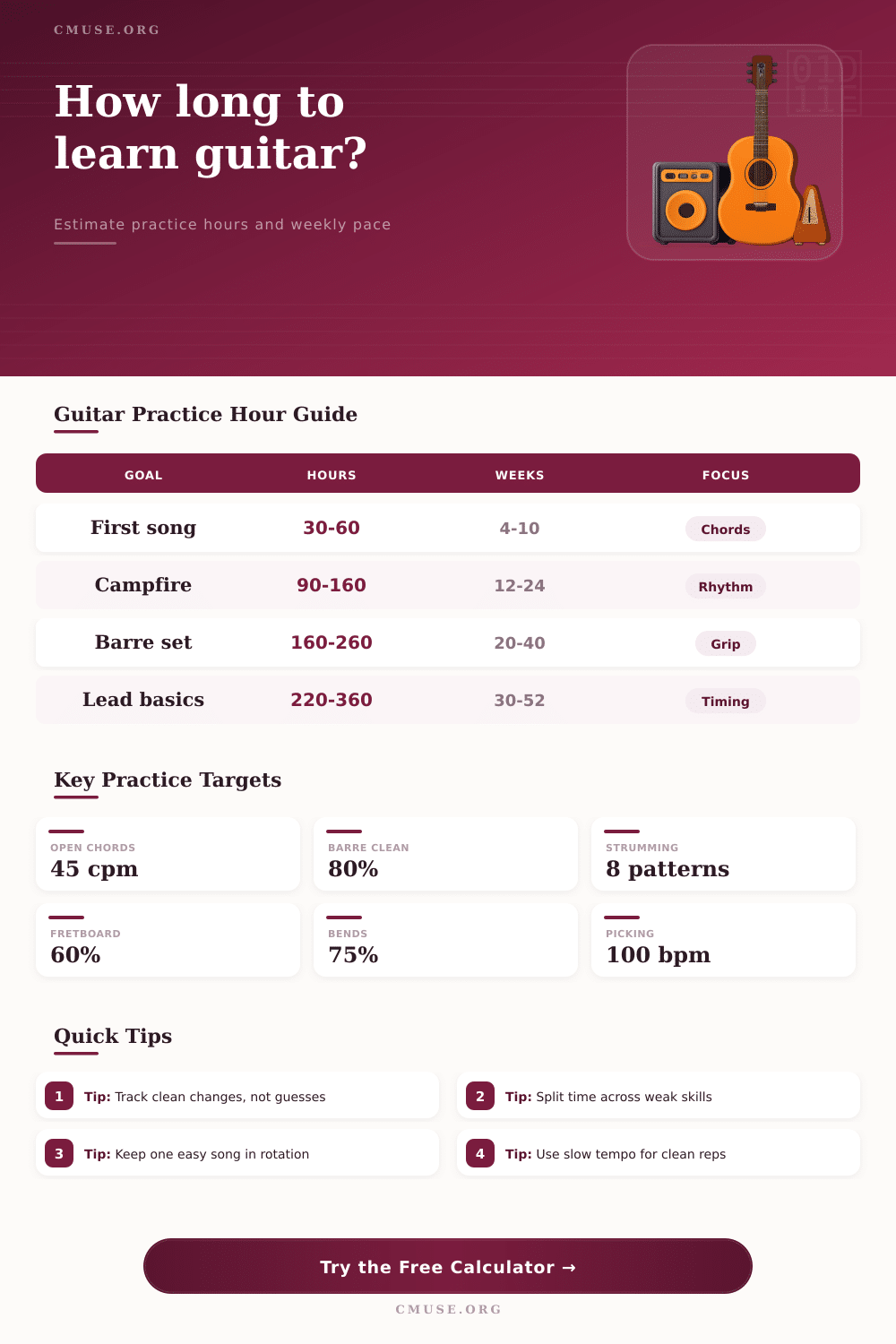
| First song | 30 to 60 hours | Open chords, simple downstrums, clean fretting, steady count-in | One song played start to finish without stopping |
| Open chord fluency | 60 to 120 hours | Fast chord switches, relaxed strumming, basic muting, song memory | 45+ clean changes per minute across common chord pairs |
| Campfire rhythm | 90 to 180 hours | Eight to twelve songs, capo changes, common strum grooves, dynamics | Can keep singing-speed rhythm through a small set |
| Barre chord player | 160 to 280 hours | F and Bm shapes, wrist angle, thumb position, clean transitions | 80%+ clean barre tone at slow and medium tempo |
| Lead basics | 220 to 380 hours | Pentatonic positions, bends, vibrato, alternate picking, phrasing | Bends land near pitch and picked notes stay even |
| Skill area | Early target | Solid beginner target | Intermediate target |
|---|---|---|---|
| Open chord changes | 25 clean cpm | 45 to 60 clean cpm | 70+ clean cpm with rhythm feel |
| Barre chord clarity | 30% to 45% | 65% to 80% | 85%+ through full progressions |
| Strumming vocabulary | 2 to 4 patterns | 6 to 10 patterns | 12+ patterns with accents and muting |
| Fretboard recall | Open strings and 5th fret | Natural notes to 12th fret | Octaves, intervals, and position shifts |
| Alternate picking | 70 to 85 bpm | 90 to 115 bpm | 120+ bpm with string crossing |
| Song type | Typical hours per song | Technique demand | Completion test |
|---|---|---|---|
| Two or three open chords | 3 to 5 hours | Basic fretting, slow changes, downstrums | Full song at slow tempo with clean chord landings |
| Open chords with strum pattern | 5 to 8 hours | Chord switching, groove, accent control | Verse and chorus keep pulse without pauses |
| Barre chord rhythm song | 8 to 14 hours | Grip endurance, clean release, muted strums | Barre shapes ring during the hardest progression |
| Lead riff or simple solo | 10 to 18 hours | Picking, bends, timing, phrase memory | Riff lands with metronome and reference pitch |
| Fingerstyle arrangement | 14 to 24 hours | Thumb independence, chord grip, melody balance | Bass and melody stay clear at performance tempo |
| Practice setup | Useful audio spec | Best for | Watch point |
|---|---|---|---|
| Steel-string acoustic | About 70 to 90 dB nearby | Chord strength, strumming dynamics, song memory | Heavy strings can make barre chords feel slower at first |
| Clean electric practice | Low gain, tuner at A4 440 Hz | Chord clarity, bends, timing, alternate picking | Too much compression can hide uneven fretting |
| High-gain electric practice | Noise gate kept light | Muting discipline, rock riffs, palm-muted rhythm | Distortion masks pitch accuracy unless checked clean |
| Nylon-string classical | Lower tension, wider string spacing | Finger independence, left-hand shape, tone balance | Wide neck changes chord reach compared with electric |
| Headphone amp or interface | Metronome and backing track level matched | Quiet focused reps, timing checks, recorded review | Keep monitoring loudness comfortable for long sessions |
Remember that initial month of trying to learn guitar? Your fingertips is sore, the neck is slippery, and it doesn’t even sound very good. It can gets frustrating. You’re eager to play something, but it are challenging to find the right position for your thumb and get your fingers around the correct spot on fretboard. In fact, most students give up because they expected to see results after a few weeks more then hours of consistent focus.
That’s where many go wrong. By inputting how much free time you have plus your existing skill level, this calculator will translate your unclear goals into a plan you can use. It also need an honest answer about the clarity of your barre chords and how fast you are at changing them. That seems trivial until you try it. How many clean open chord changes do you want to perform per minute?
How the Guitar Learning Calculator Works
If you have just twenty then you won’t be able to accompany anyone and will need to practice playing solo. At that rate (twenty), you’ll still feel rushed in slow tempos. Fluency kicks in somewhere around forty-five, seventy changes per minute according to the reference table. It isn’t so much about speed. It is about making it easier to remember where the chord shapes are, leaving you free to concentrate on melody and rhythm.
The key factor here is a clear barre chord. A lot of folks think they understands the shape of the F major barre chord because they have figured out how to finger it on occasion. They don’t realize that they will struggle with every bar they attempt until those 6 strings is ringing clean 80% of the time. The calculator gives it such weight because learning barre chords rely on proper hand strength, thumb placement, and wrist angle.
If you’re lacking clarity, then it will extend the timeline so you can condition your hands physicaly. And that makes sense as tendons will not adapt overnight. Bad habits formed by playing buzzes or through pain take longer to overcome.
The estimated time frame also shifts depending on your goals for songs. Learning one new song every week is a different workload than hoarding ten songs over six months. Not only do you has to apply a particular technique and put it into memory, but you also need to devote extra effort towards each new song. This means considering the average difficulty of your chosen songs; for example, learning a complicated piece that involves complex fingerpicking or strumming patterns takes longer than a simple folk tune.
Consistency is a key element of any practice plan. To achieve consistency, select pieces that connect with you. Selecting songs that is too challenging can negatively impact your consistency. This is what your focus percentage says about you. Your practice habits are reflected in the focus percentage input. For many folks, it tells you that you overestimate the amount of focused practice time you use.
Strumming around, tab surfing and setting up gear doesn’t make you any better. You need to get into the zone and use all that equipment for something specific. Slow down tricky transitions. Isolate weak fingers. Use a metronome. Deliberate repetition builds muscle memory. And this take work. Repetition, not just exposure to something, strengthens brain connections. It’s unglamorous but it works.
The consistency multiplier adjusts the timeline upward if you are practicing irregularly. Skipping a day is not as bad as skipping a week. Weekend marathon sessions does little; short regular practice does a lot. Muscle memory is built by doing it regularly rather than just for long durations.
The breakdown section breaks your time into where it’s being used (fretboard knowledge/rhythm/chord mechanics). It can help target your weak spots. Maybe you’re able to change quickly but you struggle with your strumming. This helps you see what needs work without repeating things that feel naturaly.
Learning guitar is a game of inches played out over hundreds of hours. The math is a real measure of how far away you are from where you want to be. Treat the estimates as mile markers instead of deadlines. Every day is different; that’s the nature of progress. It helps to have a plan, because without it we tend to drift off course.
Focus on practicing with purpose. After all, you wanted to learn guitar so you could make music, not do algebra. Make sure expectations remains reasonable, and goals are concrete. If you consistenly put in focused practice time, you’ll notice gradual improvement in rhythm and clean chord changes. You should of practiced more to see results faster.