🎸 Guitar Harmony Calculator
Find harmonized notes, intervals & chord tones for any root note and key
| Scale / Mode | Interval Pattern (semitones) | Character | Common Key |
|---|---|---|---|
| Major (Ionian) | 2–2–1–2–2–2–1 | Happy, Bright | C, G, D |
| Natural Minor | 2–1–2–2–1–2–2 | Sad, Dark | A, E, D |
| Dorian | 2–1–2–2–2–1–2 | Jazzy Minor | D, A |
| Phrygian | 1–2–2–2–1–2–2 | Exotic, Spanish | E, B |
| Lydian | 2–2–2–1–2–2–1 | Dreamy, Floating | F, C |
| Mixolydian | 2–2–1–2–2–1–2 | Bluesy Major | G, D |
| Locrian | 1–2–2–1–2–2–2 | Tense, Unstable | B |
| Maj. Pentatonic | 2–2–3–2–3 | Open, Country | C, G, A |
| Min. Pentatonic | 3–2–2–3–2 | Rock, Blues | A, E |
| Blues Scale | 3–2–1–1–3–2 | Gritty, Soulful | A, E, G |
| Harmonic Minor | 2–1–2–2–1–3–1 | Classical, Dramatic | A, D |
| Melodic Minor | 2–1–2–2–2–2–1 | Jazz, Sophisticated | A, D |
| Scale Degree | Major Key Interval (3rd above) | Minor Key Interval (3rd above) | Semitones |
|---|---|---|---|
| I (Root) | Major 3rd | Minor 3rd | 4 / 3 |
| II | Minor 3rd | Minor 3rd | 3 / 3 |
| III | Minor 3rd | Major 3rd | 3 / 4 |
| IV | Major 3rd | Major 3rd | 4 / 4 |
| V | Minor 3rd | Minor 3rd | 3 / 3 |
| VI | Minor 3rd | Major 3rd | 3 / 4 |
| VII | Major 3rd | Minor 3rd | 4 / 3 |
| String | Standard Tuning | Frequency (Hz) | Drop D / Half-Step Down |
|---|---|---|---|
| 6th (Low) | E2 | 82.41 Hz | D2 / E♭2 |
| 5th | A2 | 110.00 Hz | A2 / A♭2 |
| 4th | D3 | 146.83 Hz | D3 / D♭3 |
| 3rd | G3 | 196.00 Hz | G3 / G♭3 |
| 2nd | B3 | 246.94 Hz | B3 / B♭3 |
| 1st (High) | E4 | 329.63 Hz | E4 / E♭4 |
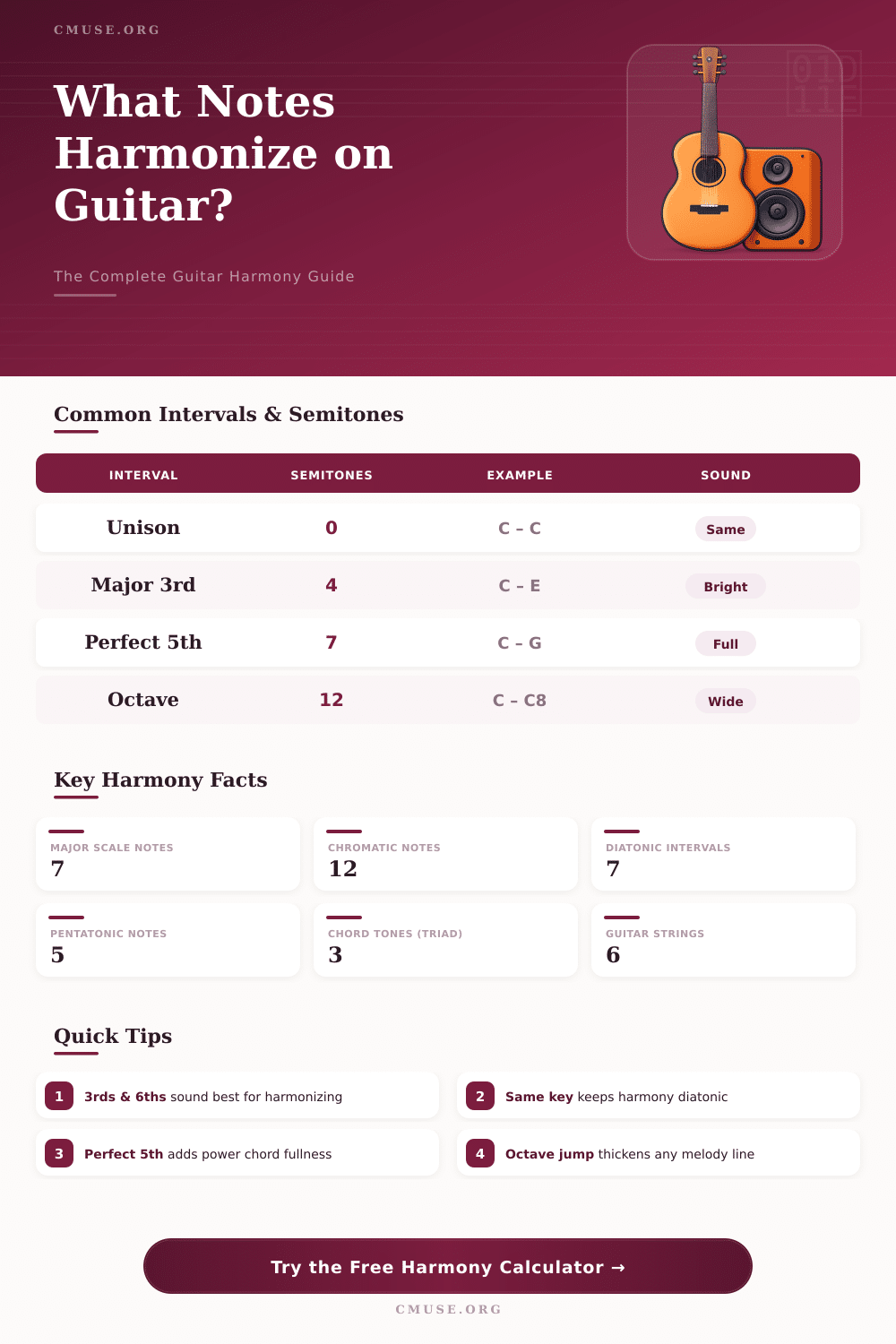
Guitar harmony appears when two or several notes sound together. One can hear that on one alone instrument or between some guitars, that play one with the other. It is made up of a mix of musical tone parts that vibrate together.
To form such chords a guitarist mixes gaps between the notes, so that the resulting sound pleases the ear of the listener.
What Is Guitar Harmony
Guitar harmony in solo is a method, by means of which two or more guitars issue different tones together, what gives a full and rich sound. One musician cares about the main melody or leading role, during the others follow the same pattern, but start from another spot in the scale. In the most many cases for guitar chords, one folk keeps the melody way, and the otehrs play a alike part at a set gap over or below the basic note.
Here is a basic example in the tone of C major. When one guitarist plays the sequence C E F E, the second can add harmony by means of a third over it, so playing E G A G. For instance, if the leading part stressed something, the matching line would match by means of C. Sometimes in metal music with two guitars, the helper way glides upward in two steps in the scale from the main line. Major thirds, minor thirds, perfect fourths and perfect fifths all work well, during the notes stay in the main scale.
A bit of fourths sound more well than only thirds, especially if that fourth is part of the chord. When the melody tone is D, one can add G as a matching element above it, what forms a fourth. Nice cases of guitar harmony, that combines thirds with fourths, presents in the song Jessica of the Allman Brothers.
Guitar harmony can also bee seen as a whole set of rules. They help to find out what tones work from one moment to the next, whether alone or together, to escape ugly sounds for the ear. Learning a bit of music theory is useful to match melody, especially in live shows on guitar, when one hears the theme for the first time.
One has also tools to make harmony by means of electronic aids. A foot pedal for harmony adds one or several notes above or below the played tone, keeping everything in the range of the chosen scale. Before one created presets, that set the base tone and the scale gaps.
Changes in method allow the musician to copy the guitar signal into a second input of the harmonizer, what makes changes of the base during the song itself.
Double lead guitars have a rich past in rock. The Allman Brothers and the group of Alice Cooper certainly used two lead guitarists. Boston does that especially well, andalmost in every bit, that Brian May plays in concert, he uses it.