🎸 Guitar Fret Calculator
Calculate precise fret positions for any scale length — build, set up, or verify your instrument
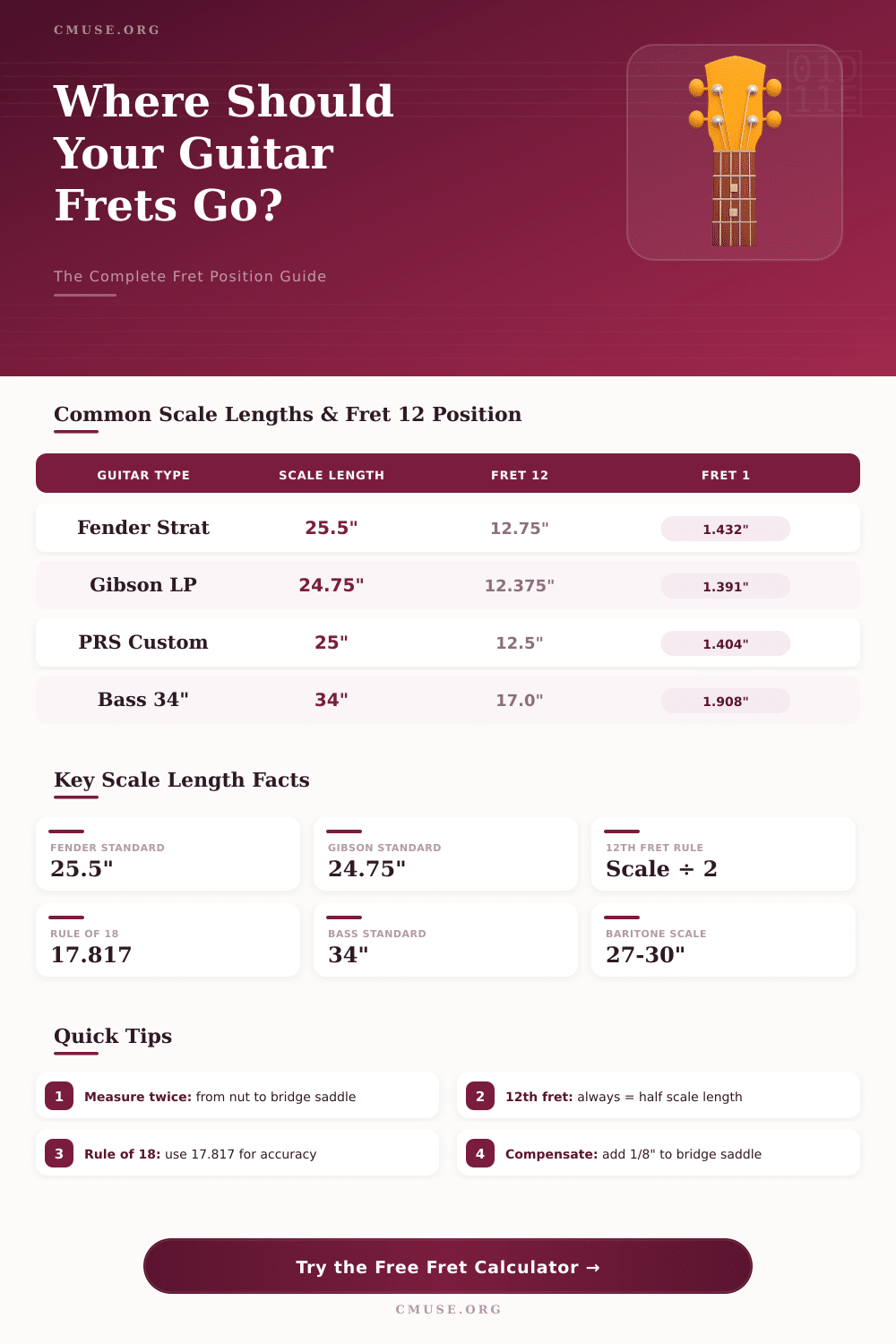
| Fret # | 24.75" Gibson (in) | 25.5" Fender (in) | 25.5" Fender (mm) | 34" Bass (in) |
|---|---|---|---|---|
| 1 | 1.391" | 1.432" | 36.37mm | 1.909" |
| 2 | 2.700" | 2.780" | 70.61mm | 3.706" |
| 3 | 3.931" | 4.047" | 102.79mm | 5.396" |
| 4 | 5.089" | 5.240" | 133.09mm | 6.987" |
| 5 | 6.181" | 6.366" | 161.69mm | 8.488" |
| 7 | 8.152" | 8.392" | 213.16mm | 11.189" |
| 9 | 9.889" | 10.183" | 258.64mm | 13.578" |
| 12 | 12.375" | 12.75" | 323.85mm | 17.0" |
| 17 | 18.563" | 19.125" | 485.78mm | 25.5" |
| 22 | 22.032" | 22.688" | 576.27mm | — |
| Tuning Name | String 6→1 (Low→High) | Instrument | Common Scale |
|---|---|---|---|
| Standard E | E2–A2–D3–G3–B3–E4 | Electric/Acoustic | 25.5" |
| Drop D | D2–A2–D3–G3–B3–E4 | Electric Guitar | 25.5" |
| Open G | D2–G2–D3–G3–B3–D4 | Acoustic/Slide | 25.5" |
| Classical Std | E2–A2–D3–G3–B3–E4 | Classical Nylon | 648mm |
| Bass Standard | E1–A1–D2–G2 | Bass Guitar | 34" |
| Baritone B | B1–E2–A2–D3–F#3–B3 | Baritone Guitar | 27" |
| 7-String Std | B1–E2–A2–D3–G3–B3–E4 | 7-String Electric | 26.5" |
| Method | Divisor Used | Accuracy | Best For |
|---|---|---|---|
| Equal Temperament | 17.81715 | Highest (exact) | All modern instruments |
| Rule of 18 | 18.0 | Approximate | Quick estimates only |
| Historical (lutes) | 17.835 | Period-accurate | Period instrument builds |
| Metric Equal Temp | 17.81715 | Highest (exact) | Metric luthier builds |
The metal strips on the neck of a guitar are called guitar fret bars. They sit across the neck. The bottom guitar fret sits just after the head of the instrument.
Those strips split the neck into exact parts that relate to the steps of the musical scale. In guitars each guitar fret marks one half step in the western tradition, where octaves are made up of twelve half steps.
Guitar Fret Bars: What They Are and Why They Matter
Usually guitars have from 19 to 24 guitar fret bars, but one can build them with other amounts as needed. Fender and Gibson models usually carry 21 or 22 of them. Acoustic guitars normally come with 20 guitar fret bars, although some come with 18 or 19.
Of those only 12 to 14 guitar fret bars reach easily on an acoustic instrument. When a guitar owns extra guitar fret bars, for instance 24, the upper positions become reachable because of the different position of the cutaway on the body.
The size of guitar fret bars seriously affects the style of play on guitar. Narrow and high guitar fret bars require gentle pressure, on the other hand heavier strips require strong touch. Also the height of guitar fret bars changes the need for adjustment of the neck.
One considers jumbo guitar fret bars better by many criteria compared to small, but sliding on them can feel annoying becuase of the risk, that they bite the fingers during the moves.
Guitar fret bars are made from various materials and come in different thicknesses. The options go from small to jumbo, and between the materials stand stainless steel and nickel-silver. For classical guitars the typical guitar fret wire measures around 80 to 85 thousandths of an inch in width, with crown height of 50 thousandths before usage.
On Gibson guitars one uses a bit thicker wires, of 90 to 95 thousandths wide, but with the same crown height. Stainless steel guitar fret bars become very popular and won knows them because of their long life. Certain strings, like those from stainless steel, can be more rough against the guitar fret bars.
To press the string against the guitar fret takes the least pressure, only so that it touches the strip. If one presses too hard, the note will sound too high. Especially at high guitar fret bars it happens easily, that one pushes the string too much and the sound becomes sharp.
The distance between guitar fret bars shrinks while one climbs toward the bridge. Every next guitar fret sits at the twelfth root of two times closer to the bridge than the prior. The guitar tunes in fourths, what matches to five guitar fret bars between separate strings.
The exception counts between the G and B strings, that sit a major third apart, soonly four guitar fret bars.
Wear of guitar fret bars shows as small grooves on them, especially in the bottom positions. Polishing the guitar fret bars with 000-wool helps them last. Good crowning and polishing of guitar fret bars greatly improves the tuning of the guitar.
If guitar fret bars wear too much, you need to replace them.