🎸 Guitar Delay Calculator
Find the perfect tempo-synced delay time in milliseconds for any BPM
✨ Delay Calculation Results
| BPM | Whole Note | Half Note | Quarter Note | Dotted 8th | Eighth Note | Sixteenth |
|---|---|---|---|---|---|---|
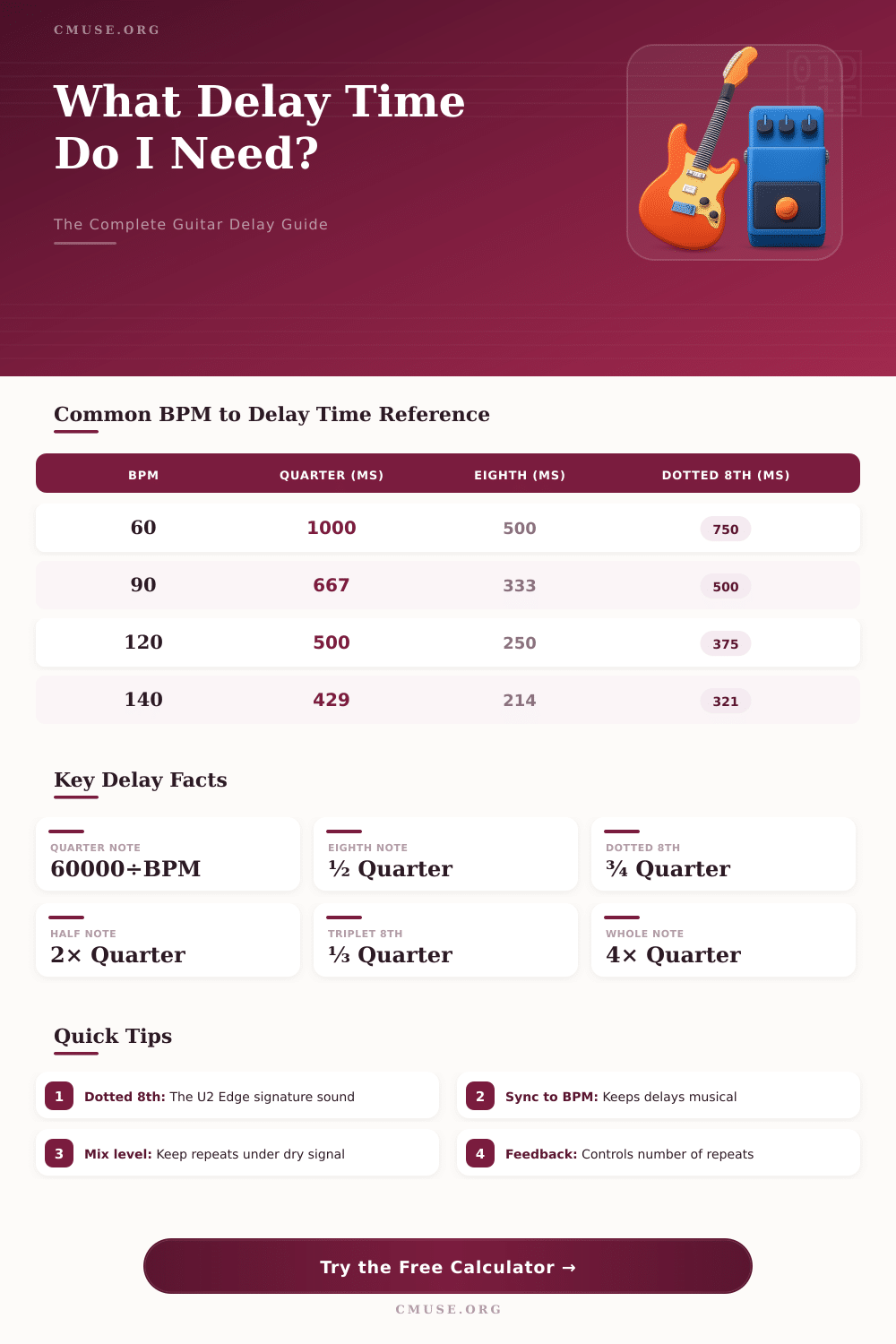
| 60 | 4000 | 2000 | 1000 | 750 | 500 | 250 |
| 70 | 3429 | 1714 | 857 | 643 | 429 | 214 |
| 80 | 3000 | 1500 | 750 | 563 | 375 | 188 |
| 90 | 2667 | 1333 | 667 | 500 | 333 | 167 |
| 100 | 2400 | 1200 | 600 | 450 | 300 | 150 |
| 110 | 2182 | 1091 | 545 | 409 | 273 | 136 |
| 120 | 2000 | 1000 | 500 | 375 | 250 | 125 |
| 130 | 1846 | 923 | 462 | 346 | 231 | 115 |
| 140 | 1714 | 857 | 429 | 321 | 214 | 107 |
| 150 | 1600 | 800 | 400 | 300 | 200 | 100 |
| 160 | 1500 | 750 | 375 | 281 | 188 | 94 |
| 170 | 1412 | 706 | 353 | 265 | 176 | 88 |
| 180 | 1333 | 667 | 333 | 250 | 167 | 83 |
| 200 | 1200 | 600 | 300 | 225 | 150 | 75 |
| Subdivision | Beats | Multiplier | Example @120 BPM (ms) | Common Use |
|---|---|---|---|---|
| Whole Note | 4 | ×4.000 | 2000 | Pad swells, sustain |
| Dotted Half | 3 | ×3.000 | 1500 | Slow atmospheric |
| Half Note | 2 | ×2.000 | 1000 | Ballad echoes |
| Dotted Quarter | 1.5 | ×1.500 | 750 | Syncopated feel |
| Quarter Note | 1 | ×1.000 | 500 | Standard echo |
| Dotted Eighth | 0.75 | ×0.750 | 375 | U2/Edge style lead |
| Eighth Note | 0.5 | ×0.500 | 250 | Tight rhythmic delay |
| Triplet Eighth | 0.333 | ×0.333 | 167 | Funky triplet feel |
| Sixteenth Note | 0.25 | ×0.250 | 125 | Fast slapback effect |
| Triplet Sixteenth | 0.167 | ×0.167 | 83 | Machine-gun effect |
| Delay Type | Character | Typical Range (ms) | Best Genre | Notable Pedals/Units |
|---|---|---|---|---|
| Digital Delay | Clean, transparent repeats | 1–2000+ | Any genre | Boss DD-8, TC Flashback |
| Tape Echo | Warm, slightly degrading repeats | 50–800 | Rockabilly, Blues, Psychedelic | Echoplex EP-3, Memory Man |
| Analog Delay | Dark, slightly lo-fi repeats | 20–600 | Indie, Shoegaze, Classic Rock | Boss DM-2, MXR Carbon Copy |
| Ping-Pong | Stereo L/R bouncing repeats | 100–1000 | Pop, Ambient, Studio | Line 6 DL4, Strymon Timeline |
| Slapback | Single short repeat, no feedback | 50–150 | Rockabilly, Country, Early Rock | Most delays at 0% feedback |
| Reverse Delay | Reversed repeats, eerie texture | 100–600 | Psychedelic, Ambient, Experimental | Boss RV-6, Strymon BigSky |
| Multi-Tap | Multiple discrete echo points | 50–2000 | Ambient, Post-Rock, Studio | Strymon Timeline, Eventide H9 |
| Genre / Style | Typical BPM | Subdivision | Delay Time (ms) | Feedback % | Mix % |
|---|---|---|---|---|---|
| Classic Rock Lead | 110–130 | Quarter Note | 462–545 | 25–40% | 20–35% |
| U2 / Edge Sound | 90–120 | Dotted Eighth | 375–500 | 30–50% | 30–45% |
| Country Slapback | Any | Slapback | 80–120 | 0% | 20–30% |
| Ambient / Post-Rock | 60–90 | Dotted Quarter | 750–1000 | 50–80% | 40–60% |
| Blues Shuffle | 80–100 | Triplet Eighth | 200–250 | 20–35% | 15–25% |
| Heavy Metal Rhythm | 140–200 | Eighth Note | 150–214 | 15–25% | 10–20% |
| Jazz Chorus Effect | 120–200 | Sixteenth | 75–125 | 0–15% | 20–30% |
Guitar Delay gives the sound of guitar a fuller sense of space. It fits with reverb or serves as another option instead of it. Before being too visible, delays usually add gentle depth to the whole sound.
Pedals for delay make echo. That ranges from fast slapback repeats to long stretched echoes. While the guitarist plays between the repeats, the pedal keeps the signal and plays it back.
How Guitar Delay Works
Like this it makes a layered sound that can sound truly new.
The guitarist of U2, The Edge, uses delay playing arpeggios on electric guitar. It makes a steady background similar to a synth pad. Singers and other musicians also use it to add dense or light upper quality to their sound.
Long delay tiems of ten seconds or more create a loop from a whole musical phrase.
Guitar Delay is much more exact than regular reverb. The time of delay repeats according to rhythmic patterns, like eighth notes, dotted eighths or triplets, with a set amount of repeats. Dotted eighth delay needs a bit of knowledge about music theory to use it well.
Delay matched with rhythm by means of tap allows the time to match the rhythm of a song, which creates extra rhythmic pulses. Quarter note delay copies exactly one rhythm that is played, while dotted quarter or triplet values give a shaking rhythm.
For big solo Guitar Delay, you use a time around 380 milliseconds, with feedback of 45 percent and mix level around 40 percent. If you place it at the end of an overdriven signal chain, it gives a nice echo. In slow songs, a bit longer delay of 400 milliseconds or more, with more feedback, works well.
One single soft repeat of around 200 milliseconds is another reliable mode.
Delay pedals match various tastes. Analog delays use older darker circuits, like the classic Memory Man or DM-2. Bucket brigade delays are technically analog, but they have there own type because of special modulation traits, like vibrato.
They sound a bit more bright and less deep than usual analog delay. Digital delays work differently.
Fans of Pink Floyd maybe want pedals that copy the Binson Echorec. Fans of U2 can choose the EHX Memory Man. The Boss DD-3T pleases fans of Bloc Party, while the Line 6 DL4 helps for live looping.
The Boss RE-20 Space Echo works well for vintage reggae sounds. Some pedals offer extras like MIDI, separate tap or expressionpedal.
Guitar Delay should come after overdrive and distortion pedals in the signal chain. Low mix level allows more original signal to pass, while high mix makes the delay much bigger. If reverb is in the delay, it creates huge waves of surrounding texture, almost like another pad of sound.
Guitar Delay also works well with acoustic guitar. It is fun for stacking rhythms or copying reverb sound by means of really short settings and a bit of blending.