🎸 Guitar Bridge Position Calculator
Calculate exact bridge saddle placement, fret positions, and intonation compensation for any scale length
📊 Bridge Position Results
| Fret # | Distance from Nut (in) | Distance from Nut (mm) | Note (E String) |
|---|---|---|---|
| 1 | 1.431" | 36.35mm | F |
| 2 | 2.782" | 70.67mm | F# |
| 3 | 4.056" | 103.03mm | G |
| 4 | 5.258" | 133.55mm | G# |
| 5 | 6.391" | 162.33mm | A |
| 7 | 8.504" | 215.99mm | B |
| 12 | 12.750" | 323.85mm | E (Octave) |
| 15 | 15.932" | 404.67mm | G |
| 17 | 17.627" | 447.72mm | A |
| 24 | 19.125" | 485.78mm | E (2nd Oct.) |
| Scale Length | Nut to 12th Fret | Bridge Saddle (no comp.) | Typical Compensation |
|---|---|---|---|
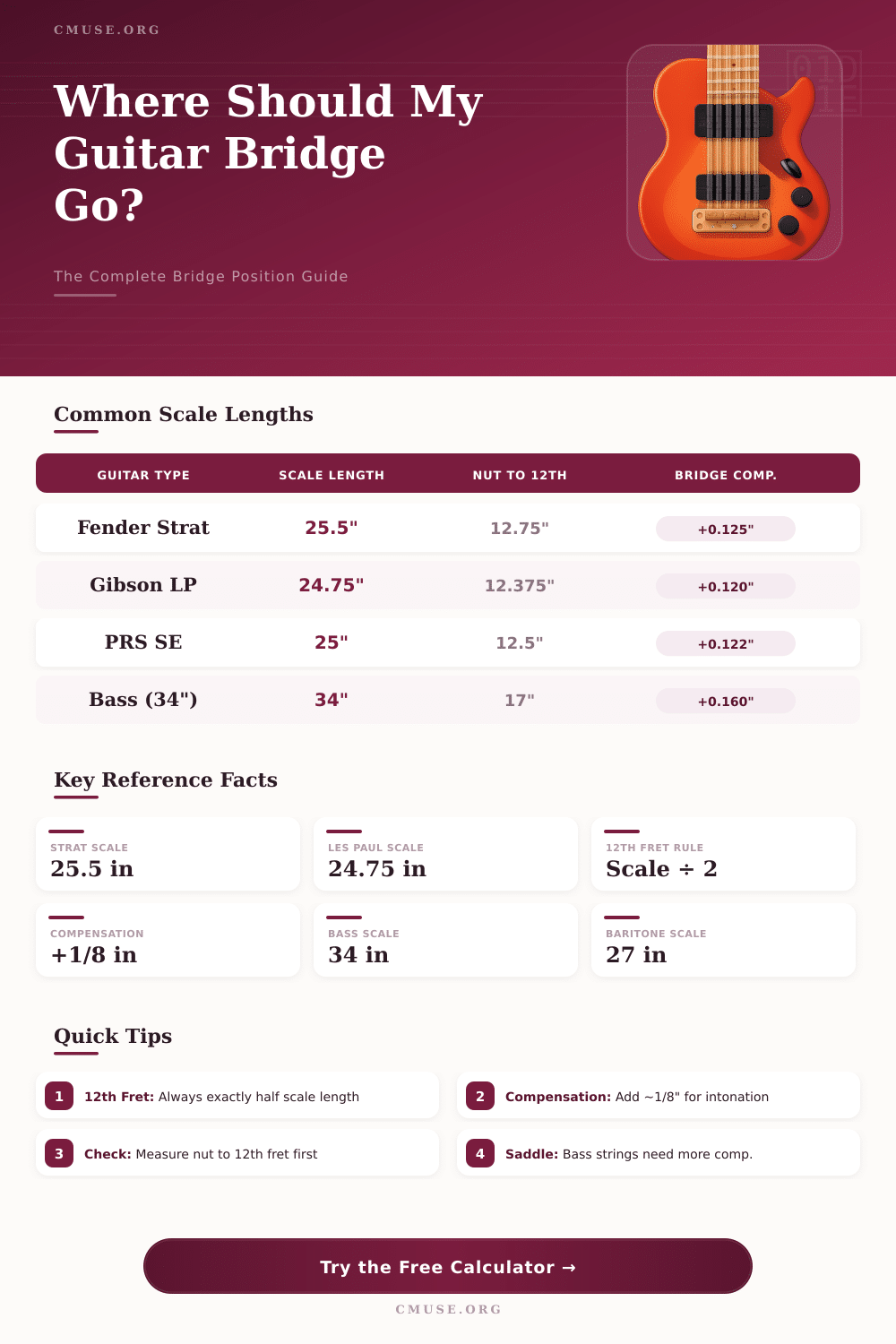
| 24.75" (628mm) | 12.375" / 314.3mm | 24.75" from nut | +0.120" (3.0mm) |
| 25.0" (635mm) | 12.500" / 317.5mm | 25.0" from nut | +0.125" (3.2mm) |
| 25.5" (648mm) | 12.750" / 323.9mm | 25.5" from nut | +0.125" (3.2mm) |
| 27.0" (686mm) | 13.500" / 342.9mm | 27.0" from nut | +0.140" (3.6mm) |
| 30.0" (762mm) | 15.000" / 381.0mm | 30.0" from nut | +0.150" (3.8mm) |
| 34.0" (864mm) | 17.000" / 431.8mm | 34.0" from nut | +0.180" (4.6mm) |
| 35.0" (889mm) | 17.500" / 444.5mm | 35.0" from nut | +0.185" (4.7mm) |
| String Type | Gauge Range | Typical Compensation | Compensation (mm) |
|---|---|---|---|
| Extra Light Electric | .008 – .038 | +3/32" (0.094") | +2.4mm |
| Light Electric | .009 – .042 | +1/8" (0.125") | +3.2mm |
| Medium Electric | .010 – .046 | +1/8" (0.125") | +3.2mm |
| Heavy Electric | .011 – .052 | +5/32" (0.156") | +3.9mm |
| Acoustic Light | .011 – .052 | +5/32" (0.156") | +3.9mm |
| Bass Light | .040 – .100 | +3/16" (0.188") | +4.8mm |
| Bass Medium | .045 – .105 | +3/16" (0.188") | +4.8mm |
| Classical Nylon | Nylon | +3/32" (0.094") | +2.4mm |
The guitar bridge position ranks between the most important elements that one must exactly determine during building of the instrument. It must involve the place where the tuning result correctly. If not, the sound of the guitar will sound wrong almost always.
Also the vertical guitar bridge position requires attention, so that it well match with the area.
Where to Put the Guitar Bridge
The saddle at the bridge holds the strings at one end, while the nut stops them at the other. The twelfth fret sits almost exactly halfway between those two spots. On every quite good guitar, one must arrange the bridge like this, that the spot where the string breaks, sits exactly at the scale distance from the nut.
One defines the scale as twice the length between nut and twelfth fret. Because various guitars use different scales, it matters to know the planned lenght before setting the bridge.
One must first join the neck to the body, before laying any bridge. The place where neck joins to body, plays a big role. For instance, on two guitars with alike body shapes, one with neck joint at the twelfth fret and the other at the fourteenth fret, the bridge on the first instrument sits more near too the bottom edge.
Every guitar bears six strings of different thicknesses and tones. Here is why the saddle of the bridge tilts; to make up for those differences. Some builders go even more far and make saddles with different string lengths under every string.
For instance, the guitar bridge position for B-string commonly moves more backwards than that for the high E or G. Usually the B-string tunes best according to the planned scale, hence well arranging the saddles with space for both-way changes and finding the bridge by means of measurement to the B-saddle shows a reliable method.
Even on guitars with movable bridge, like archtop models, one must lay it in the right place. In case that such bridge lands accidentally and lacks marks on the upper surface, one finds the right guitar bridge position by means of playing harmonics at the twelfth fret and comparison with the fretted note there.
Acoustic guitars normally do not have an adjustable bridge. Electrical models work otherwise. The guitar bridge position seriously affects the sound of acoustic guitar, because it depends on vibration of the top.
Electric guitar does not need top vibration to make sound, hence there is more freedom for bridge position, with only comfort issues to think about. One can evenshorten the body, if the scale length stays same.
One must measure carefully before cutting. Measure thrice, cut once. The saddle needs to seat deeply and flatly in the slot, without space for shaking.
In the guitar factory, one does not always apply strict rules for saddle position, which can cause surprisingly bad results even on expensive instruments.