🎸 Guitar Amp Ohm Calculator
Calculate speaker impedance for series, parallel & mixed wiring configurations
🔺 Series Wiring
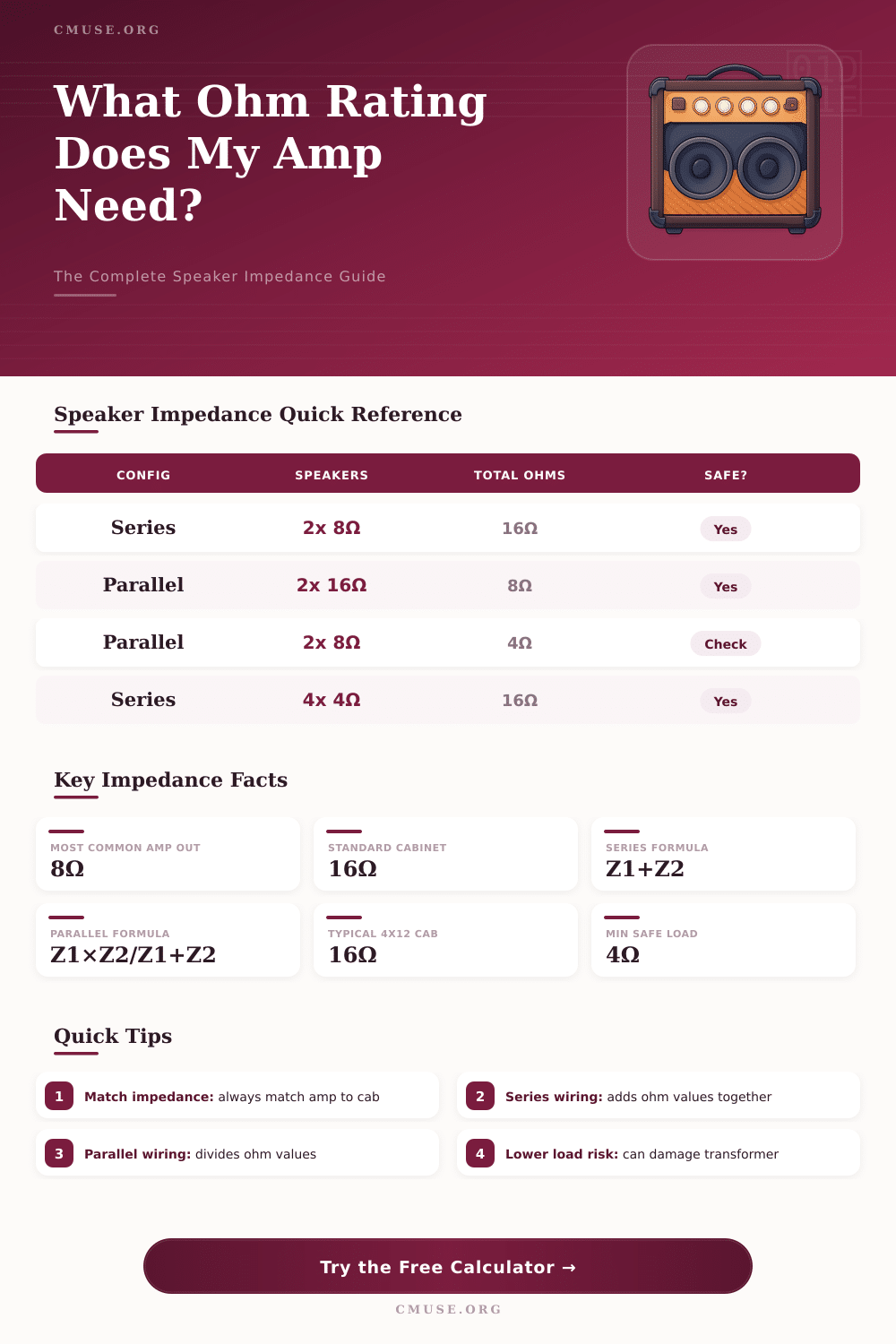
All speakers connected end-to-end. Impedance adds up. Best for increasing total ohms. Each speaker gets equal power.
🟢 Parallel Wiring
All speakers share the same two wires. Impedance divides. Most common for speaker cabinets. Increases power handling.
🟡 Series-Parallel (4x)
Two pairs wired in series, then the two pairs wired in parallel. Standard for 4x12 cabs. Total Z equals single speaker Z.
⚠ Impedance Mismatch Rules
Higher load (more ohms) than amp output: safe but reduced power. Lower load (fewer ohms): risks overheating transformer.
| Configuration | Speakers | Each Speaker | Total Load | Wiring |
|---|---|---|---|---|
| 1x12 Combo | 1 | 8Ω | 8Ω | N/A |
| 1x12 Combo | 1 | 16Ω | 16Ω | N/A |
| 2x12 Cabinet | 2 | 16Ω | 8Ω | Parallel |
| 2x12 Cabinet | 2 | 8Ω | 16Ω | Series |
| 2x12 Cabinet | 2 | 8Ω | 4Ω | Parallel |
| 4x12 Cabinet | 4 | 16Ω | 16Ω | Series-Parallel |
| 4x12 Cabinet | 4 | 8Ω | 8Ω | Series-Parallel |
| 4x12 Cabinet | 4 | 4Ω | 4Ω | Series-Parallel |
| 4x12 Cabinet | 4 | 16Ω | 4Ω | All Parallel |
| Amp Power | Speaker Load | Voltage (V) | Current (A) | Typical Use |
|---|---|---|---|---|
| 5W | 8Ω | 6.3V | 0.79A | Practice combo |
| 15W | 8Ω | 10.95V | 1.37A | Small combo |
| 30W | 8Ω | 15.49V | 1.94A | Club gig amp |
| 50W | 8Ω | 20V | 2.5A | Stage head |
| 50W | 16Ω | 28.28V | 1.77A | Stage head |
| 100W | 8Ω | 28.28V | 3.54A | Full stack |
| 100W | 16Ω | 40V | 2.5A | Full stack |
| 200W | 4Ω | 28.28V | 7.07A | Bass / PA |
| Speaker Size | Common Imp. | Typical Power | Peak Power | Notes |
|---|---|---|---|---|
| 6.5" Coaxial | 8Ω | 25–50W | 75W | Small practice |
| 8" Guitar Speaker | 8Ω | 15–30W | 60W | Mini combo |
| 10" Guitar Speaker | 8 / 16Ω | 25–50W | 100W | 2x10 cabs |
| 12" Guitar Speaker | 8 / 16Ω | 25–100W | 150W | Most common |
| 15" Bass Speaker | 4 / 8Ω | 100–300W | 600W | Bass cabinets |
The Ohm of guitar amplifiers can seem hard to understand at first, even though it comes down to some basic ideas. Resistance and Ohm measure by means of Ohm. A higher value of Ohm means more hardly the electricity flows through it.
While we switch audio signals from one circuit part to other, for example from pickups of guitar to Amp or from that to speaker, same Ohm ensures the best motion of signal, energy and harmonics.
How Ohms Affect Guitar Amps and Speakers
Speakers own Ohm, but amplifiers do not work entirely the same. Ohm point shows how much resistance the speaker or the cabinet gives to the Amp. Various cabinets with speakers have different Ohm, because that depends on the number of speakers and on the way one wires them.
The wiring can be 4 Ohm, 8 Ohm or 16 Ohm. Hence many amplifiers have switches left for choosing the right Ohm.
Almost all Guitar Amp own input Ohm around 1 megaohm. A passive pickup of Guitar normally has between 6 and 15 kilo-ohms of Ohm. The basic rule says that input Ohm should be at least tenfold more than the Ohm of the source.
Because pickups sit in that range of 5 until 15 kilo-ohms, 1 megaohm works well as standard. High input Ohm reduces load impacts and helps too preserve the tone of the pickup. If the Ohm of the load is too low, excessive signal loss can happen.
The input of Amp or effects unit sets the Ohm by means of a resistor from the input to the ground, what shunts part of the signal. With lower resistance, grows the loss of signal. On the other hand, 500 kilo-ohms, and especially 1 megaohm, one considers right and usual for instruments.
In tube amplifiers, same Ohm between the device and the speakers usually give the best results. Modern amplifiers handle mismatch of 2:1, whether more up or below. When one connects a speaker with higher Ohm than the Amp expects, the sound becomes quieter.
In the world of Guitar Amp, low Ohm commonly give warm tone, while high Ohm create more crackling sound. High Ohm can also cause expanded voltage spikes, what harms the speakers of the Amp.
If one connects two 8-Ohm cabinets in parallel to one Amp, the whole load becomes 4 Ohm. Two 16-Ohm cabinets in parallel result in 8-Ohm load. When speakers one wires in series, the resistance doubles.
Never join a load less than what the specs of the Amp say. A multimeter resistance reading shows around three quarters of the rated Ohm, so an 8-Ohm speaker reads about 6 Ohm.
High Ohm means high resistance, but that does not directly block high power. The power rating of the speaker defines itself separate from its Ohm. Wire for tone matters, but the main spots to takecare of are the Ohm value of the speakers, the fixed Ohm of the Amp and the kind of used speakers.