Golden Ratio Song Section Calculator
Find the 61.8 percent and 38.2 percent golden-section targets for a song, then compare a planned bridge, drop, final hook, or climax against the nearest bar and phrase grid.
Full Calculation Breakdown
| Target | Percent | Time | Calculated Bar | Phrase Snap |
|---|---|---|---|---|
| Late phi | 61.8% | 2:10.000 | Bar 53.0 | Bar 53 |
| Song Length | 38.2% Mirror | 61.8% Golden Hit | Typical 4/4 Bar At 120 | Section Use |
|---|---|---|---|---|
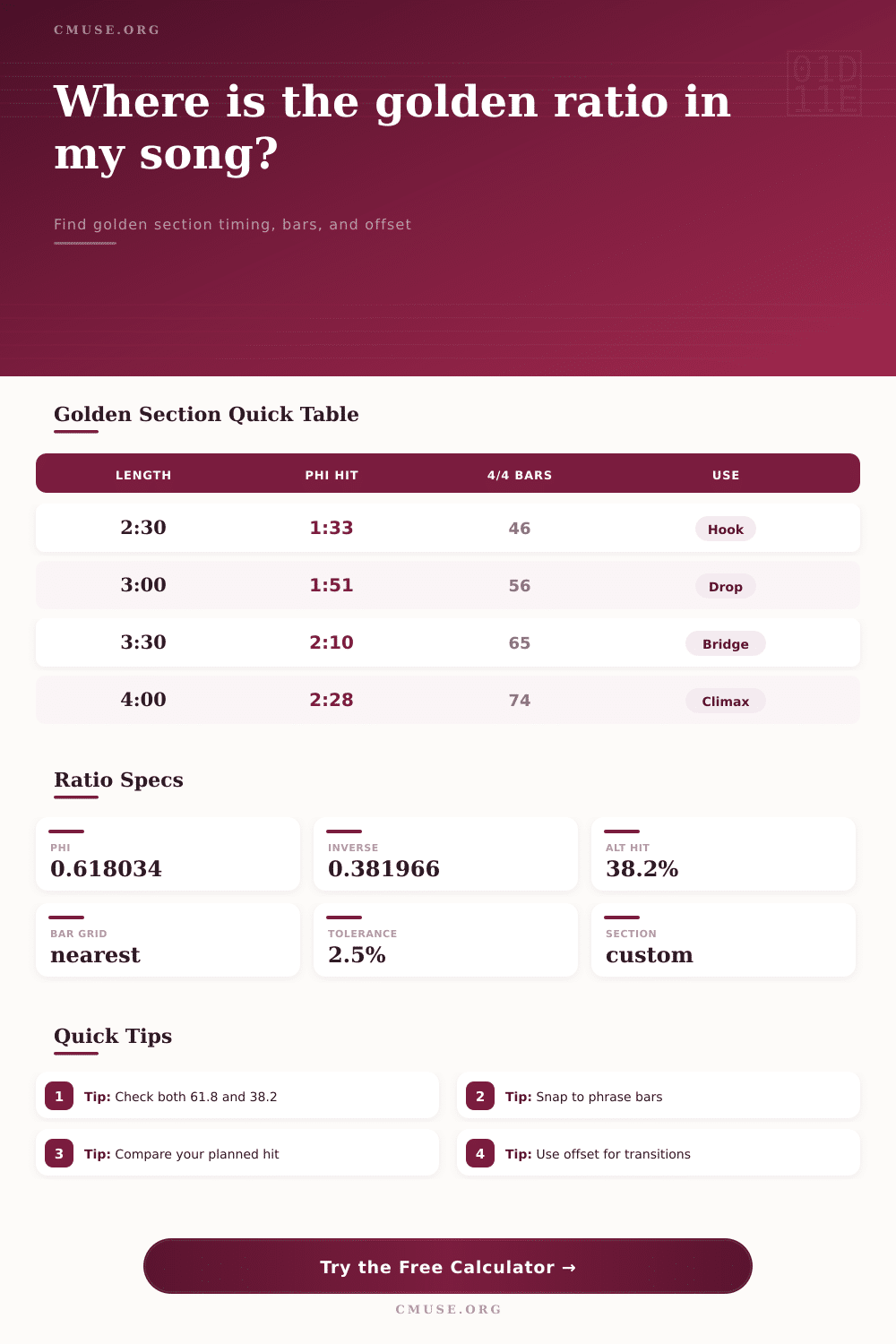
| 2:30 | 0:57.295 | 1:32.705 | Bar 47 | Fast hook return or short bridge |
| 3:00 | 1:08.754 | 1:51.246 | Bar 56 | Pop bridge, drop, or final hook |
| 3:30 | 1:20.213 | 2:09.787 | Bar 65 | Bridge into final chorus lift |
| 4:00 | 1:31.672 | 2:28.328 | Bar 75 | Solo peak, breakdown exit, or chorus |
| 4:30 | 1:43.131 | 2:46.869 | Bar 84 | Extended build or second drop |
| 5:00 | 1:54.590 | 3:05.410 | Bar 93 | Long-form climax or outro pivot |
| BPM | 4/4 Bar Length | 3:30 Golden Bar | 3:30 Phrase Snap | Arrangement Note |
|---|---|---|---|---|
| 72 | 3.333 sec | Bar 39.9 | Bar 41 on 4-bar grid | Ballad sections need fewer bars |
| 90 | 2.667 sec | Bar 49.7 | Bar 49 or 53 | Mid-tempo pop bridge range |
| 96 | 2.500 sec | Bar 52.9 | Bar 53 | Common final chorus setup |
| 120 | 2.000 sec | Bar 65.9 | Bar 65 | Dance-pop and rock grid |
| 128 | 1.875 sec | Bar 70.2 | Bar 69 or 73 | EDM drop often needs 8-bar snap |
| 174 | 1.379 sec | Bar 95.1 | Bar 97 | DnB phrasing usually favors 16-bar blocks |
| Ratio Point | Percent | 3:30 Time | 3:30 96 BPM Bar | Useful Section |
|---|---|---|---|---|
| Early mirror | 38.1966% | 1:20.213 | Bar 33.1 | First chorus, first drop, or early reveal |
| Midpoint control | 50% | 1:45.000 | Bar 43.0 | Middle-eight check or arrangement balance |
| Late golden hit | 61.8034% | 2:09.787 | Bar 52.9 | Bridge, final chorus, drop, or solo peak |
| Two-thirds energy | 66.6667% | 2:20.000 | Bar 57.0 | Modern pop final-hook entry |
| Three-quarter lift | 75% | 2:37.500 | Bar 64.0 | Last chorus variation or outro lift |
| Section Plan | Current Hit | Golden Difference | Phrase Fit | Reading |
|---|---|---|---|---|
| Planned climax | 2:10 | 0.2 sec late | On grid | Strong golden placement |
Many times when you are writing a song, you tend to lean on what you hear in your head to form a song. Then you find out that something sounds wrong about it. Maybe build up didn’t stretch long enough and the drop felt flat. Perhaps the bridge came too sooner.
Maybe you assume that’s just a personal preference. That is not necessarily the case. Math explains how music creates and releases tension, and it have nothing to do with guesswork.
Use Math to Make Better Songs
Effective song structure conforms to what’s known as golden ratio, a natural phenomenon that occurs in nature. What it means is that you reach the best bit of a song at certain percentages within its overall length. In the case of most songs, sweet spot happens roughly two-thirds (62%) of the way through.
No hard-and-fast philosophy here. It is just an awareness of when people tend to pay attention. Looking at the inputs to this calculation, the duration makes a bigger difference than you’d imagine. The golden moment in a five minute rock epic differ from one on a three minute pop track.
Consider actual duration of the music (intros count), but not dead air if it’s irrelevant. It also depends on tempo, which defines how long each bar lasts. It sounds bad if your golden hit doesn’t align with a bar. It is better if it snaps onto an eight-bar or perhaps a four-bar block that are commonly used as phrase boundary.
Once you enter your approximate start and stop times, the calculator do the math for you, converting those approximations into exact bars and saving you from having to do any mental dividing in the heat of creativity. It also shows how far off your intended hit is from that golden section ideal. That’s where the true decision making come in.
Is your bridge ten seconds too early? Does it feel like it lacks weight? Is it twenty seconds too late? Maybe the song drags on. And these are tiny changes, yet they change the emotional arc entirely.
A lot of producers obsess over one side of this golden ratio, the late mark at sixty-one point eight percent. What they neglect is its reflection, the thirty-eight point two percent mark. For those early drops and choruses, this first marker is ideal. It sets the pattern but doesn’t resolve it. This second part work with the first to create a balanced structure that sounds like it was meant to be there. It provides a familiar beat to the unexpected.
Consider genre convention too. For example, an EDM track may align to an eight-bar grid with a hard snap in place, ensuring that the drop lands squarely on a downbeat. In contrast, a piece of jazz may be more fluid and view the golden ratio as a sort of point of gravity around which the music moves but not necessarily as a direct line to follow.
This is all laid out clearly in the reference table alongside bar counts for popular song durations at different tempos. All that stuff is an aid, it’s not a ruler. You could totally break all those rules and make a great record. But it helps you know where the landmarks in the structure are so you can break the rules on purpose.
You change the tempo a little bit to line up the climax. You add a phrase to extend the intro. You shift bridge over by two bars. And it goes from a vague sense of unease to a solvable problem.
But it isn’t about making all of the songs fit into some mathematical formula. Rather, it’s about holding these ratios like a compass. So when something in an arrangement seem disconnected, you refer to the times. Or maybe the climax doesn’t feel powerful enough. Check the offset.
You’re creating a musical experience for the audience. Half of the challenge is making sure the arrival is on time. The other half is what you place along the way. And without a road, how can you appreciate the scenery?