Gauge Swap Tension Calculator
Compare a current string set against a proposed set by scale length, tuning, construction, gauge, unit weight model, and total pull before changing setup feel.
🎯 Gauge Swap Presets
⚙ Instrument And Model Inputs
Current Gauge Set
Proposed Gauge Set
Custom Open Frequencies
Manual Unit Weight Override
Calculation Breakdown
📊 Swap Snapshot Cards
Longer scale raises tension by the square of length.
Single-string peak that may drive feel and setup.
Difference between highest and lowest string tension.
Estimated or overridden unit weight for string 6.
🧵 String Set Comparison Grid
📋 Open String Gauge, Unit Weight, And Tension Table
| String | Open pitch | Current gauge | Current UW | Current tension | Proposed gauge | Proposed UW | Proposed tension |
|---|
📏 Gauge And Unit Weight Reference
| Gauge | Plain steel UW | Nickel wound UW | Phosphor bronze UW | 25.5 in E-standard example |
|---|---|---|---|---|
| .009 in / 0.23 mm | 0.000018 lb/in | Plain | Plain | E4 near 13 lb when plain |
| .010 in / 0.25 mm | 0.000022 lb/in | Plain | Plain | E4 near 16 lb when plain |
| .026 in / 0.66 mm | 0.000150 lb/in | 0.000120 lb/in | 0.000129 lb/in | D3 near 18 lb wound |
| .036 in / 0.91 mm | 0.000288 lb/in | 0.000230 lb/in | 0.000248 lb/in | A2 near 19 lb wound |
| .046 in / 1.17 mm | 0.000470 lb/in | 0.000376 lb/in | 0.000404 lb/in | E2 near 17 lb wound |
| .105 in / 2.67 mm | 0.00245 lb/in | 0.00160 lb/in | 0.00172 lb/in | E1 near 38 lb bass |
🎸 Common Set Tension Reference
| Set | Typical gauges | Scale and tuning | Typical total pull | Swap note |
|---|---|---|---|---|
| Extra light electric | 9 11 16 24 32 42 | 25.5 in, E standard | About 82 to 90 lb | Easy bends, lower downforce at the nut and bridge. |
| Regular light electric | 10 13 17 26 36 46 | 25.5 in, E standard | About 98 to 108 lb | Common baseline for comparing heavier swaps. |
| Medium electric | 11 14 18 28 38 49 | 24.75 to 25.5 in | About 108 to 124 lb | Often paired with lower tuning or firmer action. |
| Light acoustic | 12 16 24 32 42 53 | 25.4 in, E standard | About 150 to 170 lb | Bronze wounds carry more total load. |
| Medium acoustic | 13 17 26 35 45 56 | 25.4 in, E standard | About 175 to 195 lb | Check relief and top response after swapping. |
| Four-string bass | 45 65 80 100 | 34 in, E standard | About 150 to 180 lb | Long scale makes unit weight especially important. |
📐 Scale Length Tension Multiplier Table
| Scale length | Metric length | Versus 25.5 in | Same gauge effect | Common instrument context |
|---|---|---|---|---|
| 24.0 in | 610 mm | 88.6% | Looser for the same pitch and gauge | Short-scale electric or travel guitar |
| 24.75 in | 629 mm | 94.2% | Slightly easier bends than 25.5 in | Common short-scale electric |
| 25.4 in | 645 mm | 99.2% | Nearly the 25.5 in reference | Many steel-string acoustics |
| 25.5 in | 648 mm | 100% | Reference pull in this table | Common long-scale electric |
| 27.0 in | 686 mm | 112.1% | Noticeably tighter unless tuned lower | Baritone or extended-range guitar |
| 34.0 in | 864 mm | 177.8% | Bass gauges need very different unit weight | Standard long-scale electric bass |
🎵 Tuning Shift Tension Table
| Pitch change | Frequency ratio | Tension ratio | Practical reading |
|---|---|---|---|
| Up 1 semitone | 1.059 | 112.2% | A small pitch raise can feel like a full gauge step. |
| Down 1 semitone | 0.944 | 89.1% | Common way to offset an 10 to 11 swap. |
| Down 2 semitones | 0.891 | 79.4% | Often needs heavier strings to keep attack firm. |
| Drop only low string | Depends | One string only | Low string may need a heavier proposed gauge. |
| Capo at fret 2 | 1.122 | 125.9% | Equivalent pitch rise if retuned to the same open notes. |
It’s something we’ve all experienced: you grab a fresh pack of strings looking for that crisp definition and bright snap, only to tune up and realize your guitar has spent some time wedged into a vice. Before you can even play your first chord, the neck bend, the action increase, and your hands hurt. Most players is guilty of letting the gauge number be their sole guide; what they fail to notice is the underlying force that realy counts. It’s called tension.
Tension are the combined pull of each of those six string against the neck. It will change everything about playing an instrument. But it’s the why behind the numbers that keeps your rig in check, which is where a string tension calculator like the one at the top of this page come into play.
Why String Tension Matters for Your Guitar
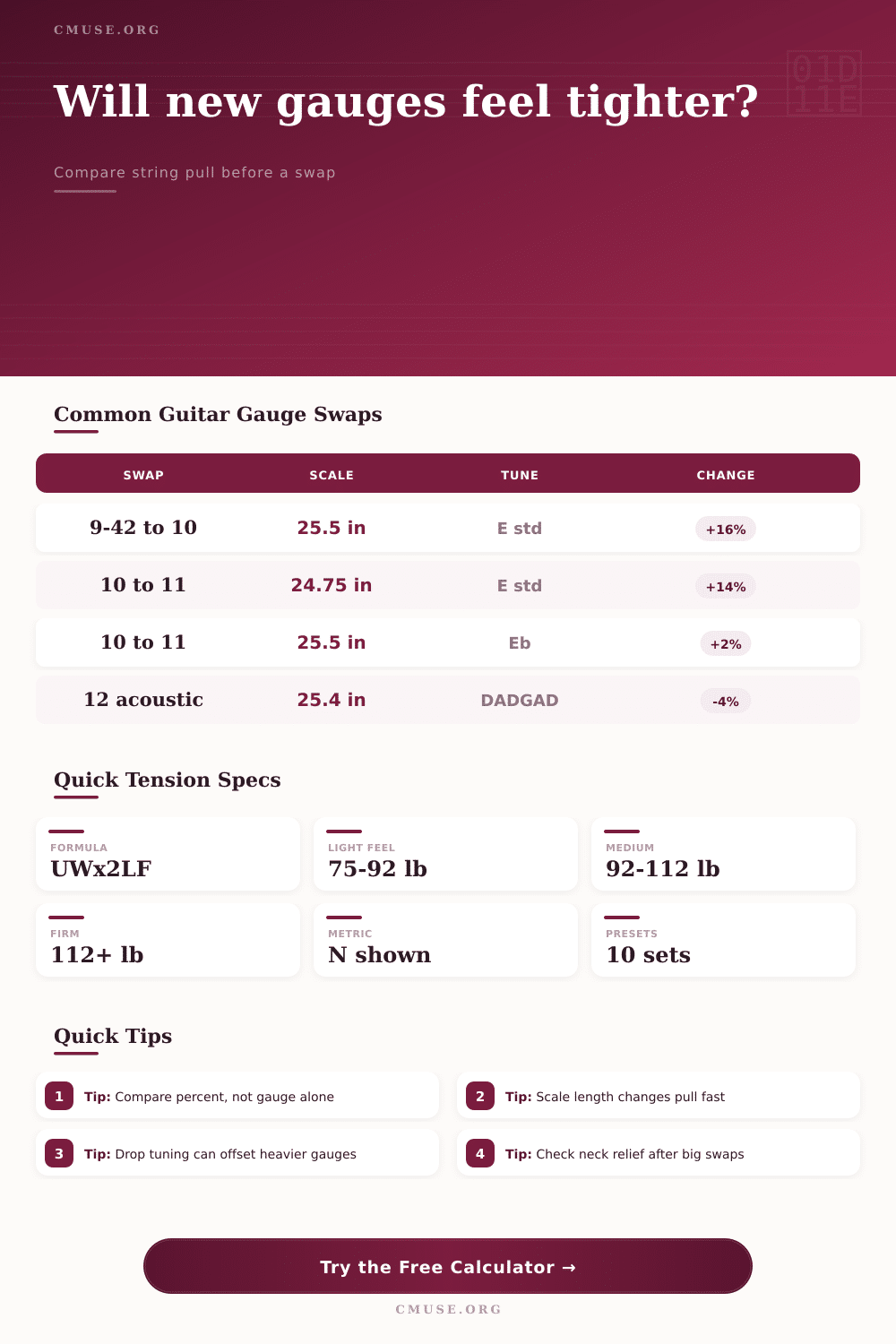
String tension is not simply a function of thickness; rather, it’s a three-way relationship: Gauge, pitch (which includes scale length). Change any one of these variables and the balance is broken. Many guitarists believe that moving from ten-gauge to eleven-gauge strings is a minor adjustment. And it can seem manageable…until they discover that string tension scale with the square of its length and frequency. Heavy gauges are amplified much more by a longer scale length than a short one. That’s also why baritone guitars must use thick strings not only for sound, but so that the tension doesn’t becomes too floppy.
On the flipside, a short-scale guitar can gets away with using lighter strings because its shorter length reduce the lever arm pulling on the nut. Diameter isn’t everything A steel flatwound and a nickel roundwound of equal diameter are not the same unit weight. Unit weight is the driving force behind the tension equation, which is why the calculator takes this into account.
For example, if you substitute your nickel wound strings with stainless steel without altering gauge size, you may notice an increase in pull. Why? Because it’s steel. And steel is heavier. It is not pound for pound, mind you, but per inch. More weight equal more tension at a given tune. Many players switching to stainless find themselves dropping to a lighter gauge set to compensate for the perceived change. At the same time, they enjoy the brighter sound of the metal. The calculator makes those kinds of comparisons because it estimates the unit weight of strings based off their construction. No need to remember what each type of string weigh per inch.
Another area of adjustment is tuning. Going down a half step drops your tension considerabley. This has become an increasingly popular tweak to lighten the feel while keeping the tonal depth of the higher gauge strings. You can drop your heavier string set a half step and end up in the same tension range that you would be playing a lighter set at standard pitch. That is why the tables on the page are so helpful; they illustrate how shifting pitches changes the amount of load.
It’s not simply a matter of producing the proper note. It’s also about controlling the structural stress applied to the instrument. Excessive tension will warp the neck over time if the truss rod isn’t correctly adjusted. Too little tension and you have buzzing and dead spots. Balancing strength with playability are the name of the game. Make sure to check the neck relief after any major swap.
The overall tension number may appear close, but sometimes how the tension is distributed over the strings will alter the feel. Adding some weight to the low E will create more down force on the saddle and potentially impact your intonation. A light high E could of being too loose for accurate bends. Don’t rely solely on the spreadsheet; use your ears and fingers for the outcome… It’s what you’ll have to live with.
The calculator provide a good starting point, but your fingers and ears ultimately makes the decision. Apply it as a preventative measure to avoid being surprised. Apply it as a tool to plan ahead for when you swap out strings so that you don’t end up with something you can’t play. And then go play.