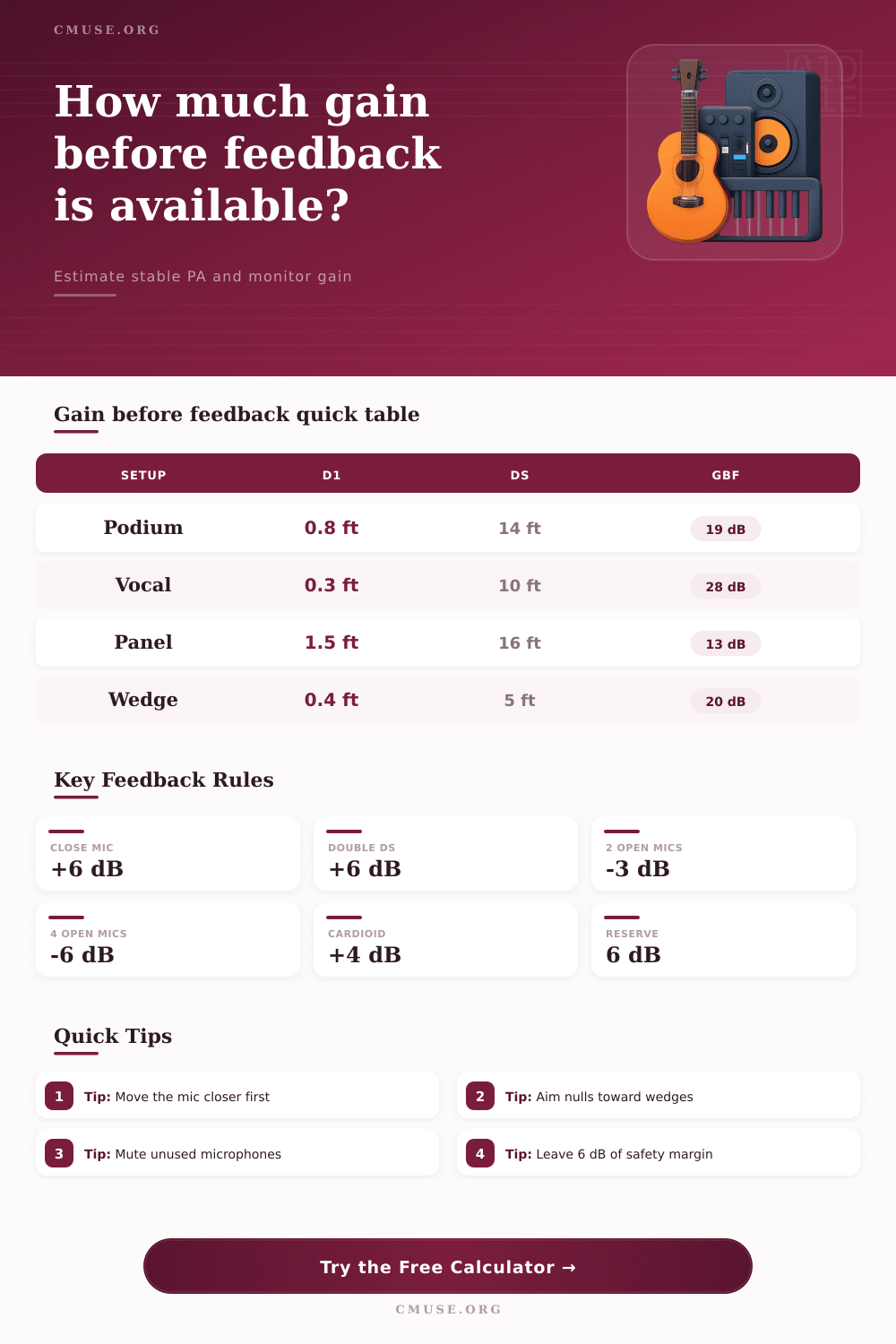
Gain Before Feedback Calculator
Estimate usable PA or monitor gain from source-to-mic distance, speaker-to-mic isolation, open microphones, pickup pattern, and room or EQ conditions.
Geometry matters most: closer microphones, greater speaker-to-mic distance, fewer open mics, and useful pattern rejection all raise stable gain before feedback.
Estimate uses a PAG-style distance relationship: 20 log10((D0 x Ds) / (D1 x D2)), then applies open-mic, pattern, room, and feedback-stability adjustments.
| Pattern | Calculator adjustment | Useful null area | Feedback note |
|---|---|---|---|
| Omnidirectional | 0 dB | None | Natural tone but least isolation from PA or wedges. |
| Subcardioid | +2 dB | Broad rear reduction | Useful when tone matters and speaker spill is moderate. |
| Cardioid | +4 dB | Rear of mic | Common handheld choice when the wedge is behind the mic. |
| Supercardioid | +6 dB | Rear-side nulls | Can help if wedges are placed off the rear axis. |
| Hypercardioid | +6.5 dB | Tighter rear-side nulls | Good isolation but rear lobe placement matters. |
| Short shotgun | +8 dB | Narrow pickup | Works only when the source stays inside the pickup angle. |
| Change | Approx GBF move | Why it works | Practical reading |
|---|---|---|---|
| Halve source-to-mic D1 | +6 dB | More direct source reaches the microphone. | Usually the strongest single fix for speech or vocals. |
| Double speaker-to-mic Ds | +6 dB | Less loudspeaker energy returns to the mic. | Move wedges, rotate mains, or increase physical spacing. |
| Double speaker-to-listener D2 | -6 dB | More system gain is needed at the audience position. | Long throws can need delays or better speaker placement. |
| Double open microphones | -3 dB | Added open channels raise acoustic loop gain. | Mute unused channels or use automixing when possible. |
| Add narrow feedback filters | +3 to +6 dB | Problem resonances are reduced. | Useful after placement and mic technique are already right. |
| Condition | Adjustment | Typical signs | Calculator use |
|---|---|---|---|
| Reflective room, little EQ | -6 dB | Hard surfaces, ringing, close walls, little tuning. | Use when feedback starts early across several frequencies. |
| Typical room, basic ringing out | -3 dB | Normal hall or club with a few broad EQ moves. | Good default for many PA and wedge estimates. |
| Treated room, careful placement | 0 dB | Controlled reflections and sensible speaker aiming. | Use when the room behaves predictably. |
| Narrow feedback filters set | +3 dB | Several precise notches after placement is fixed. | Represents extra usable gain from targeted filters. |
| Outdoor or very dry stage | +2 dB | Low room return but wind or stage spill may remain. | Use for open-air speech or music reinforcement. |
| Setup | Typical distances | Open mics | Expected reading | Best improvement |
|---|---|---|---|---|
| Podium speech | D1 0.75 ft, Ds 14 ft | 1 | Healthy if the loudspeaker is forward of the mic. | Keep the mic close and mains ahead of the lectern. |
| Lead vocal wedge | D1 0.3 ft, Ds 8 ft | 1 | Strong with good null aiming and controlled monitor EQ. | Put the wedge in the microphone rejection zone. |
| Panel discussion | D1 1.5 ft, Ds 16 ft | 4 | Often tight because open-mic penalty is large. | Use automix or mute inactive microphones. |
| Choir overhead pair | D1 4 ft, Ds 22 ft | 2 | Limited because the source is far from the mics. | Use fewer, closer mics and keep PA energy off the pickup. |
| Theater headset | D1 0.12 ft, Ds 18 ft | 8 | Close mic distance offsets many open channels. | Control inactive mics and keep lavs away from hats or hair. |
Gain before feedback is the amount of amplification that a persons can add to the audio system prior to the audio system create a feedback loop. A feedback loop occur when the microphone pick up the sound that is create from the loudspeaker, then the loudspeaker play that same sound that the microphone picked up. Thus, the sound continuously loops back and play at an increasing volume.
In order to understand the gain before feedback in a system, this value will help to determine an amount of volume that can be used during the performance. The physical placement of the microphone and loudspeaker within the system, as well as the number of open microphone and the acoustics of the performance room, impacts the gain before feedback. The distance between the microphone and the sound source will have a major impact on the gain before feedback for that system.
What is gain before feedback
If the technician moves the microphone closer to the sound source, the microphone will pick up more sound from that source, increasing the gain before feedback. For example, halving the distance between the mouth and the microphone will increase the gain before feedback by approximately six decibel. Additionally, the distance between the loudspeaker and the microphone will also impact the gain before feedback for the system; increasing the distance between the loudspeaker and the microphone will increase the gain before feedback for that system, because the loudspeaker will emit less sound into the microphone.
Another factor that will impact the gain before feedback of a system is the pickup pattern of the microphone. The pickup pattern for a microphone determine in which direction the microphone picks up sound, as well as in which direction it will ignore sound. For example, a cardioid microphone will ignore sound that comes from the rear of the microphone; in this way, the gain before feedback will increase if the loudspeaker is place behind the microphone.
Thus, while the microphone pickup pattern will not increase the volume of sound that the microphone captures, it can reduce the amount of sound from the loudspeaker that enter the microphone. The number of open microphones in the system will impact the gain before feedback of the audio system. Each additional microphone that is opened will increase the gain of the system, which will decrease the gain before feedback.
For example, if the number of open microphones is doubled, the system will lose the gain before feedback by approximately three decibel. Thus, systems that have many open microphones will have less gain before feedback than systems that have only one open microphone. One method of controlling the gain before feedback is to mute any microphone that are not being used during the performance.
The acoustics of the room in which the performance occur can also impact the gain before feedback of the system. Reflections is created when sound waves from the loudspeaker hit the walls or other objects in the performance room, and the sound reflect into the microphone. Thus, increasing reflections will increase the gain before feedback of the system.
Rooms that have many hard surfaces will exhibit many reflections; rooms with many reflections will have less gain before feedback. Rooms with soft surfaces, or rooms outdoors without any surrounding hard surface will have fewer reflections of sound into the microphone; rooms with fewer reflections will have more gain before feedback of the system. Equalization can be used to reduce feedback in a system; however, it is not a replacement for properly place the microphone and loudspeaker.
While the equalization settings can be used to remove the feedback created from specific frequency, the equalization cannot fix the problem created when the microphone is too close to the sound source. Loudspeakers and microphones should be physically positioned to create the maximum gain before feedback, and equalization can be used to fix the remaining, smaller problem in the system. By calculating the gain before feedback for the system, it is possible to understand if there is enough headroom for the sound in the system before feedback occur.
Providing enough headroom for the system will ensure that it remain stable during the performance.