Fret Offset Calculator
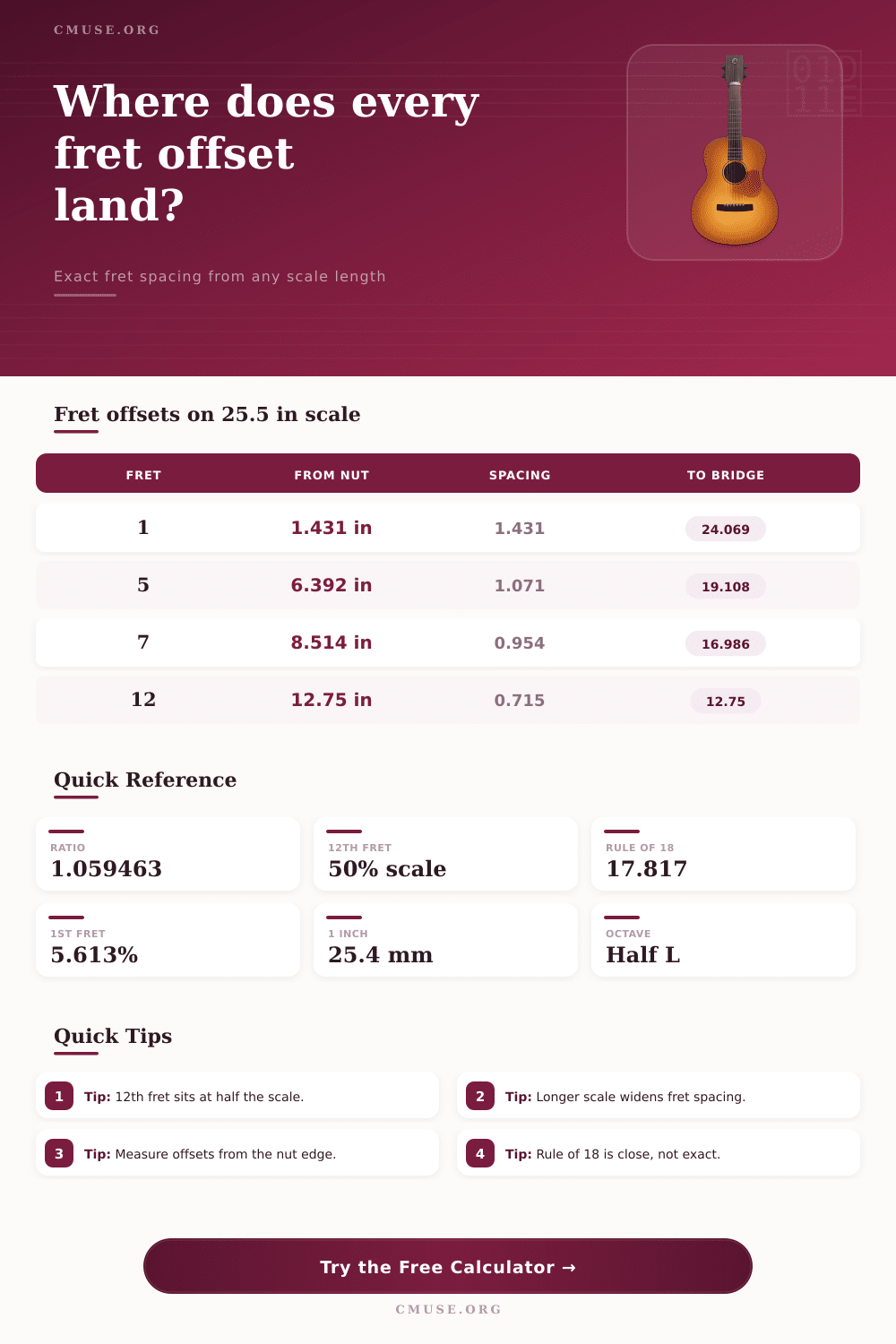
Find the exact distance from the nut to every fret, fret-to-fret spacing, octave placement, and the classic Rule-of-18 comparison for any scale length.
Fret Ratio
1.059463
12th root of 2
Rule Of 18
17.817
Divisor per remaining length
12th Fret
50%
Octave at half the scale
1st Fret
5.613%
Offset from the nut
| Instrument | Scale (in) | Scale (mm) | 12th fret (in) |
|---|---|---|---|
| Fender Strat / Tele | 25.5 | 647.7 | 12.75 |
| Gibson Les Paul | 24.75 | 628.7 | 12.375 |
| PRS | 25 | 635 | 12.5 |
| Fender Bass | 34 | 863.6 | 17 |
| Short-Scale Bass | 30 | 762 | 15 |
| Baritone | 27 | 685.8 | 13.5 |
| Soprano Ukulele | 13.5 | 342.9 | 6.75 |
| Tenor Ukulele | 17 | 431.8 | 8.5 |
| Mandolin | 13.875 | 352.4 | 6.938 |
| Classical Guitar | 25.6 | 650.2 | 12.8 |
| Fret | From nut (in) | From nut (mm) | Spacing (in) |
|---|---|---|---|
| 1 | 1.431 | 36.35 | 1.431 |
| 2 | 2.781 | 70.64 | 1.350 |
| 3 | 4.056 | 103.02 | 1.275 |
| 4 | 5.259 | 133.59 | 1.203 |
| 5 | 6.392 | 162.36 | 1.135 |
| 6 | 7.464 | 189.55 | 1.071 |
| 7 | 8.514 | 216.26 | 1.011 |
| 8 | 9.450 | 240.04 | 0.954 |
| 9 | 10.357 | 263.06 | 0.901 |
| 10 | 11.193 | 284.31 | 0.850 |
| 11 | 11.985 | 304.41 | 0.802 |
| 12 | 12.750 | 323.85 | 0.757 |
| Fret | Exact (in) | Rule of 18 (in) | Difference (in) |
|---|---|---|---|
| 1 | 1.431 | 1.431 | 0.000 |
| 5 | 6.392 | 6.388 | 0.004 |
| 7 | 8.514 | 8.510 | 0.004 |
| 12 | 12.750 | 12.748 | 0.002 |
| 17 | 15.875 | 15.876 | -0.001 |
| 19 | 16.917 | 16.918 | -0.001 |
| 24 | 19.125 | 19.124 | 0.001 |
| Fret # | From nut (in) | From nut (mm) | Spacing prev (in) | Spacing prev (mm) |
|---|
But even after all that time spent voicing your pickups, polishing the finish, and sanding the fretboard…you’re not entirely happy with how it’s playing in tune. If you’re one of those builders who trusts their eyeballs over there numbers, this is something you know all too well.
As we go further down the neck, the string distance from the nut to each subsequent fret decrease according to a very specific logarithmic decay (specifically: the twelfth root of two). That’s a lot of complicated math which is why there’s an instant answer here via some nifty exponential geometry. You’ll get exact measurements at any point along the neck without having to suffer through doing the trig yourself.
Why Fret Spacing Math Matters for Perfect Tuning
The rest of the design hang off this one factor, that’s right, the scale length. For instance, Gibson tends towards a twenty-four and three quarter inch scale while Fender has settled on twenty-five and a half for their classic Stratocaster. At the same tuning pitch, that half an inch make a huge difference in string tension. Heavier strings is needed for the same feel on longer scales. This improves clarity but can make bending harder. On shorter ones, the feeling are slinkier and finger-friendly, though floppiness may set in without upping the string gauge.
In the tool above, we’ve got some presets that will allow you to switch back and forth between these icons to see the relative change in fret positions from one tradition to another. Not all frets move equally away from this center line. The 12th fret is the great equalizer. It divides the scale in half; it’s the perfect octave. Dividing the scale like this make all the other frets fall off predictably in a curve.
There is a Rule of 18 that builders can use as a quick and dirty shop trick. You divide the rest of the string length by seventeen point eight one seven to calculate your next fret. Surprisingly it holds up pretty well down near the nut, but starts to drift significantly higher up the neck. The calculator has a reference table comparing this rule of thumb to the precise mathematical formula. What that shows is small fractional differences that accumulate over the span of two-dozen frets.
When you’re routing slots in a completed board with no wiggle room, those fractions counts. Since each fret added to the string will compound the error over time, precision isn’t negotiable. If your first fret placement is off even a fraction of an inch, there is a big pitch shift on the 12th. The entire instrument throw out of tune at higher register notes.
If your design require moving the entire grid up or down slightly from the zero point, you can use this tool to enter custom offsets for nut compensation. This is common in instruments with unusual bridge shapes or specially-tuned intonation schemes that differ than typical fixed-saddle designs. The fretboard can be thought of like a map, too, not simply a line of wire. Every position along it has a certain relationship to the open string by a given frequency ratio (i.e., the 12th fret is an octave, the 7th is a major third, etc.). Knowing those markers on the fretboard help give meaning to the seemingly random numbers that populate the output table. This isn’t just about putting metal down; it’s about representing sound in physical form.
And if you work in a metric world, where your calipers or tape measure are marked in millimeters, there’s a convenient option for converting back and forth so one unit doesn’t spoil a carefully laid out design. It’s a common error among many beginner luthiers; they spend hours tinkering with the action and string height but completely neglect the underlying geometry of the fret placement. There is nothing that can be done during the setup process if your neck was mathematically incorrect from the outset. You should of checked it before.
The calculator shows you the exact distances between every fret and the bridge, great for checking for symmetry and positioning inlays, too. It factors in how many frets there are in total as well, allowing you to easily calculate an extended-range instrument or shorter scale length. All this boils down to how to strike a balance between exact measurement and intuition. On one side you have solid mathematical reality; on the other, something crafted by human hands. What do you get? The tool gives you the one, so you can concentrate on the other.
Begin with your target scale length then measure where the octave falls halfway through, and let the generated coordinates guide your cutting. The numbers will only be worth something if you pay enough attention to applying them. If you set up the spacing correctly from the outset each note will ring true and what was once just wood and wire becomes something that actualy sings.