Frequency To Tension Calculator
Estimate string tension from an exact frequency in hertz, scale length, gauge or unit weight, material density, and construction factor.
🎯 Frequency And String Presets
⚙ Frequency To Tension Inputs
Calculation Breakdown
📊 Current String Specs
🎵 Instrument Comparison Grid
📈 Frequency Sweep Table
| Frequency Step | Hz | Ratio | Single String | Course Pull |
|---|
🔧 Gauge To Tension Table
| Gauge | Material Model | Same Frequency | Tension | Feel Band |
|---|
📏 Scale Length Tension Table
| Instrument Scale | Speaking Length | Frequency | Tension | Change |
|---|
📘 Reference Frequency And Tension Table
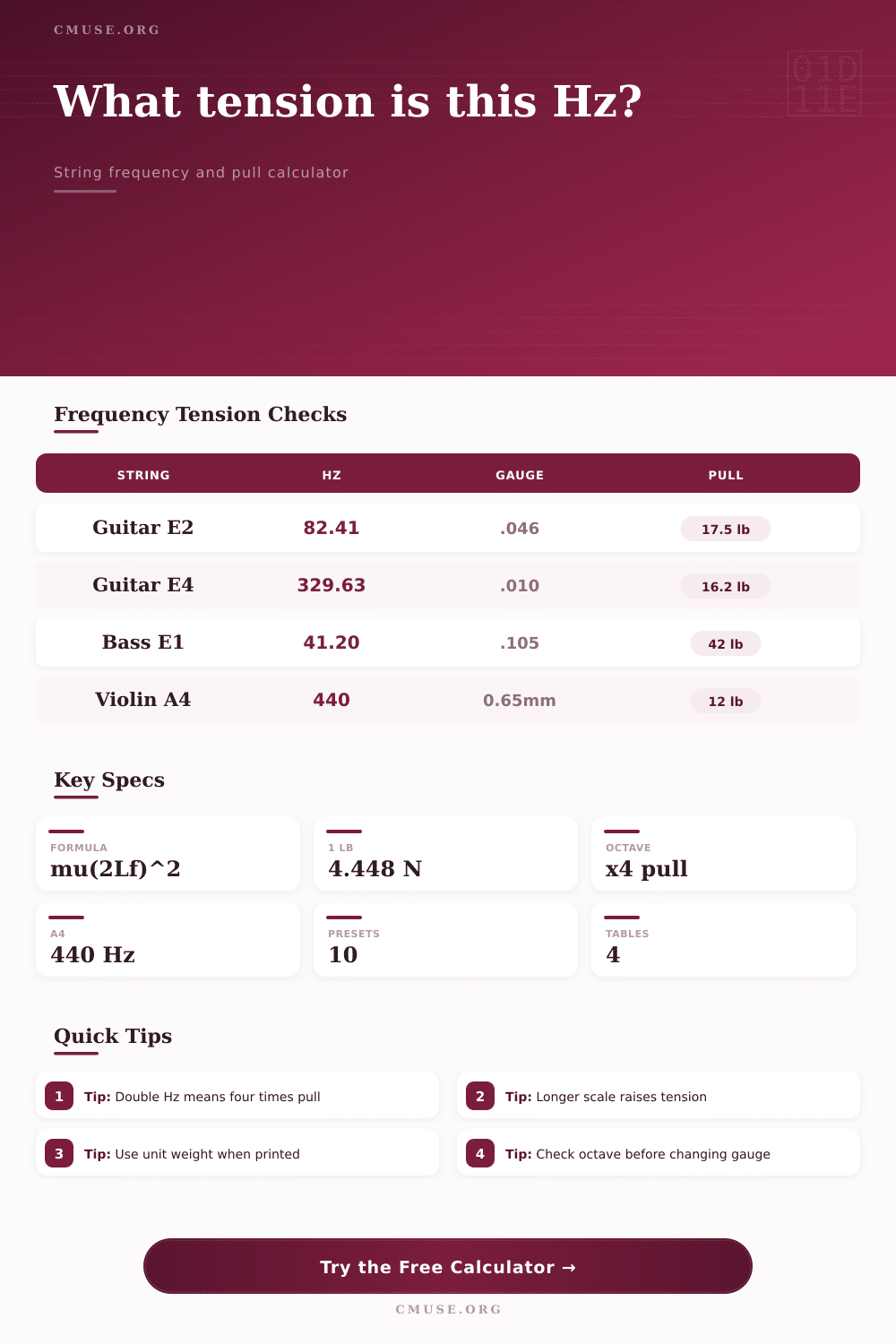
| Reference String | Frequency | Scale | Gauge | Estimated Pull |
|---|
💡 Practical Tension Tips
Few guitar players realy consider how much force is acting against the wood they’re plucking. Whether you are looking for the green light of a clip-on tuner or tuning by ear, this tension create not only the structure of the instrument but also its sound and playability. Every time you strike a high E on the highest string, you’re asking a piece of metal to resist just the right amount of tension so that it sings. Get it wrong and the instrument will fight back. Get it right and the guitar plays and sounds stable and clear.
So what do all these numbers mean? Once you know the frequency and scale length of your instrument, the calculator above figure out the rest for you, saving you from having to figure out the conversion factors and numbers that typically gets the best of even seasoned builders. It’s very simple.
How String Tension Works
Three variables affect how much tension a string have. How long is the string from the bridge to the nut The gauge of the string is how much it weighs per inch. What note you’re trying to sound So if you need a higher pitch with the same string gauge you just has to pull it tighter. To make something easier to play and reduce the tension you have two options, you can either lighten the string (change its gauge) or lower the pitch (and hence change the note). Most people don’t want to change their notes so change the gauge instead. It’s really about knowing what exactly you’re measuring.
Let’s take scale length. Consider the scale length of a Gibson Les Paul, which is roughly 24.75 inches. And that small number make all the difference. A shorter scale requires less string tension to play at the same pitch as a longer scale using the same string gauge. So what you can see is how many players experience Gibsons feeling slightly softer under their fingers, despite having the same set of strings.
Some examples show how different instrument compare by scale length. These references can be seen in this table. They make it clear how a standard guitar scales up against a violin or a bass. With the bass guitar, the strings is much thicker and the scale is much longer. This means the tension on the string increase greatly to make the note play low. Without that additional pull, it wouldn’t sit still and would produce nothing but a muddy thud instead of a well-defined note.
And then there’s the added complication of the density of the material. Nylon is light; steel is dense. If you use a nylon string on your guitar with the same diameter as a steel one, you’ll notice the tension have dropped significantly. This is because the nylon weighs far less than the steel string per inch. Classical guitars are designed to cope with a different type of load. Because of this, they has specific neck reinforcements and bridge design. This is due to the tension. Because you’re using a different material, the tension change dramatically.
The calculator allows you to choose the material: plain steel, nickel wound, fluorocarbon etc, and it will calculate the linear mass according to the known density of these materials. The key to the equation is knowing how much mass exists along a single unit of length, and it does this without making you Google the density of stainless steel…
But there’s a caveat when dealing with wound strings. If you only give the diameter, it assumes you are working with a solid rod. However, anyone who plays guitar or bass knows that those strings is actually wrapped around a core. Air exists between those wraps which means the string weighs less than a solid rod of equal diameter. That’s why we have the construction factor. It’s a multiplication number typicaly about 0.5 for most wound strings, but it accounts for the lack of mass in the string. Neglecting this will result in an overestimate of your tension by a significant amount. Always use the unit weight given on the package by the manufacturer. That takes into consideration the precise wrap density and core size of each individual string.
Changing strings is also about balance. How hard do you pull until it sounds right? Pull it hard enough to sing true and sound clear, but not so hard that you bend the neck or put extra pressure on the bridge. Going up a size to address intonation will add more string pull to the whole neck. Maybe the truss rod should of go back out to compensate. Before you even take off the existing set of strings, the calculator shows this give and take. Where is your starting point and where should you aim?
At the end of the day, what sounds good to your ears and fits in your hands is what matters. Numbers are simply the map. They give you the territory, yet you’re the one traversing it. Knowing what that real-world pull is on your neck enables you to make educated decisions whether you’re angling for a moddern precision set up or something more vintage. No more guesswork and now you’re engineering your sound. And that’s the true benefit of understanding the math behind the music.