Frequency Resonance Calculator
Compare string, pipe, Helmholtz, and LC resonance, then check pitch, wavelength, period, and bandwidth with one music-ready calculator.
🎵 Resonance Presets
⚙ Resonator Setup
String resonance inputs
Use these fields for guitar, bass, violin, or any stretched string where length, tension, and linear density control the pitch.
📊 Resonance Spec Grid
📖 Reference Tables
| System | Formula | Inputs | Use |
|---|---|---|---|
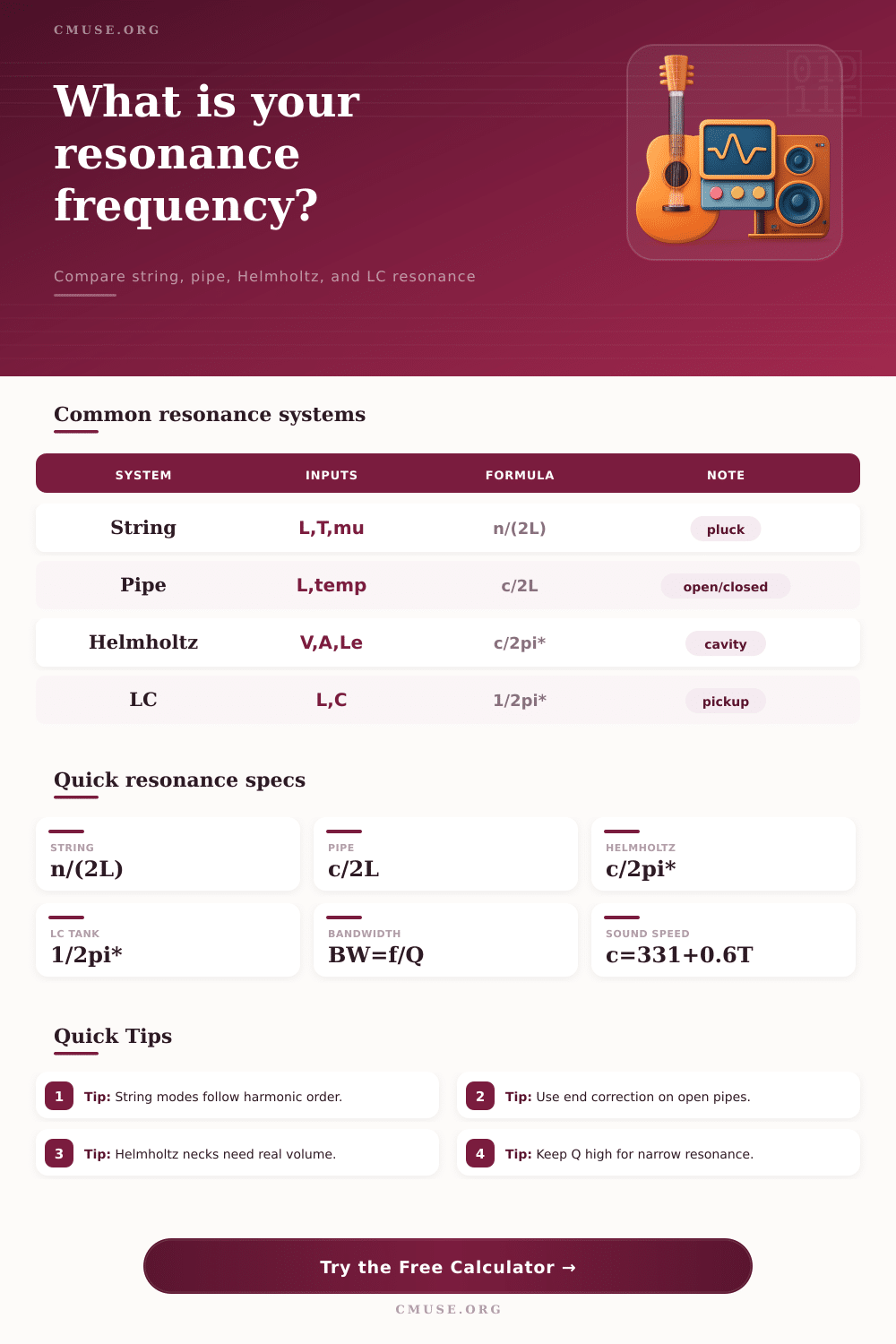
| String | n/(2L) * sqrt(T/mu) | Length, tension, density | Guitar, bass, violin |
| Pipe | n c / (2L) | Length, temperature | Flute, organ pipe |
| Closed pipe | (2n-1)c / (4L) | Length, temperature | Clarinet, horn |
| Helmholtz | c/(2pi) * sqrt(A/VL) | Volume, neck area | Port, box, vent |
| LC tank | 1/(2pi * sqrt(LC)) | L and C | Pickup peak, synth |
| Source | System | Typical pitch | Note |
|---|---|---|---|
| Concert guitar E2 | String | 82.4 Hz | Scale length target |
| Bass guitar E1 | String | 41.2 Hz | Longer scale, heavier string |
| Flute C5 | Open pipe | 523.3 Hz | Second harmonic example |
| Clarinet G3 | Closed pipe | 196.0 Hz | Odd modes only |
| Note | Open pipe | Closed pipe | Comment |
|---|---|---|---|
| C4 | 0.658 m | 0.329 m | Middle C region |
| G4 | 0.391 m | 0.195 m | Bright flute range |
| C5 | 0.329 m | 0.165 m | Octave above middle C |
| G5 | 0.196 m | 0.098 m | Short tube territory |
| Target | Inductor | Capacitor | Comment |
|---|---|---|---|
| 440 Hz | 470 mH | 0.28 uF | Concert pitch peak |
| 1.0 kHz | 100 mH | 0.25 uF | Midband test point |
| 2.5 kHz | 10 mH | 0.40 uF | Bright resonance |
| 4.2 kHz | 4.7 mH | 0.29 uF | Pickup-style peak |
💡 Practical Tips
Resonance are the process by which a vibration produce a sound. Resonance occurs when the frequencies of a vibration is matched to a physical objects. Resonance can be found in many different type of instruments and devices.
Changing the tension, length, volume, or electrical component of a device or instrument can manipulate resonance. Resonance does not occur magic within a device or instrument; rather, it is the result of physical science. One of the main ways in which resonance can be created within an instrument is through the use of string.
Resonance in Instruments and Devices
Strings create resonance in that the strings vibrates at a tension across a fixed length of the string. Changing the tension of the string, the mass of the string, or the length of the string can manipulate the pitch of a string. An increase in the tension of a string will increase the pitch of that string; the use of a thicker string will decrease the pitch of that string.
Additionally, decreasing the length of a string will increase the pitch of that string. Strings also create harmonics, which are the overtones of a string that creates a specific tone for that string. Air can also be used to create resonance within an instrument.
Air creates resonance within tube, such as those in flutes or other wind instruments. Within these tubes, air create standing waves. The air will determine the length of the tube by the wavelength of the standing wave created.
If the temperature of the air within the tube increases, the speed of sound increase. An increase in the temperature of the air will increase the pitch of the sounding tube, and a decrease in the temperature will decrease the pitch of the sounding tube. Additionally, closed pipes will produce different harmonic than open pipes, thus the type of pipe can impact the length of the pipe.
Helmholtz resonance can be used in devices with a certain amount of volume. Examples of these devices include bass port on speakers and bottles. The volume of the cavity will pull the frequency of the resonance created within that cavity down; the area of the neck of that cavity will push the frequency of the resonance within that cavity up.
If the area of the neck of that cavity are too small for that type of device, the airflow will be restrict. Airflow that is restricted will decrease the output of sound from that device. Because changes to the radius of the neck will significantly impact the frequency of the sound created by the device, an engineer must be precise in they calculations of the dimensions of those devices.
Resonance can also be created within electronic device in devices known as LC tanks. LC tanks use inductance and capacitance within the device to create resonance. Resonance within these devices will occur at a certain peak in the device in which the inductance of the device meets the capacitance of that device.
If the capacitance within an LC tank device are increased, the frequency of the resonance within that device will halve. The Q factor of the device regulates at what rate the frequency peak within the device. Higher Q factors indicate a more narrower, specific peak for the devices resonance, while lower Q factors will create a broader peak for the resonance within that electronic device.
In the creation of an instrument or device, an engineer will desire to establish a target frequency. Different mathematical formula will determine the physical components of the device required to reach that target frequency. For instance, an engineer can measure the linear density of the string to determine the correct string for the device or instrument.
An engineer can measure the volume of the cavity to determine the correct resonator for that device. Any error in measuring these components will result in devices with incorrect pitch for the target frequency. Thus, either a tuner or a spectrum analyzer (scope) can accomplish testing the frequency of the device.