FM Operator Ratio Calculator
Turn carrier-to-modulator (C:M) ratios and modulation index into real modulator frequency, sideband frequencies, harmonic vs inharmonic character and Carson bandwidth
Full Calculation Breakdown
| Sideband n | Lower (C - n·M) | Upper (C + n·M) | Bessel Order |
|---|---|---|---|
| — | — | — | — |
| C:M Ratio | Type | Harmonics Present | Character |
|---|---|---|---|
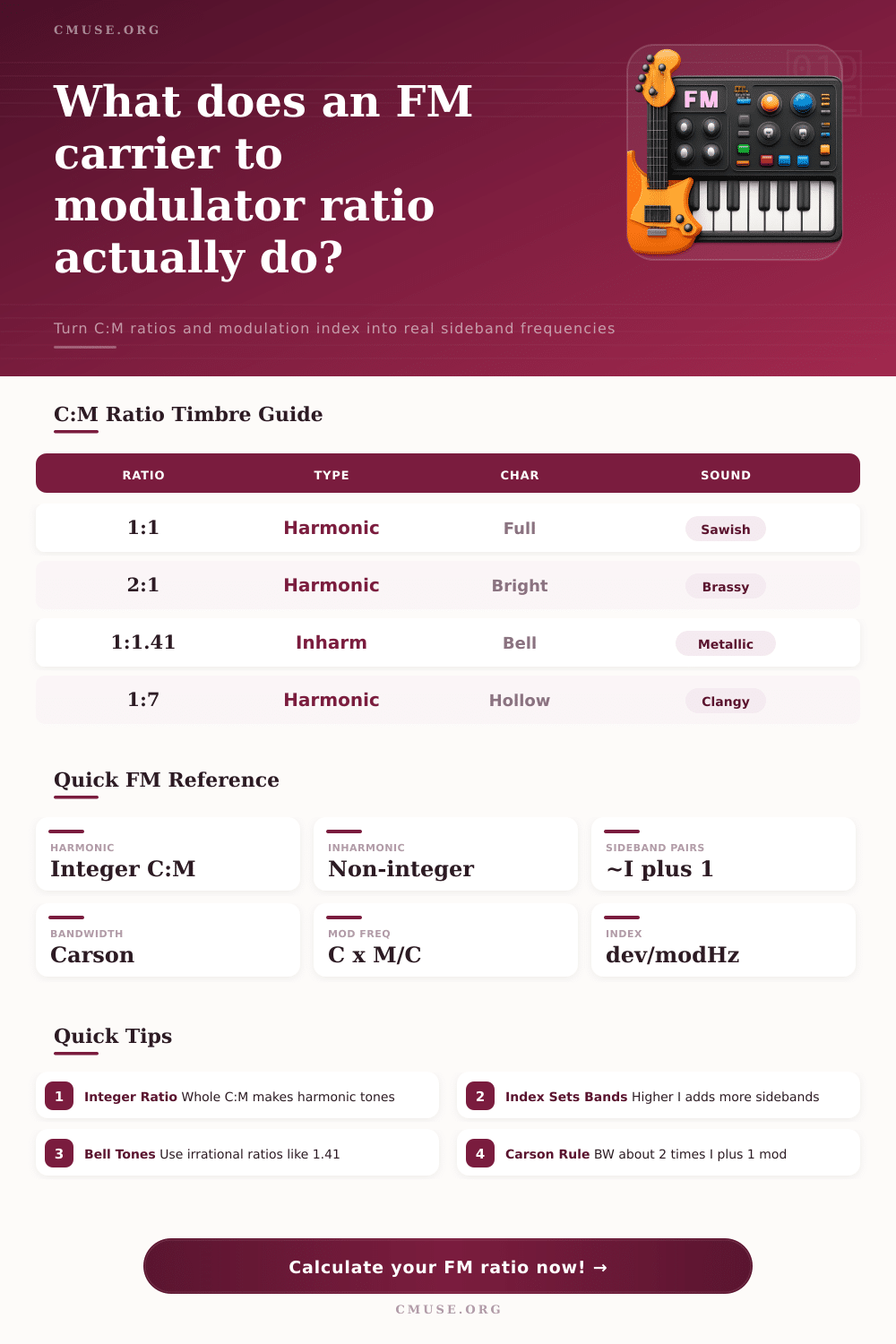
| 1:1 | Harmonic | All (1,2,3,4...) | Full, sawtooth-like |
| 2:1 | Harmonic | Odd + even, bright | Brassy, bright |
| 1:2 | Harmonic | Odd only (1,3,5...) | Hollow, square-ish |
| 3:2 | Harmonic | Sparse harmonic set | Clarinet / reedy |
| 1:1.41 | Inharmonic | Non-integer partials | Bell, metallic |
| 1:7 | Harmonic | Wide-spaced (7,8,6...) | Clangy, hollow |
| Index I | Significant Pairs (~I+1) | Brightness | Carson BW |
|---|---|---|---|
| 0 | 1 (carrier only) | Pure sine | 2 · mod |
| 1 | ~2 pairs | Mellow | 4 · mod |
| 2 | ~3 pairs | Warm | 6 · mod |
| 3 | ~4 pairs | Full | 8 · mod |
| 5 | ~6 pairs | Bright | 12 · mod |
| 8 | ~9 pairs | Very bright | 18 · mod |
| Sideband | 1:1 (mod 440) | 2:1 (mod 220) | 1:1.41 (mod 620) |
|---|---|---|---|
| Carrier | 440 Hz | 440 Hz | 440 Hz |
| +1 mod | 880 Hz | 660 Hz | 1060 Hz |
| -1 mod | 0 Hz | 220 Hz | -180 Hz (fold) |
| +2 mod | 1320 Hz | 880 Hz | 1681 Hz |
| -2 mod | -440 Hz (fold) | 0 Hz | -801 Hz (fold) |
| Property | 1:1 Harmonic | 1:1.41 Bell | Why |
|---|---|---|---|
| Ratio reduces | 1:1 integer | 100:141 irr. | Integer = harmonic |
| Partials | Integer multiples | Non-integer | Defines pitch clarity |
| Perceived pitch | Clear, fused | Ambiguous | Inharmonic blur |
| Typical use | Lead, bass, brass | Bells, mallets | Spectrum shape |
The concept of frequency modulation take this starting point for most synthesizers (a single oscillator) and turns it into a spectrum generator. Unlike simply pitching an oscillator upwards and downwards, in FM, modulator wave shifts the carrier frequency in real-time. That results in sidebands which are either harmonic or inharmonic based off how ratio is set. Two key numbers, carrier-to-modulator ratio and modulation index; can often make all the difference between a clean brass patch and something more chaotic and metallic.
To run the math for yourself go to the top of the page and enter the numbers into the calculator. But how do we make sound design choices with these numbers?
How to Use FM Synthesis Numbers for Sound Design
Your carrier frequency should be pitch around which everything turns (this is typically the pitch of the MIDI note you are trying to create). The modulator frequency is what dictate the position of sidebands. Using a simple ratio such as 1:1 will result in sidebands landing exactly on integer multiples of fundamental frequency. That gives you a harmonic spectrum that sounds musical. Often it sound like a sawtooth wave if you keep index low. Then every partial supports root note.
But if you change that ratio to an irrational number like 1:1.41, suddenly the math become different. Now the sidebands dont line up with the harmonic series. They become scattered throughout frequency range and produce metallic, bell-type sounds whose perceived pitches is unclear. This is where electric pianos/choirs sound like classical music. They are airy and complex. It’s all about adding texture using fractional ratios vs clarity of integer ones.
How to apply it? You don’t have to know your Bessel functions. Simply recognize that the higher the modulation index, the more energy will be distributed away from carrier. What does all this mean? The modulation index is basicly the size (volume) of the modulator signal compared to its frequency. If it has a small index (say 1 or 2), then most of energy stays near carrier. This produce only a few sidebands. These create a mellow tone. Increasing that index to 5 or more produces lots of additional sideband pair. These spread out across the spectrum, which creates lots of high-frequency content and makes your sound both complex and bright.
But they also consume bandwidth. To get an idea of how wide that spectrum will be, there’s Carson’s rule for you. It provides a rough estimate of spectrum width. This can be important if you are operating in a mix with little headroom or if you don’t want to much low-end to build up and create muddiness.
One trap that many new users fall into is using maximum indexes right away. They believe if they go loud enough it will sound more interesting, and while it may do that, sometimes very slight changes in ratio would of made an even larger difference than aggressive indexing. For example, moving from a 2:1 ratio to a 3:2 ratio could turn a brassy sounding lead into something with a reedy clarinet tone while leaving all other parameters unchanged.
Because it lists the actual sideband frequencies created for the settings used, you can see just what is going on. It can be eye-opening to see a number appear and realize some of them are actualy negative frequencies folding back around. That occurs with digital synthesis as it relies on sampling limitations.
FM synthesis is like drawing with light instead of stacking paint. Each operator adds a new layer of spectral complexity that interact multiplicatively with the previous layers. Stop thinking about waveforms and begin thinking about frequency relationships and it all makes sense. Relationship between index and ratio is identical whether creating an ethereal pad or hard-hitting bass. Use the supplied presets and listen to how small changes to these ratios dramaticly affect character. Then adjust to match what you need.
You’re aiming for controlled chaos that supports the music rather than simply noise. Begin with a straightforward harmonic base and add uneven tones selectively to add texture. This way your sound retains definition even through the complexities.