FM Modulation Index Calculator
Calculate FM beta, peak frequency deviation, sideband spread, and Carson bandwidth from RF or audio modulation values.
🎯Fast Presets
🎛FM Inputs
Used for occupied edge estimates around the center carrier.
Use the highest audio, tone, data, or LFO frequency that drives the FM signal.
Enter peak deviation, not peak-to-peak carrier swing.
Beta equals peak deviation divided by modulating frequency.
FM Calculation Results
Carson bandwidth is a practical engineering estimate and includes most of the FM signal power.
📊FM Formula Spec Grid
📻Common FM Systems
| FM Use | Typical Peak Deviation | Highest Modulating Frequency | Typical Beta | Carson Bandwidth |
|---|---|---|---|---|
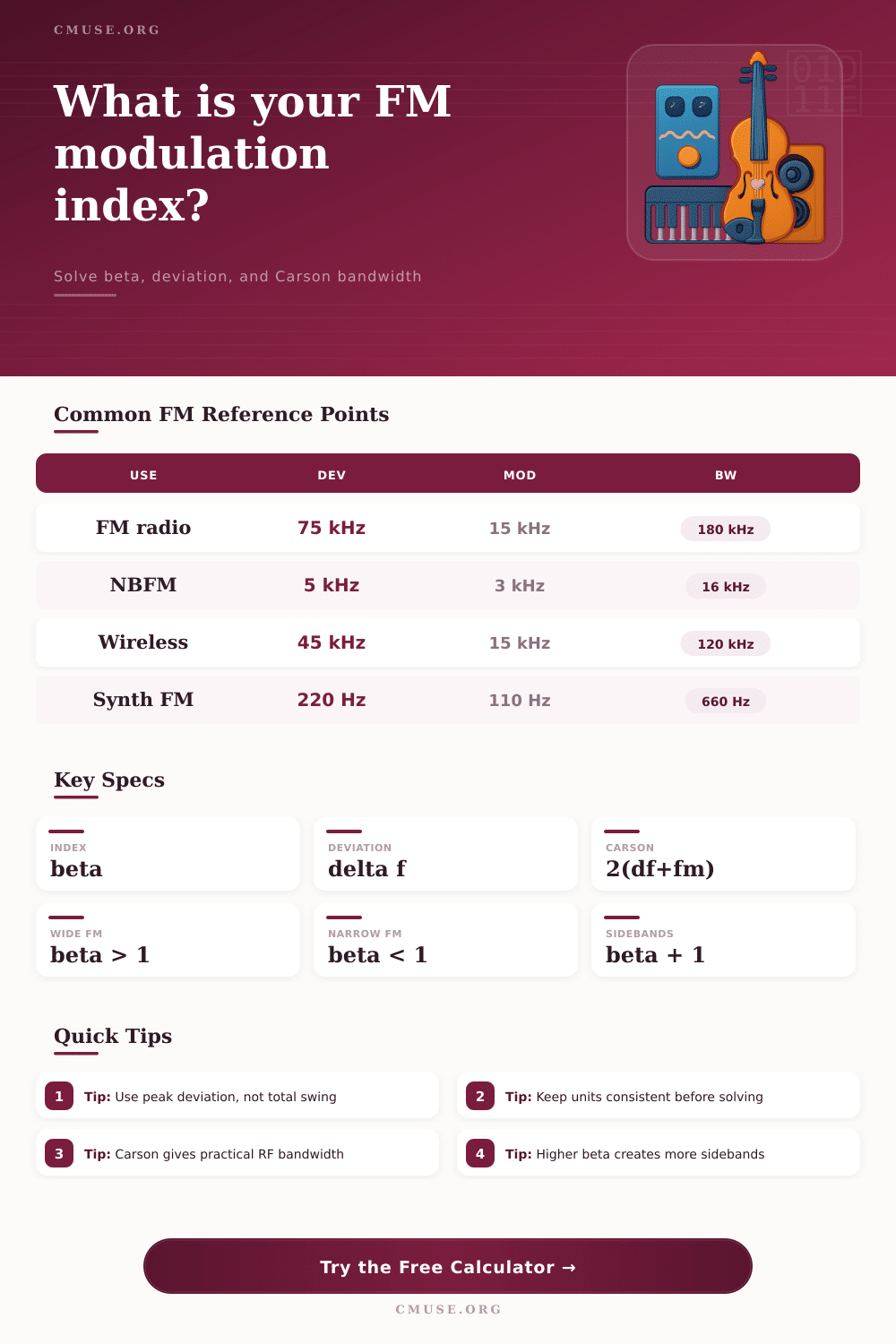
| FM broadcast audio | 75 kHz | 15 kHz | 5.00 | 180 kHz |
| Narrowband FM voice | 5 kHz | 3 kHz | 1.67 | 16 kHz |
| FRS or compact handheld voice | 2.5 kHz | 2.5 kHz | 1.00 | 10 kHz |
| Wide wireless microphone link | 45 kHz | 15 kHz | 3.00 | 120 kHz |
| Audio-rate synth FM patch | 220 Hz | 110 Hz | 2.00 | 660 Hz |
📐Modulation Index Interpretation
| Beta Range | FM Type | Spectral Behavior | Design Meaning |
|---|---|---|---|
| 0 to 0.3 | Very narrow FM | Carrier dominant, first sidebands small | Useful for small deviation tones and light vibrato |
| 0.3 to 1 | Narrow FM | First sideband pair carries much of the change | Good for controlled channel occupancy |
| 1 to 5 | Medium to wide FM | Several sideband pairs become significant | Common in voice links, wireless audio, and synth tone design |
| Above 5 | Wide FM | Many sidebands require wider channel planning | Check Carson bandwidth and adjacent-channel limits carefully |
🔀Formula Breakdown Table
| Quantity | Formula | When To Use | Unit Notes |
|---|---|---|---|
| Modulation index beta | β = Δf / fm | When deviation and modulating frequency are known | Dimensionless ratio |
| Peak deviation | Δf = β × fm | When target beta and modulating frequency are known | Same unit family as fm |
| Modulating frequency | fm = Δf / β | When deviation and beta are known | Highest modulating frequency, not carrier |
| Carson bandwidth | BW = 2(Δf + fm) | For practical occupied bandwidth estimation | Convert both terms before adding |
🎧Preset Reference Values
| Preset | Carrier | Deviation | Modulating Frequency | Expected Result |
|---|---|---|---|---|
| FM Broadcast Max | 99.5 MHz | 75 kHz | 15 kHz | Beta 5, Carson 180 kHz |
| NBFM Ham Voice | 146.52 MHz | 5 kHz | 3 kHz | Beta 1.67, Carson 16 kHz |
| Synth Bell FM | 440 Hz | 880 Hz | 220 Hz | Beta 4, Carson 2.2 kHz |
| Telemetry FM | 433.92 MHz | 4 kHz | 1.2 kHz | Beta 3.33, Carson 10.4 kHz |
💡Practical Notes
Frequency modulation are another method of signal modulation. FM rely on specific mathematical values to determine the signal’s behavior. The relationship between the deviation of the carrier frequency and the modulating frequency is called the modulation index.
The modulation index is also referred to as beta. You can calculate the modulation index by dividing the peak frequency deviation by the modulating frequency. This value display the information about how much the signal’s carrier frequency move in relation to the rate of the signal’s modulating frequency.
Modulation Index and FM Bandwidth
The value for the peak frequency deviation is the distance that the signal’s carrier frequency move away from its center point. The signal’s modulating frequency is the rate at which the signal’s carrier frequency move from its center point. A small modulation index show that the signal’s carrier frequency does not move too far from its original center frequency.
A large modulation index, however, indicate that the signal form many sideband. Many sidebands are created because the signal’s energy spread out over a large portion of the frequency spectrum. A large modulation index can create a rich sound in audio synthesis.
However, many sideband take up a large portion of the available bandwidth for broadcast communication signals. Another way of find the bandwidth of an FM signal is by using Carson’s rule. Carson’s rule is used to double the sum of the peak frequency deviation and the modulating frequency.
This value is an estimate of the signal’s bandwidth. While not an exact measurement of all of the signal’s sidebands, Carson’s rule provide a good indication of where most of the signal’s energy is located. The bandwidth of the signal is important to consider because it determine the amount of space that the signal will take up within the radio frequency spectrum.
By knowing the bandwidth of the signal, one can better plan the signal’s spectrum allocation for the avoidance of interference with other signal. The modulation index determine the number of sideband pairs that contain the signal’s energy. For modulation indices under one, most of the signal’s energy is contain within the carrier frequency.
The first pair of sidebands contain the energy radiated by the signal. For modulation indices in the range between one and five, many sideband pairs contain the signal’s energy. These frequencies is among the most common for wireless microphone system.
For modulation indices larger than five, the signal’s sidebands quickly fill the signal spectrum. This rapid filling of the spectrum can cause problems with regulatory filter. When calculating the modulation index, the frequency deviation must be the correct measurement.
The frequency deviation that should be used is the one-sided shift of the signal’s carrier frequency from its center frequency. The peak-to-peak frequency deviation should not be use. For instance, if a signal move 75 kHz above and 75 kHz below the center frequency, the frequency deviation is 75 kHz.
The one-sided shift should be used in all calculations of the modulation index. If the peak-to-peak value of 150 kHz is used instead, the modulation index will be calculated incorrect. The calculated index will not reflect the actual signal.
If the signal contain many different tone, the modulation index will use the highest frequency value. The highest frequency will create the widest spread in the signal spectrum. The highest frequency will determine the sidebands’ range of frequencies.
All lower frequencies will also create sidebands, but they will be within the range of the highest frequency. If the highest frequency is not use, the bandwidth will be underestimated. The underestimated bandwidth may lead to interference with other signal.
An understanding of the modulation index and Carson’s rule allow engineers to make design decision for the signal. The modulation index will allow the designer to determine the number of sideband that should exist within the signal. Carson’s rule will allow the signal designer to ensure that the signal take up the appropriate amount of bandwidth to fit within the allocated communication channel.
An understanding of the modulation index allow individuals to gain control over the sound created by a synthesizer. Additionally, an understanding of the modulation index allow engineers to gain control over the efficiency with which a radio signal transmit its information.