FM Modulation Calculator
Calculate modulation index, frequency deviation, Carson bandwidth, occupied range, and significant FM sidebands.
🎚FM presets
📻Signal inputs
Use peak deviation Δf, not total peak-to-peak carrier swing. Carson bandwidth is a practical occupied-bandwidth estimate, not a hard spectral cutoff.
🧮Core FM formulas
β = Δf / fm
Δf = β × fm
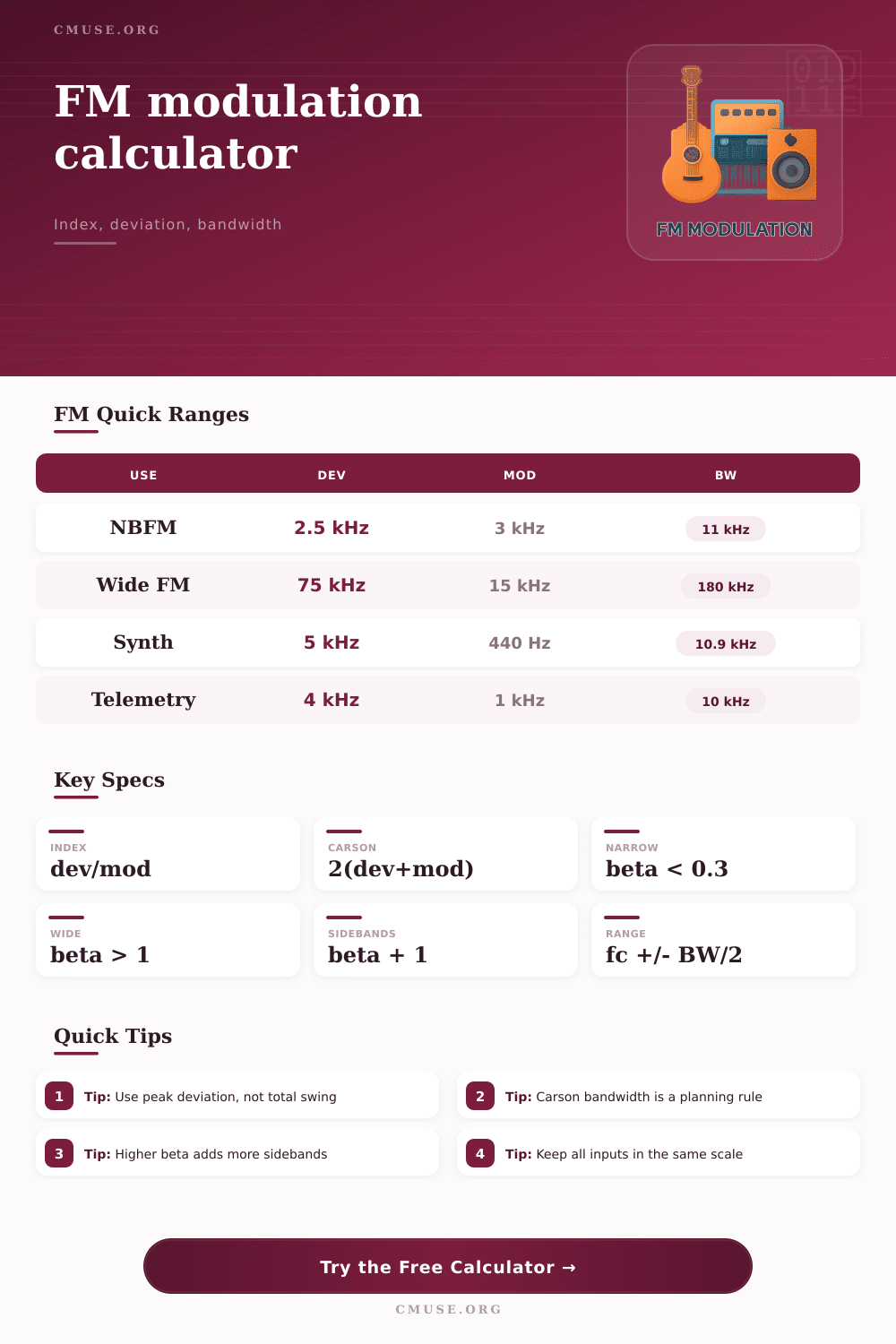
BW = 2(Δf + fm)
Lower = fc - BW/2, Upper = fc + BW/2
📊Current spectrum spec grid
📐FM index interpretation
| Index β | FM type | Typical spectrum | Use case |
|---|---|---|---|
| 0 to 0.3 | Narrowband approximation | Carrier plus first sidebands dominate | Small pitch vibrato, light telemetry, low deviation links |
| 0.3 to 1 | Moderate FM | Several audible sidebands appear | Expressive synthesis, compact radio channels |
| 1 to 5 | Wideband FM | Many sidebands shape tone and bandwidth | FM synthesis tones, audio program links, richer spectra |
| Above 5 | Very wide FM | Broad spread, Carson planning becomes important | FM broadcast, sound design, large-deviation tests |
📡Common FM reference scenarios
| Scenario | Carrier | Peak deviation | Rule-of-thumb bandwidth |
|---|---|---|---|
| Commercial FM broadcast audio | 88 to 108 MHz | 75 kHz | About 180 kHz for 15 kHz audio by Carson rule |
| Narrow voice communication | VHF or UHF channel | 2.5 kHz | About 11 kHz for 3 kHz voice audio |
| Analog wireless microphone | VHF or UHF carrier | 25 to 50 kHz | Varies with audio limit and companding system |
| Audio-rate FM synthesis | Any oscillator pitch | Set by modulation depth | Sidebands extend at integer multiples of fm |
🎛Preset comparison table
| Preset | fc | fm | Δf and expected result |
|---|---|---|---|
| FM Broadcast Stereo | 100.1 MHz | 15 kHz | 75 kHz deviation, β = 5, Carson BW = 180 kHz |
| Narrow Voice Radio | 146.52 MHz | 3 kHz | 2.5 kHz deviation, β = 0.83, Carson BW = 11 kHz |
| VCO Vibrato Patch | 440 Hz | 6 Hz | 5 Hz deviation, gentle pitch movement with low audio spread |
| Bell FM Synthesis | 440 Hz | 660 Hz | 3300 Hz deviation, β = 5 for bright inharmonic tone |
🌊Estimated sideband amplitudes
| Order n | Frequency offset | Bessel amplitude Jn(β) | Relative note |
|---|---|---|---|
| 0 | Carrier | -0.178 | Carrier component |
| 1 | ± 15 kHz | -0.328 | First pair |
| 2 | ± 30 kHz | 0.047 | Second pair |
| 3 | ± 45 kHz | 0.365 | Third pair |
| 4 | ± 60 kHz | 0.391 | Fourth pair |
| 5 | ± 75 kHz | 0.261 | Fifth pair |
💡Calculation tips
The modulation index is an value that describes the relationship between the peak deviation and the modulating frequency. To calculate the modulation index, the peak deviation of a signal are divided by the modulating frequency of that signal. The modulation index determine the shape of the signal, as well as how much bandwidth that signal will occupy.
High value of the modulation index will result in wide signals that contain many sideband, whereas low values of the modulation index will result in narrow signals that contain few sidebands. Sideband are additional frequencies that are create around the carrier frequency. The sidebands contain the multiples of the modulating frequency, and the more sidebands that are created the more higher the modulation index.
Modulation Index and FM Bandwidth
For FM broadcast transmitters, the peak deviation is 75 kHz and the modulating frequency are 15 kHz, resulting in a modulation index of five. Five is a high modulation index that create many sidebands and consumes a wide bandwidth of that signal. The Carson rule is an established method for calculating the occupied bandwidth of FM signals.
To use the Carson rule, the peak deviation of the signal is add to the modulating frequency. The sum is doubled, and a small guard band is added to that value. The Carson rule is a helpful guideline for FM engineers, though it is only an estimate of the bandwidth of the signal.
FM broadcast transmitters uses the Carson rule to ensure that the signal occupies a bandwidth of 180 kHz. Unlike FM broadcast transmitters, land mobile system use VHF and UHF bands, and have to be narrow in bandwidth. To achieve these narrow bandwidths, the peak deviation is limited to 2.5 kHz, and the modulating frequency is limited to under 3 kHz.
These low values of both parameters of land mobile systems will keep the modulation index of those signals to near one. The narrow bandwidth of land mobile systems allows for many user to share the same repeater pair; the narrower the bandwidth, the less interference that occurs between user of that system. FM synthesis use the modulation index to create different type of sounds.
Additionally, FM synthesis uses the sidebands that FM modulation creates as the basis of the synthesized sounds. One control for FM synthesis is adjusting the brightness of a sound. Brightness is controlled by the modulation index; high values of the modulation index create inharmonic sounds.
High modulation indexes create many sidebands that contain sound that a person can hear. There are different methods to estimate the bandwidth of FM signals. Each method have a specific use.
The Carson rule is used as the default method for calculating bandwidth because it is simple and safe to use. The narrowband approximation method is an alternative method, but only if the modulation index are low. Finally, the sideband count method is another technique for estimating bandwidth.
This method involve summing the Bessel components of the signal until the amplitude falls below a threshold value. Peak deviation unit can cause errors in the bandwidth calculations. For instance, if the peak to peak swing of a signal is 10 kHz, the peak deviation is 5 kHz.
If the 10 kHz value is entered into the bandwidth calculation instead of the 5 kHz peak deviation value, the resulting calculation will be incorrect. All frequency values should be of the same unit to ensure accuracy in the calculation. The simple formulas for FM signals do not account for guard bands and regulatory mask.
A 10 percent guard factor can be used in the calculation of bandwidth to account for extra bandwidth that may be needed by the channels. The local regulator establishes the final regulatory mask. Thus, the bandwidth calculator indicate the parameters of the signal, but must be modified for consideration of external limits.
The Carson rule does not remain accurate if the modulation index is higher than twelve. Such high values of the modulation index indicate that there are many sidebands in the signal. The Carson rule will understate the true bandwidth that is occupied by those sidebands.
Additionally, high values of the modulation index indicate the potential for adjacent channel interference with other signals in that bandwidth. The calculator displays a warning in these situations, as the Carson rule is beginning to approach its limit. The mathematics for calculating the modulation index are independent of the carrier frequency.
The modulation index is applied whether to a 100 MHz FM station or a 440 Hz audio synthesizer. The result of a high modulation index will, however, differ based on the application of that FM signal. High modulation indexes result in loudness of signals from FM radio transmitters, but create inharmonic sounds from FM synthesizers.
Thus, the calculator provides the numbers, but the user must decide which are the most important for they application.