🎵 Flute Measurement Calculator
Calculate tube length, tone hole spacing, embouchure size & bore dimensions for any flute pitch
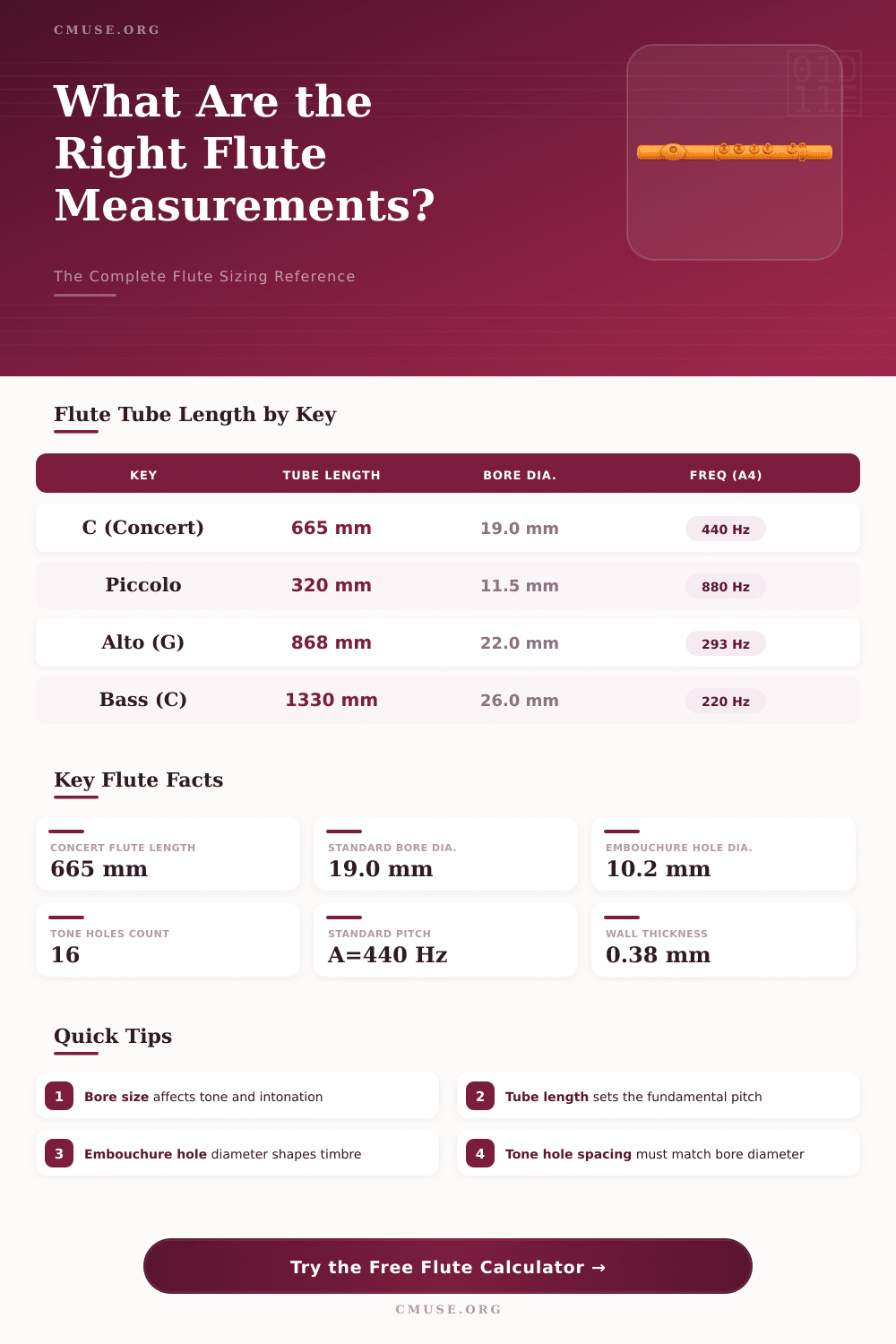
| Flute Type | Tube Length (mm) | Bore Dia. (mm) | Emb. Hole (mm) | Fundamental (Hz) |
|---|---|---|---|---|
| Contrabass C | 2660 | 35.0 | 16.0 | 55.0 |
| Sub-Bass C | 1864 | 30.0 | 13.5 | 110.0 |
| Bass C | 1330 | 26.0 | 11.8 | 220.0 |
| Alto G | 868 | 22.0 | 11.0 | 293.66 |
| Tenor G | 721 | 20.0 | 10.5 | 195.99 |
| Concert C | 665 | 19.0 | 10.2 | 440.0 |
| Irish D | 585 | 18.5 | 10.0 | 587.33 |
| Sopranino F | 466 | 15.5 | 9.5 | 698.46 |
| Piccolo C | 320 | 11.5 | 8.2 | 880.0 |
| Hole # | Note | Distance from Emb. (mm) | Diameter (mm) | Chimney (mm) |
|---|---|---|---|---|
| 1 | D5 | 168.5 | 8.5 | 4.8 |
| 2 | E5 | 224.3 | 8.5 | 4.8 |
| 3 | F5 | 250.8 | 8.5 | 4.8 |
| 4 | G5 | 298.6 | 8.5 | 4.8 |
| 5 | A5 | 347.9 | 8.5 | 4.8 |
| 6 | B5 | 390.1 | 8.5 | 4.8 |
| Material | Density (g/cm³) | Wall Thickness (mm) | Tube Weight per 100mm (g) |
|---|---|---|---|
| Silver (925) | 10.36 | 0.38 | 23.1 |
| Nickel Silver | 8.70 | 0.40 | 20.7 |
| Gold (9k) | 14.0 | 0.35 | 29.4 |
| Platinum | 21.45 | 0.30 | 38.3 |
| Copper | 8.96 | 0.40 | 21.3 |
| Grenadilla Wood | 1.28 | 4.00 | 29.0 |
| Bamboo | 0.70 | 3.50 | 14.5 |
| PVC Plastic | 1.38 | 2.50 | 20.3 |
The length of flute have big everything, especially when one buys used instrument from old store or online. One can get good idea about the tone size of the scale if one measures the whole distance from one end to the other. This called “tone length” shows one of the centre of the mouth hole to the most far part of the flute.
Those tools for Flute measurement help to show what happens during the playing of flute.
How Flute Length Affects Sound
The usual concert flute forms a round air column with diameter of around 66 cm. Its basic tone is middle C, and it reaches a range of almost three octaves upward to C7. The measures range between 65 and 70 cm, according to the size of the foot joint and according to that, if the flute is in C or B. It is made up of three parts: the headjoint, the body and the foot joint.
Tapered flute with round headjoint and narrowing body, that has tone length of about 580 mm, are C-flute. It sounds in A=440 hertz with a bit of correction of the headjoint. On the other hand, the most small common flutes are the piccolo and the fife, both around 30 cm long.
The half length makes the sound of piccolo doubly higher. Each octave doubles the needed length.
The bass flute sounds one octave under the concert flute. Its tube length doubles too 146 cm, what is around 57 inches. It requires J-shaped bend for bring the mouth hole in reaching distance.
Although it calls bass flute, it no truly is bass, because the most of its range sits at middle C. Bigger flutes, as the alto, the bass and the contrabass, requires more breath for play, because of their bigger diameter and length.
For younger pupils, flute with curved headjoint work best because of the short arm. The child plays on full big flute according to the finger spacing. The lip plate has the same size as at straight head model.
The body of the flute decides the length of the vibrating air column. The frequency ties directly to that distance. The position of the plug in the headjoint also changes the sound, because it indeed extends the air column.
The ideal ratio of length to inner diameter for tube flute is around 21:1. Smaller tubes work for high sounding flutes and piccolos, while biggertubes help to play lower notes.
The shakuhachi is another interesting flute. Almost all advise to start with 1.8 size, that is around 54.5 cm long and sounds in C. Shorter flutes give higher tones. Starting with such size helps to find songs and teachers more easily, because many use the same key.