Flute Length Calculator
Estimate open-pipe flute tube length from note frequency, bore diameter, temperature speed of sound, embouchure correction, foot end correction, and tuning offset.
🎶 Named Flute Presets
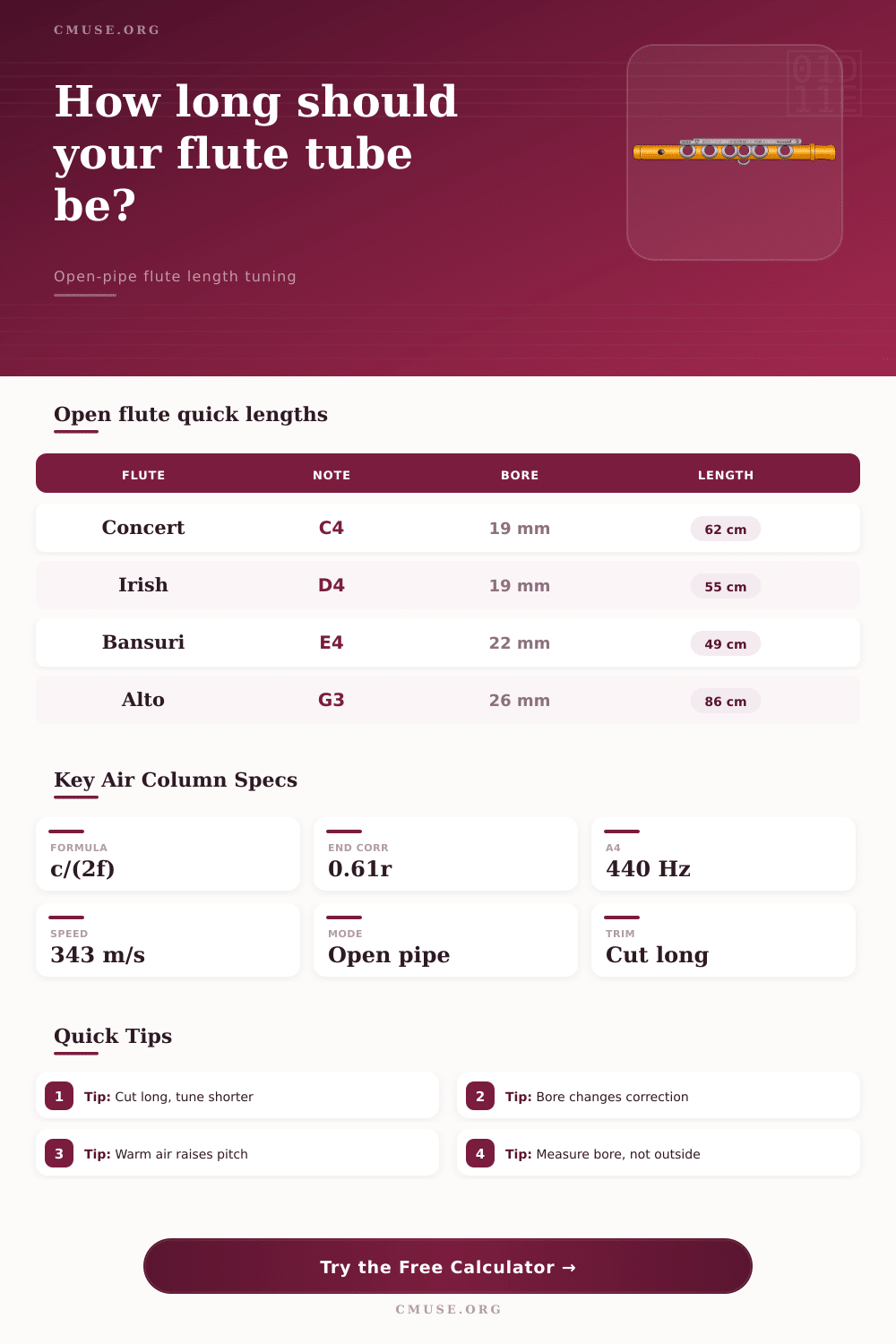
This calculator uses the open cylindrical pipe relation L effective = c / (2f), then subtracts open-end corrections to estimate physical tube length before final hand tuning.
⚙ Bore, Note, and Air Inputs
🎚 Scale Length Preview
| Step | Note | Frequency | Effective Length | Tube Length | Blank Length | End Correction |
|---|---|---|---|---|---|---|
| Calculate to generate note-by-note open-pipe lengths. | ||||||
📊 Open-Pipe Formula Snapshot
📏 Bore Reference Table
| Flute Type | Typical Bore | Wall / Chimney | Common Fundamental | Build Note |
|---|---|---|---|---|
| Concert C flute | 19.0 mm / 0.748 in | 0.9 mm metal tube | C4 with C foot | Cylindrical body with headjoint correction |
| Irish simple-system D | 18.5-19.5 mm | 3-5 mm wood | D4 | Large holes and taper can alter final tuning |
| Bansuri bamboo E | 20-23 mm | 2-4 mm bamboo | E4 or G4 | Natural bore is rarely perfectly round |
| Native American flute | 16-22 mm | 4-7 mm wood | F#4, G4, A4 | Window and slow-air chamber add corrections |
| Shakuhachi / xiao | 20-26 mm | 3-7 mm bamboo | D4 or G4 | Notched rim uses a different head correction |
| Alto flute | 26.0 mm / 1.024 in | 1.0-1.3 mm tube | G3 | Large bore needs generous correction |
| Bass flute | 32-38 mm | 1.2-1.6 mm tube | C3 | Very long effective air column |
| PVC practice flute | 20-25 mm | 2-3 mm pipe wall | D4 to G4 | Measure actual pipe ID before cutting |
🌡 Speed of Sound Reference
| Air Temperature | Approx Speed | Pitch Effect | Length Effect |
|---|---|---|---|
| 10 C / 50 F | 337.4 m/sec | Cooler air sounds flatter | Shorter length for same target pitch |
| 20 C / 68 F | 343.4 m/sec | Common room reference | Baseline calculator default |
| 25 C / 77 F | 346.4 m/sec | Warmer air sounds sharper | Longer length for same target pitch |
| 30 C / 86 F | 349.4 m/sec | Outdoor heat raises pitch | Add length or tune at playing temperature |
⚖ End Correction Factors
| Opening Condition | Radius Multiplier | Where Used | Meaning |
|---|---|---|---|
| Plain open end | 0.613 r | Foot end | Standard unflanged pipe correction |
| Rounded or rolled edge | 0.70 r | Foot end | Slightly larger acoustic extension |
| Flanged / thick ring | 0.82 r | Foot end | Large lip acts closer to a flanged pipe |
| Side oval embouchure | 0.55 r | Head opening | Useful approximation for side-blown flutes |
| Notched rim | 0.45 r | Head opening | Sharper blowing edge with less correction |
| Duct / fipple window | 0.75 r | Head opening | Window and duct add acoustic length |
🎼 Common Flute Length Comparisons
| Instrument | Fundamental | Bore Range | Approx Corrected Length | Best Use |
|---|---|---|---|---|
| Piccolo-style tube | D5 to C5 | 11-13 mm | 27-31 cm | High bright experiments |
| Concert C body | C4 | 18.5-19.5 mm | 61-63 cm | Standard flute reference |
| Irish low D body | D4 | 18.5-20 mm | 54-57 cm | Simple-system D flute planning |
| Bansuri mid E | E4 | 20-23 mm | 48-51 cm | Bamboo side-blown layout |
| Alto G tube | G3 | 25-27 mm | 85-88 cm | Low transverse flute planning |
| Bass C tube | C3 | 32-38 mm | 124-128 cm | Large folded or curved designs |
Making a flute requires the flute maker to first make a decision regarding the length of the flute tube. The length of the flute tube will determine the lowest note that can be played on the flute. Each of the steps after the flute tube is cut will be affected by the length of the flute tube, so it is critical that the flute maker create the flute tube of the correct length.
Many people may believe that the length of the flute is a simple measurement of the length of the flute from end to end. However, the length of the flute actualy includes the length of the airs inside the flute, the temperature of the environment in which the flute will be played, and the openings at the ends of the flute tube. The physics of an open tube of cylindrical shape will dictate the behavior of the flute.
How to Choose the Right Flute Length
The length of the flute will dictate the frequency of the air inside the flute. The flute maker will have to make the flute shorter than the length that would be required if the flute were made of a simple open tube. Each of the openings at the ends of the flute will add an extension to the length of the flute; that extension is referred to as the end correction.
The radius of the flute will determine the correction at the open end of the flute, and how the player will blow into the flute will determine the correction at the embouchure end. These end corrections will change if the flute is built with a different diameter of flute tube, or if the flute is built with a different shaped embouchure opening than the other flutes in that flute makers collection. Each of these variables will impact the length of the flute that the flute maker needs to cut from the flute tube.
The temperature of the flute will impact the pitch of the flute; warm air travels at a faster rate then cooler air. Additionally, the humidity of the air will also impact the pitch of the flute; moist air is less dense than air that dont contain as much moisture. The flute calculator allow the flute maker or player to enter the expected humidity and temperature of the air in which the flute will be played.
By entering these variables, the flute maker can calculate the proper speed of sound that the flute will create in that environment. The diameter of the flutes bore will impact the length of the flute, and will also affect the flutes tone. The radius of the flute will factor into the flute length calculation.
A wider bore will result in shorter flute; a narrower bore will produce a brighter sounding flute. A narrow flute bore will allow for more precise placement of the tone holes on the flute. The shape of the flute makers embouchure will impact the length of the flute.
An oval opening is made for side-blown embouchures, and each shape will impact the length of the flute in different ways. Flutes with different shaped embouchures will require different lengths of flute for the flute to produce the correct pitch. The flute calculator allows the flute maker to select the type of embouchure that will be used to play the flute; this will impact the length of the flute that the flute maker must use for cutting the flute tube.
The condition of the foot end of the flute may also impact the length of the flute. Plain open tubes, rolled edges, and flanged rings has different impacts upon the length of the flute. Each of these modifications to the flute foot end are small in relation to the length of the flute, but each of these features has a large impact upon the pitch of the flute if it isnt accounted for during flute construction.
Flute makers may choose to cut the flute tube longer than the length that the flute calculator calculates, and to trim the flute once the head joint and tone holes are completed. A trimming allowance must be made for the flute; it is difficult for any person to cut the flute to the exact length that is required. By making an allowance for the flute maker to trim the flute once it is nearly complete, the flute maker can adjust the pitch of the flute to ensure that it reaches the proper pitch.
The length of this allowance should of be made in consideration for the changes in the flute that may occur due to the bore diameter, the effect of temperature, and the influence of embouchure. An allowance for trimming can be made that is conservative in relation to the number of adjustments that will be required to the flute once the tone holes are drilled. Due to the way that real flutes are constructed, the flute will never be an open cylindrical pipe.
The tone holes at the flute will impact the pitch of the flute. While the flute calculator will provide the flute maker with the length of the flute that will produce the correct pitch for the flute when the flute is constructed as per the flute makers plans, that calculated length will not account for the effect that each tone hole will have upon the flute. Therefore, flute makers must use this length as the first measurement of the flute.
The flute maker will cut and trim the flute tube until the flute reach the proper pitch.