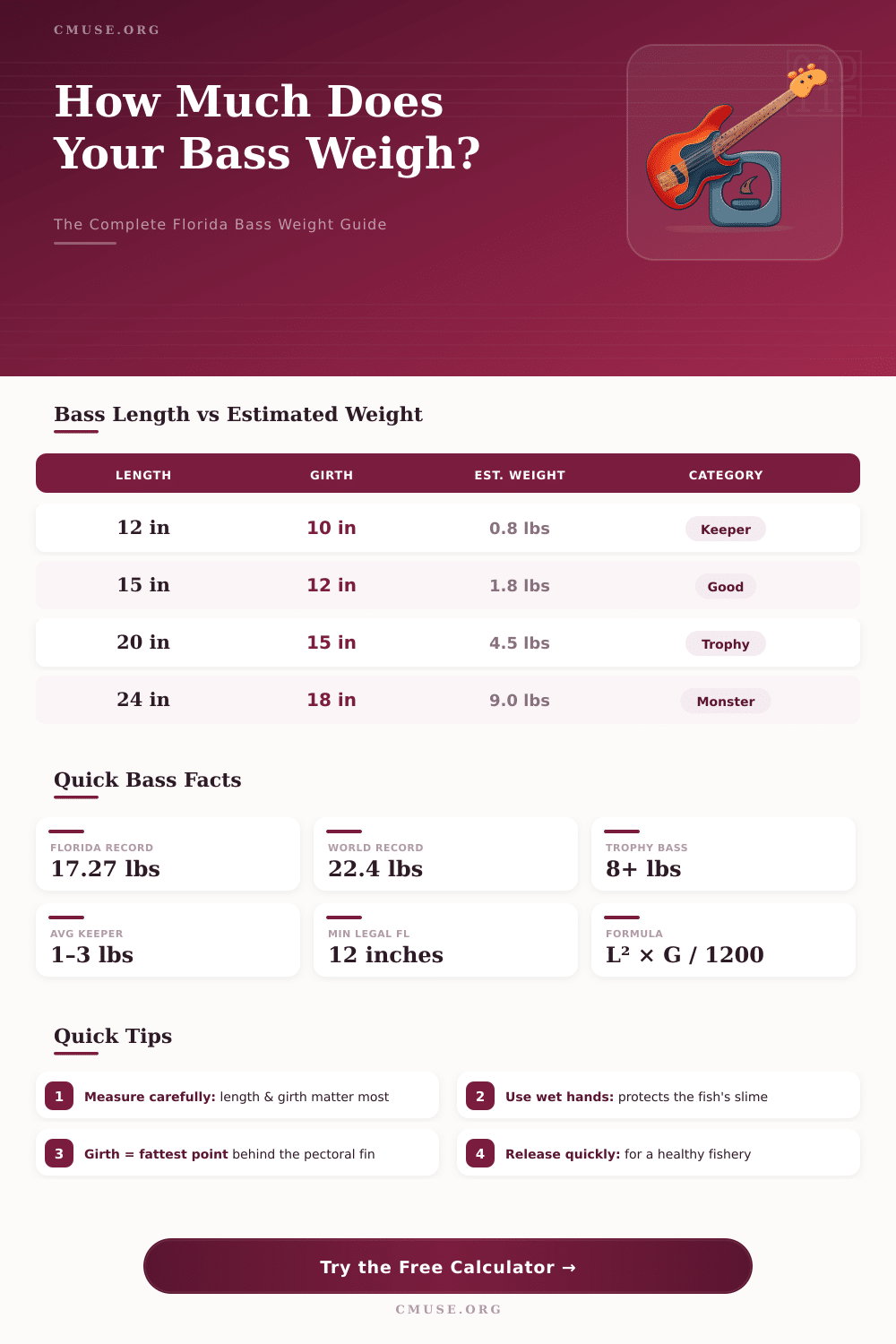
🐟 Florida Bass Weight Calculator
Estimate largemouth bass weight from length & girth measurements — imperial & metric supported
| Length (in) | Length (cm) | Avg Girth (in) | Est. Weight (lbs) | Est. Weight (kg) | Category |
|---|---|---|---|---|---|
| 10" | 25.4 cm | 8.5" | 0.60 lbs | 0.27 kg | Sub-Legal |
| 12" | 30.5 cm | 10.0" | 1.00 lbs | 0.45 kg | Keeper Min |
| 14" | 35.6 cm | 11.5" | 1.54 lbs | 0.70 kg | Good Keeper |
| 16" | 40.6 cm | 13.0" | 2.25 lbs | 1.02 kg | Nice Bass |
| 18" | 45.7 cm | 14.5" | 3.18 lbs | 1.44 kg | Above Average |
| 20" | 50.8 cm | 15.5" | 3.99 lbs | 1.81 kg | Quality Bass |
| 21" | 53.3 cm | 16.0" | 4.48 lbs | 2.03 kg | Quality Bass |
| 22" | 55.9 cm | 16.5" | 4.99 lbs | 2.26 kg | Big Bass |
| 23" | 58.4 cm | 17.0" | 5.55 lbs | 2.52 kg | Big Bass |
| 24" | 61.0 cm | 17.5" | 6.13 lbs | 2.78 kg | Trophy Class |
| 26" | 66.0 cm | 19.0" | 7.84 lbs | 3.55 kg | Trophy Class |
| 28" | 71.1 cm | 20.5" | 9.78 lbs | 4.44 kg | Monster Bass |
| 30" | 76.2 cm | 22.0" | 12.10 lbs | 5.49 kg | Monster Bass |
| Formula | Equation | Best For | 20" / 15" Result |
|---|---|---|---|
| Standard | L × G² / 1200 | Average Florida Bass | 3.75 lbs |
| Florida Strain | L × G² / 1050 | Fat Florida Strain Bass | 4.29 lbs |
| Shore Thin | L × G² / 1400 | Slender / Post-spawn | 3.21 lbs |
| Length³ Only | L³ / 1800 | No girth available | 4.44 lbs |
| Category | Weight | Typical Length | Typical Girth |
|---|---|---|---|
| Minimum Keeper (FL) | — (12" min) | 12" / 30.5 cm | ~10" / 25.4 cm |
| Quality Bass | 2–4 lbs | 16–20" | 12–16" |
| Big Bass | 4–8 lbs | 20–24" | 16–18" |
| Trophy Bass | 8+ lbs | 24–27" | 18–21" |
| Monster Bass | 10+ lbs | 27"+ | 21"+ |
| Florida State Record | 17.27 lbs | ~30" | ~23" |
| World Record (CA, 2006) | 22.4 lbs / 10.2 kg | ~32" | ~25" |
| Ratio (Girth/Length) | Typical Value | Interpretation | Suggested Formula |
|---|---|---|---|
| Below 0.55 | <0.55 | Very Thin / Spawned Out | Shore Thin / 1400 |
| 0.55 – 0.65 | ~0.60 | Below Average Condition | Standard / 1200 |
| 0.65 – 0.75 | ~0.70 | Average Florida Bass | Standard / 1200 |
| 0.75 – 0.85 | ~0.80 | Above Average (Fat) | Florida Strain / 1050 |
| Above 0.85 | >0.85 | Excellent Condition | Florida Strain / 1050 |
One commonly talks about weight of bass, whether about fishing or music. For Florida Bass it is possible to estimate the weight of fish without using a heavy scale beside the water. A good way for that is to use a formula based on measures.
One measures the length, squares it, then multiplies by the girth and shares the result by 1 200. The length and girth one measures in inches, and the result comes in pounds. The girth simply is the middle of the fish body at the thickest place.
How to Find the Weight of a Bass Fish or a Bass Guitar
There are also online calculators, that one can use: enter the length and girth, and it gives a rating. Such tools work well, because they are based on data about typical bass types. Usually the length one takes as total length, from the mouth tip until the tail end.
Some programs fully ignore the girth and only use length for the chart. A normal 22-inch bass weighs around 6.21 pounds. Maybe you chase a 20-inch one, that reaches almost 7 puonds on the scale.
Seasons affect more than many folks assume. Female bass, that are ready to lay eggs, bear extra weight, so the ratings can adjust to make up for that.
Relative weight gives a fresh viewpoint. To count it, one shares the real weight by the standard weight for that length and multiplies by 100. For instance, a 20.5-inch bass weighing 4.2 pounds, that compares with the typical weight for such size.
The heaviest recorded Florida Bass Weight already reached 22.25 pounds, seized by George Perry in 1932 from Montgomery Lake beside Valdosta in Georgia. For start, one estimates bass wait in around 3 pounds. In cold north areas, “lunker” means something above 5 or 6 pounds.
Why does one bass weigh more than another of the same length? Diet and physical shape plays a role. Some fish simply are naturally thick.
An 18-inch bass could come in at almost 9 pounds, if it truly is thick, while another of the same length barely reaches half of that.
In the bass guitar world, weight talk is totally different. Jazz and Precision models weigh average between 8 and 9 pounds, although some heavy versions pass 10. The Hofner Ignition Club bass is one of the most lightweight, at a bit more than 5 pounds.
Fender Mustang bass weighs around 7.5 pounds. Bass guitars almost always weigh more than average guitars, those long necks add a lot of mass. Around 8.5 pounds seems the limit for comfortable playing during a whole concert.
If you already played lightweight basses at around 8 pounds, something above 9 starts feeling clearly more heavy. Wellpadded body helps against that, and interestingly, lightweight instruments commonly get praise because of richer sound.