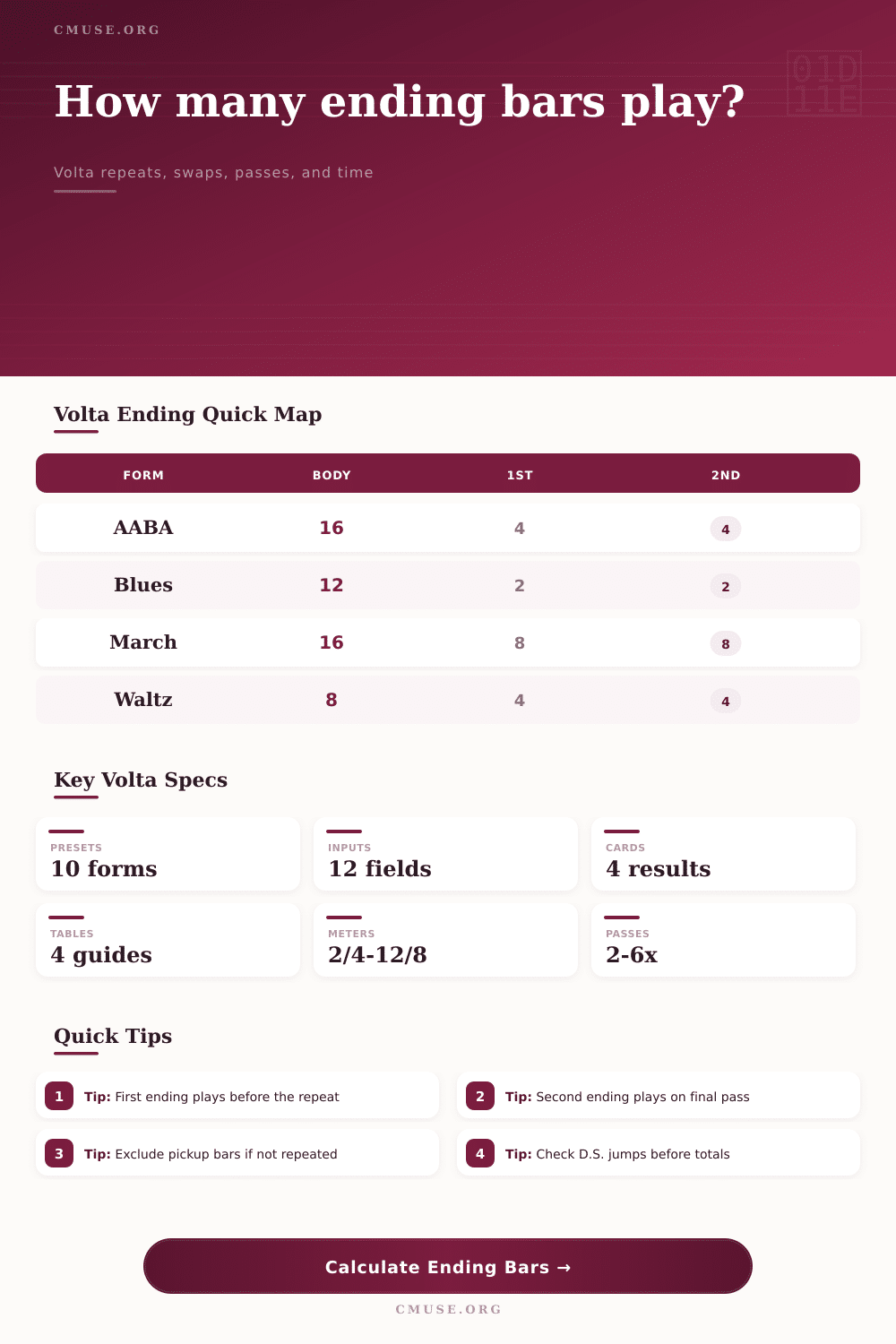
First and Second Ending Bar Calculator
Enter the repeated body, volta lengths, pass count, meter, tempo, pickups, codas, and optional third ending to total performed bars, ending swaps, repeat passes, and timeline duration.
Preset use: Load a common chart layout, then adjust the repeated body, first ending, second ending, pass count, meter, pickup, and coda bars to match the printed score.
Volta Repeat Breakdown
Unique bars printed once.
Extra performed bars from repeats.
Meter and tempo converted to time.
Counted beats across the timeline.
| Pass | Shared Body | Ending Used | Pass Bars | Running Total |
|---|
| Notation Marking | Playback Rule | Bars Counted | Common Use |
|---|---|---|---|
| 1. | Play on the first pass, then repeat back. | First ending only before the repeat. | Lead sheets, hymns, method books. |
| 2. | Skip first ending and play this on final pass. | Second ending replaces first ending. | Cadences, tags, lyric changes. |
| 1. 2. | Use the same bracket for two passes. | Ending repeats before a later final ending. | Marches and dance forms. |
| 1. 2. 3. | Each number can map to a different pass. | Count each assigned ending once. | Theater charts and multi-verse songs. |
| Form Type | Typical Body | 1st Ending | 2nd Ending | Total At 2 Passes |
|---|---|---|---|---|
| Jazz 32-bar AABA | 28 bars | 4 bars | 4 bars | 64 bars |
| 12-bar blues turnaround | 10 bars | 2 bars | 2 bars | 24 bars |
| March strain | 16 bars | 8 bars | 8 bars | 48 bars |
| Hymn stanza | 12 bars | 4 bars | 4 bars | 32 bars |
| Waltz dance strain | 8 bars | 4 bars | 4 bars | 24 bars |
| Lead sheet tag | 14 bars | 2 bars | 4 bars | 34 bars |
| Meter | Tempo Reference | One Bar At 120 | 16 Performed Bars | Volta Counting Note |
|---|---|---|---|---|
| 2/4 | Quarter-note BPM | 1.00 sec | 16.00 sec | Short march strains often repeat exactly. |
| 3/4 | Quarter-note BPM | 1.50 sec | 24.00 sec | Count written bars, not phrase beats. |
| 4/4 | Quarter-note BPM | 2.00 sec | 32.00 sec | Most lead sheets use this default. |
| 6/8 | Dotted-quarter BPM | 1.50 sec | 24.00 sec | Dotted pulse changes time, not bar count. |
| 12/8 | Dotted-quarter BPM | 3.00 sec | 48.00 sec | Blues shuffles may feel like four beats. |
| Ending Swap | Example | Bar Difference | Rehearsal Meaning |
|---|---|---|---|
| Equal endings | 1st 4 bars, 2nd 4 bars | 0 bars | Timing stays level; only notes change. |
| Shorter final ending | 1st 4 bars, 2nd 2 bars | -2 bars | Final cadence arrives earlier than repeat pass. |
| Longer final ending | 1st 2 bars, 2nd 4 bars | +2 bars | Final pass needs extra cue time. |
| Third ending form | 1st 4, 2nd 4, 3rd 8 | +4 bars | Last pass extends beyond earlier repeats. |
When you look at some complicated pieces of sheet music, it becomes clear that what is shown on the page isn’t necessarily the whole picture of what’s to be performed. The way it’s laid out physically doesn’t reflect the chronological flow of the piece; there are repeat signs and ending brackets which form something of a navigational puzzle. You might be reading from left-to-right but listening to a path that jumps forward or loops back again.
For many musicians this can make them stumble over timing in rehearsal. They may see how many bars are written down, but without the repeat instructions, they won’t know how long the performance will actualy last. This handy tool on the page does that job for you by taking in your visual notations and converting them to tangible bars and duration in seconds or minutes on a timeline. Once you define how you want the piece structured, it calculates math for you.
How to Count Bars and Time in Sheet Music
You begin by identifying the repeated body, which is the section that gets played multiple times before reaching a specific ending. That’s where you specify the length of both first and second ending. These are the sections that surround the end of the repeat span. The first ending is the one you play each time through except the final time. The second ending is saved for the last trip through the section.
Why does it matter? Because depending on which ending you use, the number of bars will be different. And that means that the final phrase come at a different time in the piece. For example, if the second ending is longer then the first, then the song continues beyond what you thought it would on the page. On the other hand, if the second ending is shorter, it cuts out sooner. The calculator factors this end/ending exchange into equation, allowing you to enter how many bars each are, and it displays resulting change in bars. That way, a bandleader or conductor can precisely determine where a solo section might have to expand or contract. They can also determine exactly where they need to cue the final chord.
The real world scores has even more wrinkles that throw off the simple counting systems above. Anacrusis bars, pickups, are added at the start and don’t count as part of first complete measure. After playing the final ending, there may be an outro, tag, or coda that follows. And then there’s directions like Dal segno that can skip a section altogether on subsequent passes. All of this takes away or adds into number of bars you will play in total. If you ignore it you’ll get your arrangements all messed up and mis-calculate your rehearsal times. The interface lets you enter these details so the final results reflect what’s actually going to happen in the performance not just as written down on paper.
Also, the time signature and tempo are essential elements to make those abstract bar counts translate to actual durations in the real world. A sixteenth of a minute in 4/4 time feels different than a measure in 6/8 time, even if the beat count is similar. Enter your desired meter and tempi (beats per minute) and it will tell you precisely how long the song lasts. This is invaluable when putting together sets with limited overall durations like live setlists or radio edits with hard time constraints.
The buildup of extra music repeat signs in a piece can be underestimated. For example, a simple eight bar melody could appear insignificant on paper. However, if it is repeated three times with unique endings, each repetition brings us into twenty four bars of real-life playing time. Across a whole concert or album that adds up fast. Knowing the duration of such things lets one plan out energy management during a performance as well as transitions from song-to-song.
On the page, there are also handy tables that quickly give reference points for things like march strains or blues progressions. These can help you double-check yourself when you feel your figures may not add up. A typical twelve bar blues has certain expected lengths at the end of each phrase that hold it firmly within a known limit. Nothing wrong with straying from this convention for creativity, but know when you are doing so and why.
In short, then, playing from notation is a process of translating symbols into sound. These marks that appear on your score are directions for re-creating the timeline of the work itself. Every repeat sign and bracket must be paid attention to if you are going to get the timing correct. It is a small thing but important when you are working as a team to stay together. Confidence comes with clarity in rehearsals. You’re free to concentrate on the expressive aspects instead of surviving.
Without the math, there’s no guessing about the structure. It takes away the mystery and becomes a clear roadmap when you’re presented with a seemingly impossible-to-read page. It doesn’t make you exempt from playing the notes. You’ll still need to do that, but at least you’ve got a map to guide you along until the end of the road.