🎼 Figured Bass Calculator
Decode figured bass notation — identify chords, inversions & intervals above any bass note
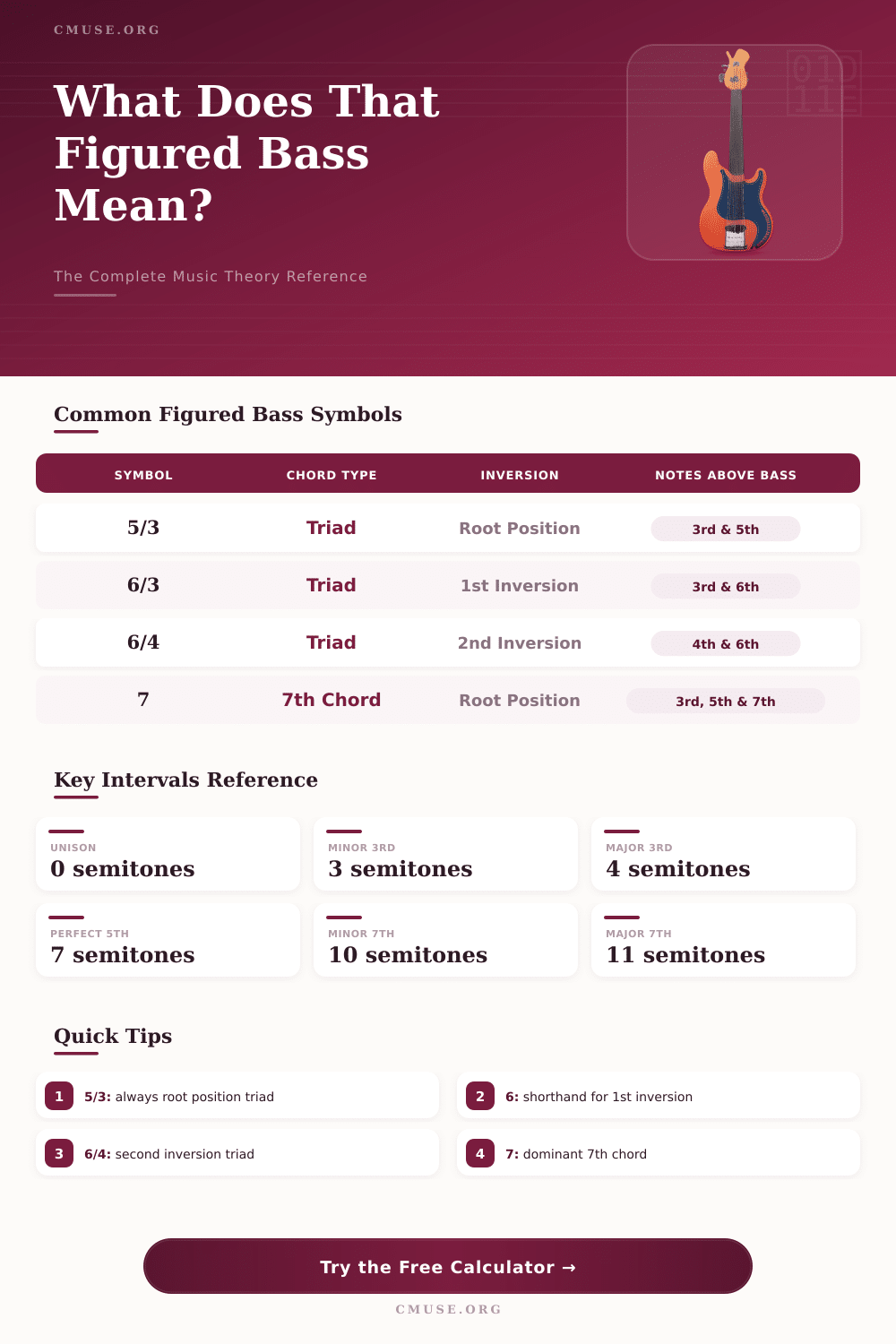
| Symbol | Inversion | Intervals Above Bass | Chord Members | Notes (C bass, C major) |
|---|---|---|---|---|
| 5/3 | Root Position | 3rd + 5th | Root, 3rd, 5th | C–E–G |
| 6 or 6/3 | 1st Inversion | 3rd + 6th | 3rd, 5th, Root | E–G–C (bass=E) |
| 6/4 | 2nd Inversion | 4th + 6th | 5th, Root, 3rd | G–C–E (bass=G) |
| 7 | Root Position 7th | 3rd + 5th + 7th | Root, 3rd, 5th, 7th | C–E–G–B |
| 6/5 | 1st Inversion 7th | 3rd + 5th + 6th | 3rd, 5th, 7th, Root | E–G–B–C (bass=E) |
| 4/3 | 2nd Inversion 7th | 3rd + 4th + 6th | 5th, 7th, Root, 3rd | G–B–C–E (bass=G) |
| 4/2 | 3rd Inversion 7th | 2nd + 4th + 6th | 7th, Root, 3rd, 5th | B–C–E–G (bass=B) |
| °7 | Fully Dim 7th | m3 + d5 + d7 | Root, m3, d5, d7 | B–D–F–A♭ |
| Interval Name | Abbreviation | Semitones | Example (from C) |
|---|---|---|---|
| Unison | P1 | 0 | C–C |
| Minor 2nd | m2 | 1 | C–D♭ |
| Major 2nd | M2 | 2 | C–D |
| Minor 3rd | m3 | 3 | C–E♭ |
| Major 3rd | M3 | 4 | C–E |
| Perfect 4th | P4 | 5 | C–F |
| Tritone | A4/d5 | 6 | C–F♯ |
| Perfect 5th | P5 | 7 | C–G |
| Minor 6th | m6 | 8 | C–A♭ |
| Major 6th | M6 | 9 | C–A |
| Minor 7th | m7 | 10 | C–B♭ |
| Major 7th | M7 | 11 | C–B |
| Octave | P8 | 12 | C–C |
| Roman Numeral | Bass Note | Figure | Chord Notes | Function |
|---|---|---|---|---|
| I | C | 5/3 | C–E–G | Tonic |
| I₆ | E | 6 | E–G–C | Tonic 1st Inv. |
| I₆₄ | G | 6/4 | G–C–E | Cadential 6/4 |
| V | G | 5/3 | G–B–D | Dominant |
| V₇ | G | 7 | G–B–D–F | Dominant 7th |
| V₆₅ | B | 6/5 | B–D–F–G | Dom 7th 1st Inv. |
| ii | D | 5/3 | D–F–A | Supertonic |
| vii° | B | 5/3 | B–D–F | Leading Tone |
| IV | F | 5/3 | F–A–C | Subdominant |
| vi | A | 5/3 | A–C–E | Submediant |
Figured Bass is a kind of musical notation, in that numbers and signs show over, under or at the deep note. They help to point out intervals, chords and single tones. A musician that plays harpsichord, organ, piano or lute can use that information to create chords above the deep line.
One also knows it as thorough bass.
What Is Figured Bass?
This method started from the baroque period of western classical music. Composers applied numerical shorthand to lead the accompanist in harmonic design. It grew from a written deep line with a series of Arab figures.
Figured Bass works somewhat differently than today’s normal signs, because instead of letters like C or E it uses numbers placed in the notation. Like this the accompanist received a bit of freedom about the playing of his part.
The figures under the deep note show the intervals, that must sound above that note. Those intervals create the triads and seventh chords, that one finds in music. If no number stands under the deep note, that points that it forms the root of a chord.
A note in the bass with “6” below shows the first inversion of a chord, that really is “6/3”, however the 3 usually one drops.
In root position one plays the chord with the root in the bottom voice. The first inversion laid the third degree in the bass. For the second inversion the fifth degree sits in the bass.
The third inversion counts only for seventh chords. Mark “6/4” points, that above the bass sounds the sixth and fourth degrees. Likewise “6/5” for the first inversion of a seventh chord really are “6/5/3”, but the 3 simply one leaves away.
Accidentals also have their role. A flat lowers the tone by a half step. A stroke through a number raises it buy a half step.
Alone accidentals without a number deal with the third degree of the chord.
For a real example, in a key without sharps or flats, B in the bass with 6 means, that the right hand plays D and G. When figures point 6 and 5, the right hand then plays D, F and G.
Figured Bass ties strongly to basso continuo, that historically was improvised accompaniment in almost every kind of baroque music, although it less commonly appears in modern music. It simply points intervals over the bass and does not name the role of the chord. The way of noting chords by means of numbers actually came before the habit of calling them as C major or C7. That system helps well for harmonic analysis, because it stresses big harmonic structures instead of every separate note.
Figured Bass forms part of a wider systemcalled partimento, that grew in the baroque era by means of hundreds of models and rules.