Festival Set Length Calculator
Plan a festival set from the scheduled slot, stage changeover, walk-on intro, outro, average song length, talk breaks, encore buffer, and target setlist count.
Stage timing model: Presets load realistic slot and stage-manager values for festival use. Adjust the inputs to test whether the setlist fits cleanly before the hard stop.
| Timing Item | Formula | Minutes | Stage Note |
|---|---|---|---|
| Waiting | Run calculation | 0 | No result yet |
| Slot Type | Common Slot | Typical Setlist | Timing Watch |
|---|---|---|---|
| Emerging artist opener | 20 to 30 minutes | 4 to 7 songs | Minimal talk and no encore buffer. |
| Acoustic or seated stage | 30 to 45 minutes | 6 to 10 songs | Story segments can overtake song time. |
| Main stage support | 45 to 60 minutes | 9 to 14 songs | Backline and intro tape must be tight. |
| Evening headliner | 75 to 105 minutes | 16 to 24 songs | Encore and curfew cushion need agreement. |
| DJ or dance tent | 45 to 120 minutes | 8 to 24 sections | Transitions replace normal talk breaks. |
| Profile | Timing Factor | Best Use | Planning Cue |
|---|---|---|---|
| Standard festival stage | 1.00x | Most multi-act festival slots | Balanced buffer and setlist count. |
| Broadcast or live-stream stage | 0.94x | Camera cues and fixed program clocks | Keep songs slightly under target. |
| Indoor club-style festival stage | 0.98x | Late-night rooms and showcase crawls | Turnover can be narrow at doors. |
| Acoustic or seated stage | 0.97x | Storytelling, folk, chamber, singer-songwriter | Talk breaks need explicit limits. |
| DJ or dance tent | 1.03x | Continuous sections and fewer stop-downs | Transitions can absorb small timing slips. |
| Timing Element | Lean Slot | Standard Slot | High-Risk Signal |
|---|---|---|---|
| Intro or walk-on | 0.5 to 1.5 min | 1 to 3 min | Long intro tape before first downbeat. |
| Talk breaks | 10 to 25 sec each | 25 to 60 sec each | Multiple speeches after applause peaks. |
| Outro or walk-off | 1 to 2 min | 2 to 4 min | Final bow overlaps stage turnover. |
| Encore buffer | 0 min | 3 to 8 min | Festival did not approve encore time. |
| Safety buffer | 5% | 8% to 12% | Shared backline, broadcast, or curfew. |
| Preset | Slot Plan | Setlist Style | Key Constraint |
|---|---|---|---|
| Main Stage Headliner | 95 min slot, encore buffer | Full catalog and crowd moments | Curfew and stage exit cushion. |
| Main Stage Support | 55 min slot, tight changeover | Single-heavy setlist | Drop one deep cut if late. |
| Tent Dance Stage | 75 min continuous set | Sections, builds, and transitions | Handoff at exact next DJ start. |
| Acoustic Garden | 40 min seated slot | Songs plus short stories | Talk length controls the count. |
| Broadcast Showcase | 28 min fixed clock | Short, camera-ready set | No stretch past program time. |
Managing the length of a festival set requires you to respect the amount of time that has been allocated to your performance. You must understand that the length of a festival set are a fixed window of time, and your setlist must account for and fit within that fixed window. While a band may have many songs that it desire to play during a festival set, the band cant play more songs during that set than the amount of time that has been allotted for that band’s set.
In addition to the amount of time that is allotted for each band, there is also non-music time for each band. For example, time may be needed for the band to change songs, play intro tapes, hear the host’s remarks, or walk onto the stage. Time for these non-music elements is often not seen by the audience, but it still consumes some of the time slot that has been allotted for the band.
How to Plan Your Festival Set Time
Thus, calculators can help bands to account for this non-music time, allowing the band to ensure that it has enough time for the music that it wish to play. Bands may also incorporate talk breaks into their set. For example, the band may wish to tell a story about itself between songs.
In these cases, the time that the band take for these storytellings is time that could of been used for playing music. Thus, band managers and set list creators can use a calculator to decide if the benefit of incorporating these storytellings into the set justifies the loss of music time. The number of talk breaks that a band can take, for instance, may depend upon whether the audience is sitting or standing, and how strict the stage manager is about the start time of the next band to perform.
Band managers also need to account for the length of each song that is to be played during the band’s set. The length of each song’s studio version may be different than the length of each song’s live version. Live versions of songs may be longer live versions than the studio versions due to the additional time that the band may take to open and close each song.
Thus, the length of each live song is used in the calculator to determine the length of the set; if the length of the songs that are to be played in the band’s set takes up more time than the time slot has allotted for the band’s set, one song must be moved to a flexible position within that bands set. In addition to accounting for each song that the band is to play, calculators can also account for the additional time for an encore for the band. Each calculator may indicate that bands should only rely upon this time if the festival that is occurring has agreed to provide the band with an encore buffer for its set.
For instance, festivals that include many bands may allow the band to use its changeover time with the next band for this encore time. Thus, calculators help band managers to determine if they have enough time for their set to play the number of songs that they want to play. Bands should also plan for unexpected delays during their set.
For instance, bands may experience delays caused by tuning their instruments, setting up their monitor mixes for themself, or the length of the applause that the audience provide during their set. To counteract this, bands should plan for a safety margin for unexpected delays at the beginning of their set so that they do not take up all of the time slot for their performance. The length of each band’s performance slot may impact the length of the safety margin that the band should plan for.
For instance, bands that are performing on a broadcast slot may have different time allowances than bands that are performing in a dance-tent slot. If the length of the songs that each band is to play takes up more time than the time slot has allotted for that band, then a series of difficult decisions must be made. For instance, bands may decide to cut their talk breaks to allow for the songs to remain intact, but that may reduce their connection to the audience.
Additionally, dropping one of the songs that the band plays may ensure that the band remains within the time slot for the performance, but it may mean that the band does not get to play a song that its fans like. Finally, removing the encore buffer will ensure that the band does not go past the time slot for their performance, but it means that they will not be able to play an additional round of songs that were not planned for the performance. These different costs and benefits can be programmed into a calculator so that each band can make these decisions before they ever arrive at teh stage.
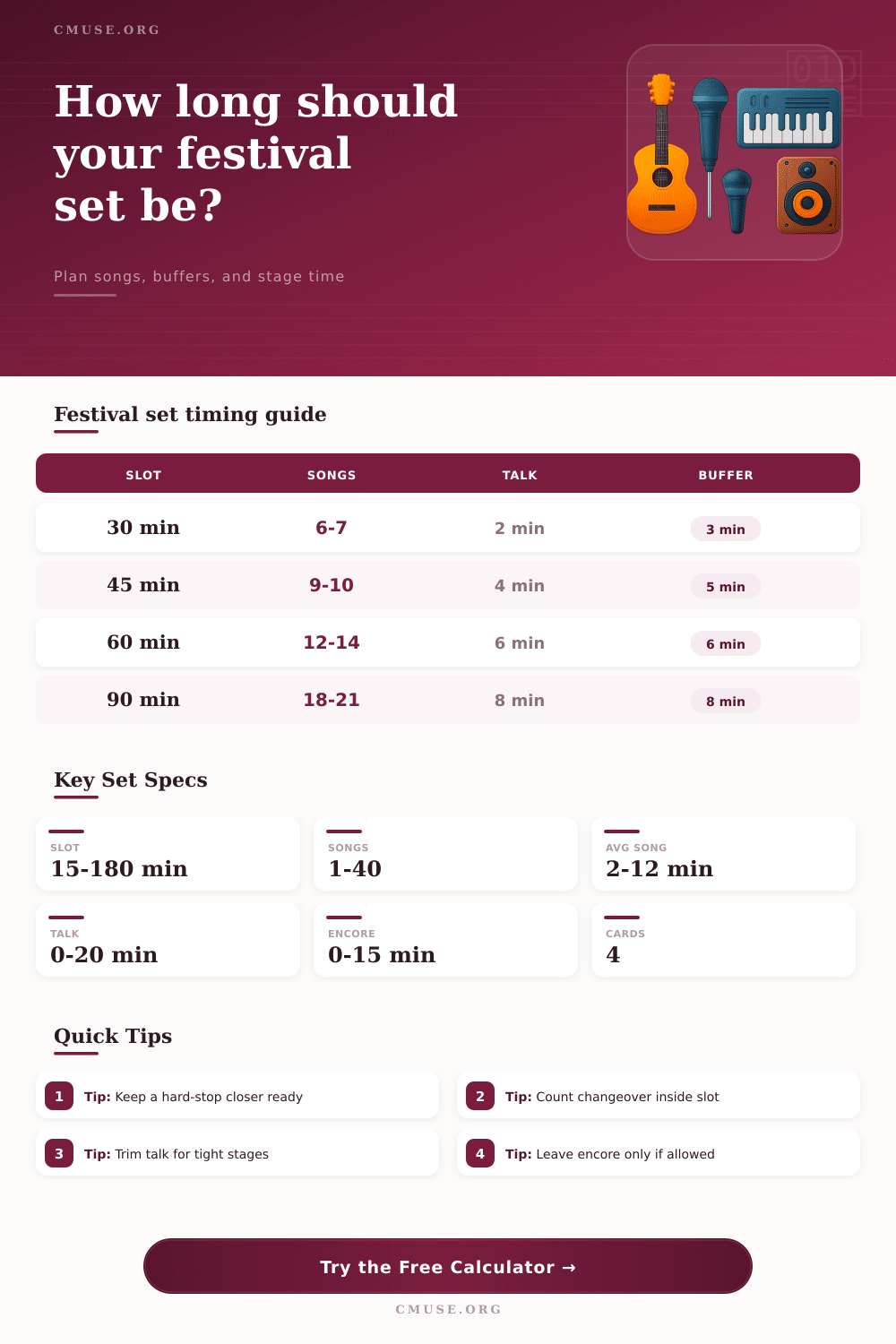
There are reference tables for the length of performance slots and the number of songs that each slot will include. For instance, shorter performance slots, such as thirty minutes, may not include time for an encore, but performance slots of ninety minutes may usually include time for an encore. These tables can help band managers to decide which inputs should be focused upon within the calculator.
While a calculator can help a band determine the length of their performance slot, there is no calculator for the atmosphere of the room in which they play their songs. For instance, the level of noise in the audience can impact the time that the next band gets to play; a loud crowd will allow them to enter the stage earlier, while a quiet crowd will take up some of their time slot. Thus, while the calculator may map out the length of the band’s set, the atmosphere of the room will determine if they remain within their time slot.