📅 Rhythm Calendar Method Calculator
Estimate your fertile window & safe days using the Standard Days / Ogino-Knaus method
Enter the length (in days) of each of your recent menstrual cycles. For best accuracy, use at least 6 cycles. Day 1 = first day of period.
✨ Your Cycle Analysis Results
| Cycle Length (days) | First Fertile Day | Last Fertile Day | Fertile Window | Estimated Ovulation |
|---|---|---|---|---|
| 24 | Day 6 | Day 13 | Days 6–13 | Day 10 |
| 25 | Day 7 | Day 14 | Days 7–14 | Day 11 |
| 26 | Day 8 | Day 15 | Days 8–15 | Day 12 |
| 27 | Day 9 | Day 16 | Days 9–16 | Day 13 |
| 28 | Day 10 | Day 17 | Days 10–17 | Day 14 |
| 29 | Day 11 | Day 18 | Days 11–18 | Day 15 |
| 30 | Day 12 | Day 19 | Days 12–19 | Day 16 |
| 31 | Day 13 | Day 20 | Days 13–20 | Day 17 |
| 32 | Day 14 | Day 21 | Days 14–21 | Day 18 |
| 33 | Day 15 | Day 22 | Days 15–22 | Day 19 |
| 34 | Day 16 | Day 23 | Days 16–23 | Day 20 |
| 35 | Day 17 | Day 24 | Days 17–24 | Day 21 |
| Shortest Cycle | Longest Cycle | First Fertile Day | Last Fertile Day | Abstinence Days |
|---|---|---|---|---|
| 26 | 28 | Day 8 | Day 17 | 10 days |
| 26 | 30 | Day 8 | Day 19 | 12 days |
| 25 | 32 | Day 7 | Day 21 | 15 days |
| 24 | 34 | Day 6 | Day 23 | 18 days |
| 23 | 35 | Day 5 | Day 24 | 20 days |
| 22 | 38 | Day 4 | Day 27 | 24 days |
| Method | Formula | Typical Effectiveness | Best For |
|---|---|---|---|
| Ogino-Knaus | Shortest–18 / Longest–11 | 76–88% | Regular cycles |
| Standard Days Method | Days 8–19 always fertile | ~95% (cycles 26–32) | Cycles 26–32 days |
| Extended Buffer (+2) | Adds 2 extra days each side | Improved safety margin | Irregular cycles |
| Symptothermal | BBT + cervical mucus | 98%+ with perfect use | All cycle types |
| Billings (mucus only) | Mucus observation | 97%+ with training | All cycle types |
The Rhythm Calendar Method is a natural family planning method. It helps women find the best time in the month to conceive or avoid pregnancy. The main idea is to guess which days the woman is fertile and avoid intimate relations in those periods.
One knows it also as a calendar method, and it works by tracking the menstrual cycles to predict ovulation.
How the Rhythm Calendar Method Works
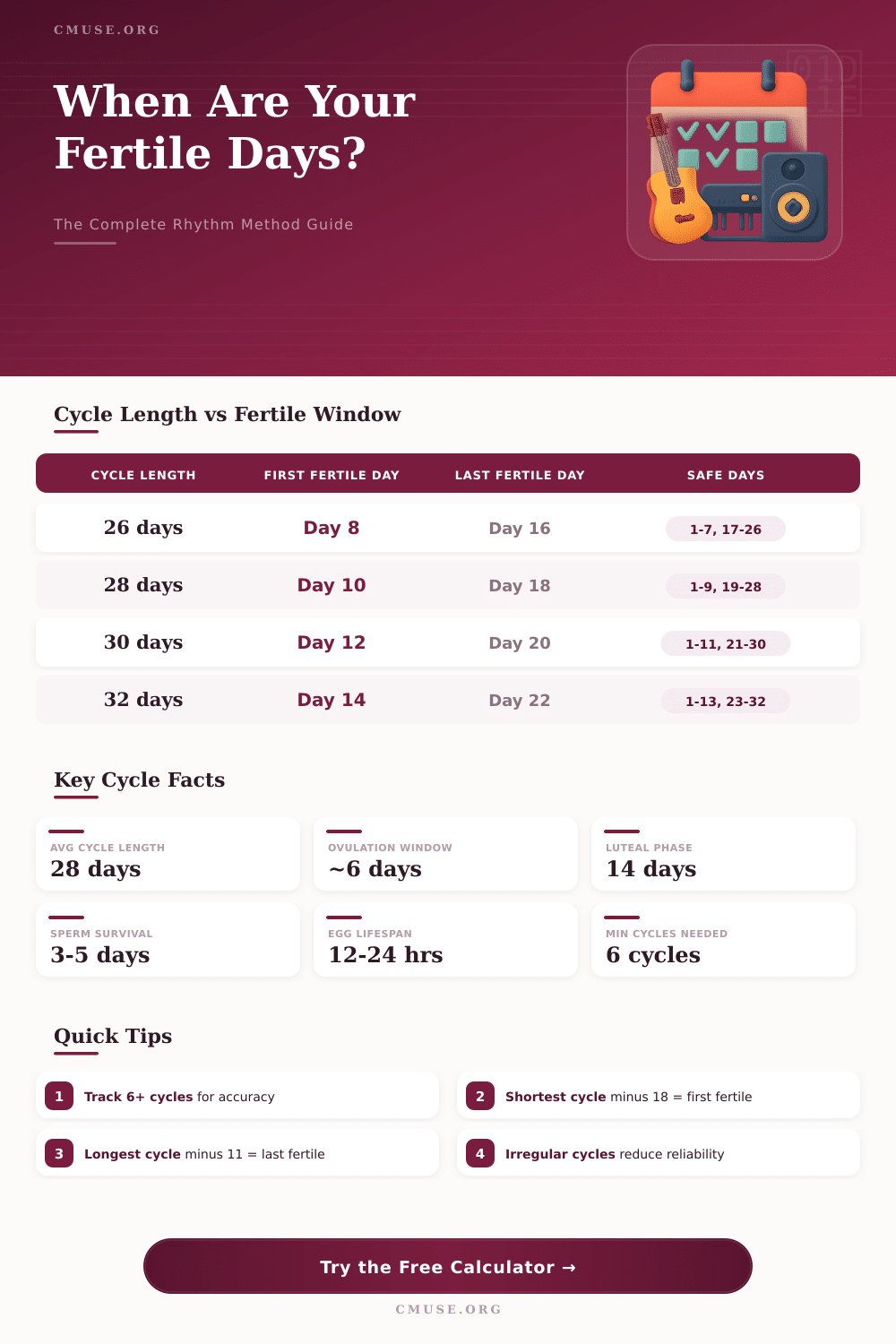
Calendar methods predict the fertile days by watching the length of menstrual cycles over some months to create a fertile timetable. To use it, one marks the first day of the period on the timetable monthly. In the next month one repeats the same and one counts the gap between the two.
This way one finds the length of the cycle. For instance, if the period starts March 1st and the next one the 30th of the same month, the cycle lasts 29 days.
Note the length of six to twelve menstrual cycles form the main stage. One can use a timetable or notebook to write the number of days for every cycle, from the first day of one period until the first of the next. When the cycles always range between 26 and 32 days, the standard day method can work.
This approach estimates the days of 8 until 19 in the cycle as the fertile window.
Methods based on timetable form a whole group of techniques. They all depend on the calculation of cycle days to guess when fertility is the strongest. The method of Knaus-Ogino and the standard day method both belong too that group.
The standard day method was launched by the University of Georgetown in 1999 and promoted by a product called CycleBeads, a ring of colored beads that helps to follow the fertile and non-fertile days.
During typical usage, the traditional Rhythm Calendar Method has a failure rate of 8 to 25 percent. During perfect usage, the failure rate drops below 5 percent. Types of natural family planning that require watching physical signs like basic body temperature usually work more efficiently.
Calendar methods alone work about 75 to 85 percent during the year.
Stress, disease or changes in daily life can change the cycle of a woman, which reduces the reliability of that method. It does not protect against sexually transmitted infections. Apps, timetables or tracking tools to follow fertility can simplify the watching of cycles and the spotting of fertile windows.
The Rhythm Calendar Method is the only kind of birth control method officially accepted by the Catholic Church, and one main reason forits continued use is that it is listed as a moral option by the CDC.