
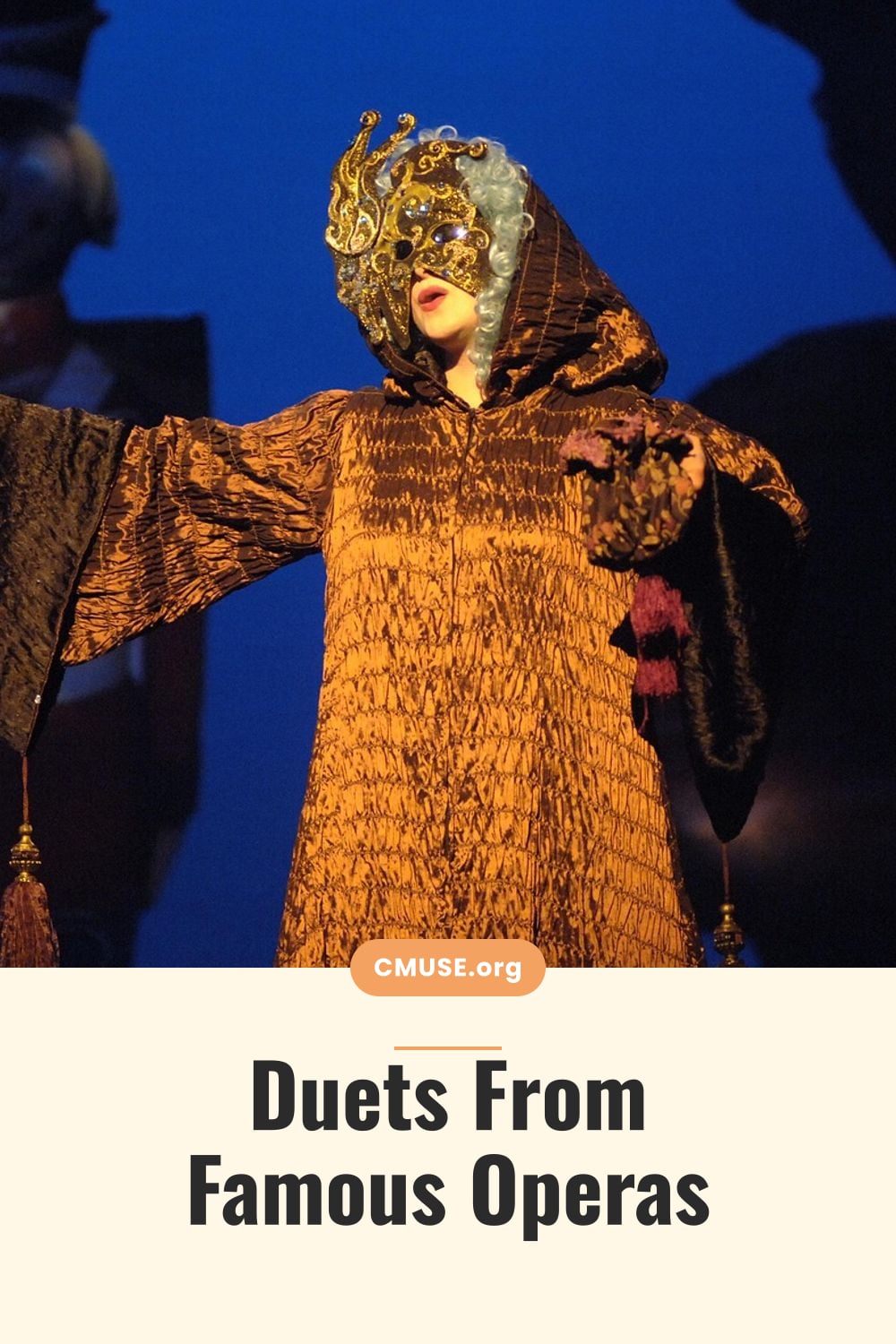
Opera duets are where the art form catches fire. A single voice can move you but two voices locked together in harmony or conflict create something electric that no aria alone can match. These moments distill love, rage, jealousy, and redemption into pure sound.
They are the reason generations of listeners return to the same scores decade after decade.
When composers write for two voices they exploit every possible relationship between them. One may chase the other in imitation, they may finish each other’s thoughts, or they may hurl opposing melodies at each other like weapons. The results range from tender to terrifying.
Listening to these duets teaches you how opera uses human connection itself as its most powerful dramatic engine.
The following selections show how differently composers have solved that challenge. Each duet earns its place by revealing something essential about the characters while delivering music that still raises goosebumps a century or more later.
Essential Opera Duets You Must Hear
1. Mozart’s La ci darem la mano from Don Giovanni
Mozart’s “Là ci darem la mano” from Don Giovanni stands at the head of the list for good reason. Written in 1787, it captures the precise moment when the young Zerlina teeters on the edge of yielding to the charming nobleman who has no intention of keeping his promises. The melody begins so simply, almost like a folk song, that you understand why she is tempted.
Giovanni’s phrases grow more ornate as he presses his advantage while Zerlina’s answers become shorter and more breathless.
The brilliance lies in how Mozart makes seduction audible. You hear her resistance crumble phrase by phrase until the final section when they sing together in blissful thirds. The music tells you everything the libretto only hints at.
Even if you know Giovanni is a cad, the duet makes you root for the seduction to succeed, which is exactly the uncomfortable thrill Mozart wanted.
That tension between beauty and moral danger is what keeps this piece feeling dangerous more than two centuries later. Singers still have to decide how innocent Zerlina sounds at the beginning and how knowing she becomes by the end. The duet rewards interpreters who understand that the real drama happens in the spaces between the notes.
2. Verdi’s Un di felice from La Traviata
Verdi’s “Un di felice” from La Traviata achieves something rarer. It is a love duet that is also a breakup duet at the same time. Alfredo declares his passion while Violetta tries desperately to talk him out of it, insisting she can only offer him a life of fleeting pleasure.
Their vocal lines cross and tangle like two people who cannot quite hear each other.
What makes the piece extraordinary is Verdi’s decision to keep Violetta’s coloratura flourishes even as she sings about sacrifice. The ornamentation is not decoration but a form of nervous deflection. She is literally decorating the truth to make it prettier.
By the time they reach the famous “croce e delizia” section their voices have merged into one soaring line. The music has already decided they are in love even if the characters have not.
This duet rewards close listening because every coloratura run carries psychological weight. Modern productions sometimes cut the more florid passages but doing so removes the very thing that shows Violetta’s inner conflict. The music is the psychology here.
3. Delibes’ Flower Duet from Lakme
The flower duet from Lakmé by Delibes offers a complete change of pace. Two women, a priestess and her servant, sing not about romance but about the simple joy of gathering flowers in a sacred river. Their voices intertwine in cascades of parallel sixths that feel almost narcotic.
The piece has become famous beyond opera thanks to its use in films and advertisements, yet its original context reveals something deeper.
Delibes composed it in 1883 as a moment of fragile calm before the cultural and religious conflict that drives the plot. The exoticism that once seemed daring now reads as a product of its time, but the vocal writing remains impeccable. The two sopranos must match timbre so perfectly that their voices seem to fuse into a single instrument.
When that happens the effect is transcendent.
The duet works because it gives the ear pure beauty without demanding plot comprehension. You do not need to know the story to feel the sense of suspension it creates. That is its secret power.
4. Puccini’s O soave fanciulla from La Bohème
Puccini’s “O soave fanciulla” from La Bohème may be the most purely romantic duet in the repertoire. Rodolfo and Mimì meet, flirt, and fall in love within the space of a few minutes while snow falls outside their garret. Their voices rise together on that famous soaring phrase that seems to capture every hopeful beginning in human history.
The genius is in the timing. Puccini lets each singer have a solo moment that feels like a personal confession before he brings them together. When their lines finally lock into unison on the word “amor” the effect is overwhelming.
It is the musical equivalent of two hearts beating as one.
Yet the duet carries a shadow. The same music will return at the end of the opera in a much darker context, reminding us that this ecstatic moment is fleeting. Knowing that only makes the first hearing more poignant.
Great opera duets often work on multiple time scales at once.
5. Gounod’s Balcony Scene from Roméo et Juliette
The balcony scene from Gounod’s Roméo et Juliette transforms Shakespeare into French lyricism without losing the urgency of first love. Roméo hides in the Capulet garden while Juliette appears above him. Their voices pass a single melody back and forth like a shared secret before they finally sing together in rapturous harmony.
Gounod understood that the tension in this scene comes from the constant threat of discovery. He keeps the orchestra restless beneath the singers, never allowing the music to settle completely. The result is a love duet that feels both weightless and dangerous.
The tenor and soprano must convey innocence and erotic charge at the same time, which is harder than it sounds.
This piece rewards singers who can float high notes while maintaining dramatic urgency. When it works the audience feels the same mixture of joy and terror that the young lovers experience.
6. Bizet’s Au fond du temple saint from The Pearl Fishers
Bizet’s “Au fond du temple saint” from The Pearl Fishers is that rarest of operatic creatures, a passionate duet between two men. Nadir and Zurga recall their youthful friendship and the moment they both fell in love with the same priestess. Their rivalry is set aside for the length of the duet as they pledge eternal brotherhood.
The melody is so famous that even people who have never seen the opera can hum it after one hearing. Bizet gives each baritone and tenor ample room to shine individually before bringing them together in octaves that resonate like a cathedral bell. The exotic flute solo at the beginning sets a mood that feels both sacred and sensual.
What makes the duet powerful is its honesty about male friendship. These characters are swearing loyalty while quietly admitting they will probably betray each other over a woman. Opera rarely captures the complexity of male bonds this well.
7. Richard Strauss’s Der Rosenkavalier Trio
Richard Strauss took the duet form to its sensual extreme in the final scene of Der Rosenkavalier. The Marschallin, Octavian, and Sophie find themselves in a complicated three-way conversation that resolves into a trio of such aching beauty it feels like the entire history of romantic love is being summarized. Although technically a trio rather than a duet, the way the three voices weave together makes it the ultimate expression of intertwined destinies.
Strauss demands perfect blend and perfect individuality at the same time. The soprano singing the Marschallin must sound mature and world-weary while the other two voices glow with youthful hope. When all three lines crest together the effect is almost too much to bear.
This is the sound of acceptance, renunciation, and new beginnings happening simultaneously.
8. Wagner’s Tristan und Isolde Love Duet
The love duet from Wagner’s Tristan und Isolde represents the outer limit of what two voices can achieve. By the time they reach the famous “Liebesnacht” they have already drunk the potion and exist in a realm where time has stopped. Their phrases overlap and dissolve into each other until it becomes difficult to tell where one voice ends and the other begins.
Wagner’s orchestra churns beneath them like the sea while the singers float above in long, aching lines. This is not a duet about falling in love. It is a duet about having already merged souls.
The music is so harmonically advanced that it still sounds restless more than a century later.
Performing it requires singers with both stamina and sensitivity. They must sustain the intense emotion without ever pushing the tone. When it succeeds the audience feels they have witnessed something almost sacred.
Few other works in any genre come closer to expressing the idea that love is a form of transcendence.
These duets remind us why opera continues to matter. They take the most private human experiences and make them vast enough for everyone to share. Whether you encounter them in a grand opera house or through recordings in your living room, they still have the power to stop you in your tracks.
The next time you listen pay attention to how the voices relate to each other. Are they supporting, competing, merging, or battling? That relationship is where the real story lives.
Opera duets do not just tell you what the characters feel. They make you feel it too, often before you fully understand why. And that, ultimately, is the whole point.