
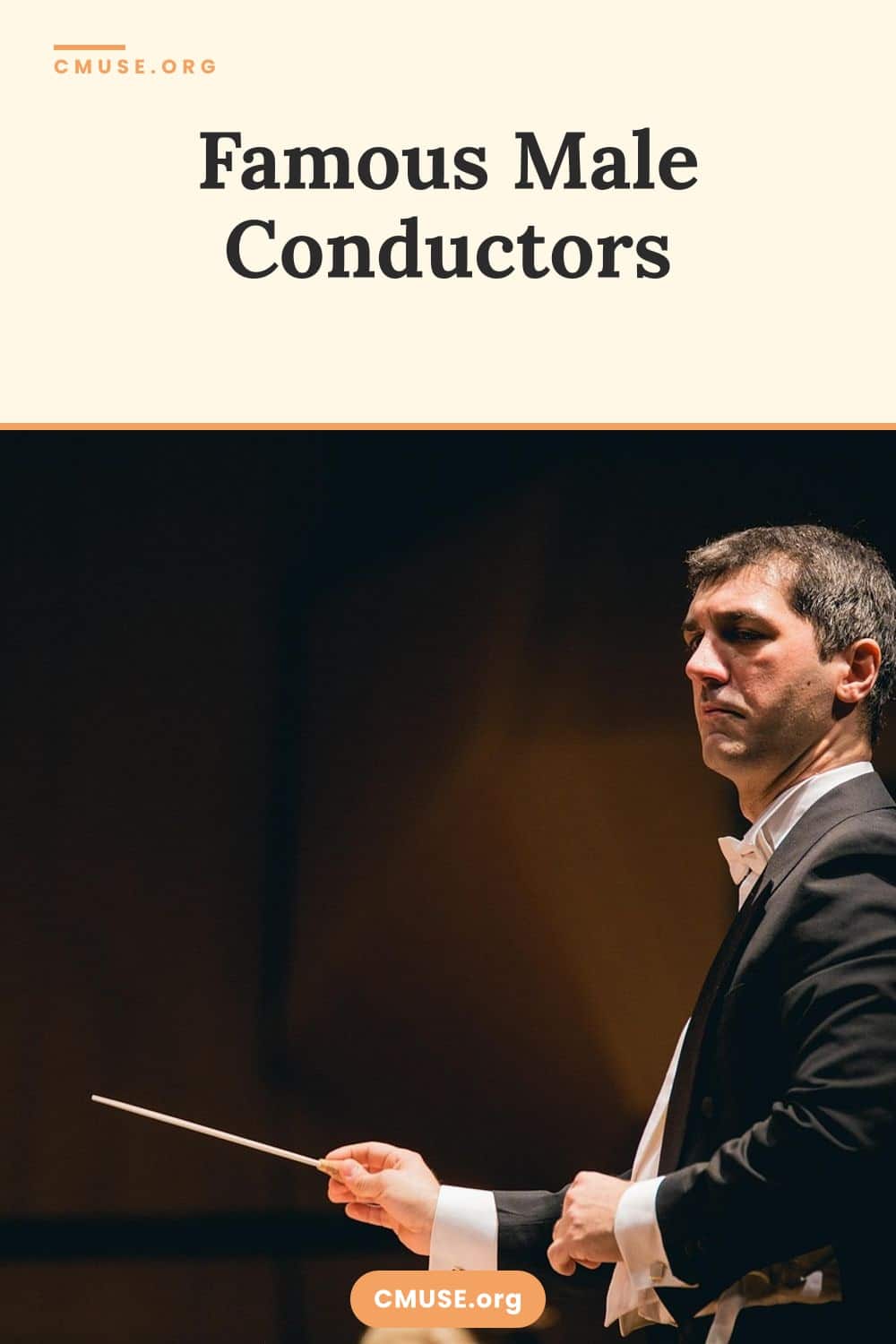
The baton cuts through the air with impossible precision, and suddenly a hundred musicians breathe as one. That single gesture, repeated across concert halls for centuries, explains why conductors still command such fascination. These men do not play a note yet they shape everything you hear.
Their personalities, techniques, and visions have defined how we understand orchestral music itself.
Some conductors become legends through sheer charisma, others through iron discipline, and a few through quiet revolution. The best ones remake a familiar score so completely that you hear it as if for the first time. What follows is a tour of the most influential male conductors of the modern era, the figures whose legacies still echo from podiums around the world.
You will meet tyrants and poets, showmen and scholars, each one leaving an unmistakable fingerprint on the repertoire.
The Most Influential Male Conductors of Our Era
1. Leonard Bernstein
Leonard Bernstein walked onto the stage like a man who had just remembered the best joke in the world. His hair flew in every direction, his face beamed pure theatrical joy, and his body seemed to conduct with every joint at once. That physical exuberance was not mere showmanship.
Bernstein believed music should feel like an event, something lived rather than merely performed. His Young People’s Concerts turned millions of children into lifelong listeners, while his recordings of Mahler finally convinced the world that those symphonies belonged at the center of the repertoire instead of its fringes. The secret was his total conviction that every note carried emotional truth worth fighting for.
2. Herbert von Karajan
Herbert von Karajan ruled the Berlin Philharmonic like a benevolent emperor for thirty-five years. Where Bernstein leapt and danced, Karajan barely moved, eyes often closed, hands carving tiny precise shapes in the air. The result was a trademark sound, plush, seamless, and immaculately polished.
Critics sometimes called it glossy, but nobody could deny the hypnotic power of those recordings. Karajan understood that the microphone magnified every detail, so he spent decades perfecting an orchestral blend that would survive the scrutiny of studio listening. His approach taught generations that power can be quiet, that control does not require visible exertion.
3. Arturo Toscanini
Arturo Toscanini stands as the original archetype of the tyrannical maestro. Short, bald, and volcanic, he terrorized orchestras on both sides of the Atlantic with a temper that became legend. Yet the same ferocity produced performances of unmatched clarity and structural logic.
Toscanini treated the score as sacred text, memorizing every part and correcting musicians on mistakes they thought invisible. His broadcast performances during World War II turned him into a symbol of artistic resistance against fascism. The lesson he left behind remains bracing: sometimes the pursuit of truth demands discomfort.
4. Wilhelm Furtwängler
Wilhelm Furtwängler conducted the way other people conduct philosophical arguments. His beat was famously imprecise, a floating, circular gesture that drove orchestras to despair until they learned to follow the larger idea instead of the downbeat. What emerged was a style of profound flexibility, tempo that expanded and contracted like living tissue.
In the slow movement of Beethoven’s Ninth or the transcendent close of Bruckner’s symphonies, Furtwängler achieved a sense of inevitability that more metronomic conductors rarely touched. His reputation suffered for years because of his decision to remain in Germany during the Nazi era, yet the recordings prove that moral complication and musical greatness sometimes coexist.
5. Carlo Maria Giulini
Carlo Maria Giulini brought the dignity of an Italian Renaissance painting to the podium. Tall, courtly, and deeply spiritual, he approached music with the reverence of a man handling holy relics. After years leading opera in Milan and London, Giulini turned to symphonic repertoire and revealed a gift for spacious, singing lines that made even familiar works feel freshly composed.
His recordings of the Verdi Requiem and Bruckner’s Ninth achieve a rare balance between architectural grandeur and intimate warmth. Giulini showed that gentleness can be its own form of authority.
6. Georg Solti
Georg Solti looked like a hawk and conducted like one too. His Chicago Symphony recordings from the 1970s and 80s still sound as if the orchestra is playing for its life. That ferocious energy came from a childhood spent fleeing Nazi-occupied Hungary and a conviction that music should never be polite.
Solti’s signature was attack, the way he made brass sections roar and strings dig in with almost brutal force. Yet he could also coax velvet tone from the same players when the music required it. The combination made him the ideal conductor for Mahler and Wagner, composers who thrived on extremes.
7. Pierre Boulez
Pierre Boulez began as an enfant terrible who declared that all opera houses should be blown up. Decades later he had become the high priest of musical modernism, conducting with surgical clarity and an ear for color that bordered on the superhuman. His performances of his own music and that of Stravinsky, Bartók, and Debussy stripped away sentimentality to reveal structural steel.
Boulez proved that intellectual rigor and sensuous beauty are not opposites. Late in life he returned to Wagner’s “Ring” cycle and showed that even the most radical modernist could find new depths in the most romantic of scores.
8. Claudio Abbado
Claudio Abbado conducted with the serene focus of a Zen master who happened to know every note of Mahler by heart. After surviving cancer, his music-making took on an almost translucent quality, as if he were channeling sound rather than imposing it. His work with the Lucerne Festival Orchestra in his final years produced some of the most profound ensemble playing ever captured.
Abbado trusted musicians to shape phrases themselves, creating a collaborative spirit that felt like chamber music on a symphonic scale. The results were interpretations that seemed to breathe with collective intelligence.
9. Riccardo Muti
Riccardo Muti carries forward the grand Italian tradition with a mixture of patrician elegance and volcanic passion. His long tenure at La Scala and later with the Chicago Symphony demonstrated an ability to balance stylistic fidelity with personal vision. Muti’s Mozart sparkles without becoming precious, his Verdi throbs with theatrical blood, and his Beethoven maintains structural iron beneath the rhetoric.
He has never been afraid to tell audiences what he thinks they need to hear rather than what they want, a quality that grows rarer each decade.
10. Seiji Ozawa
Seiji Ozawa brought an entirely different cultural lens to Western classical music. The first Japanese conductor to achieve international superstar status, he led the Boston Symphony for twenty-nine years and helped establish classical music as a genuinely global language. His podium style married technical precision with an almost mystical sense of flow.
Ozawa’s recordings of Messiaen’s “Turangalîla-Symphonie” and Berlioz’s “Symphonie Fantastique” remain reference versions because he heard colors and rhythms that European and American conductors had somehow missed. His career proved that great conducting has no single national accent.
These men, for all their differences, share one common trait. Each found a way to make the invisible audible. They stood between the composer long dead and the audience very much alive, translating ink on paper into living sound.
Some ruled by fear, others by love, a few by sheer intellectual force. All of them understood that the conductor’s real power lies not in telling musicians what to do but in helping them remember why they first fell in love with music.
The next time you attend a concert, watch the man on the podium carefully. Behind those small, decisive movements lies centuries of tradition, decades of study, and an entire philosophy of what music can mean. The baton may be thin, but its shadow stretches across entire lives.