
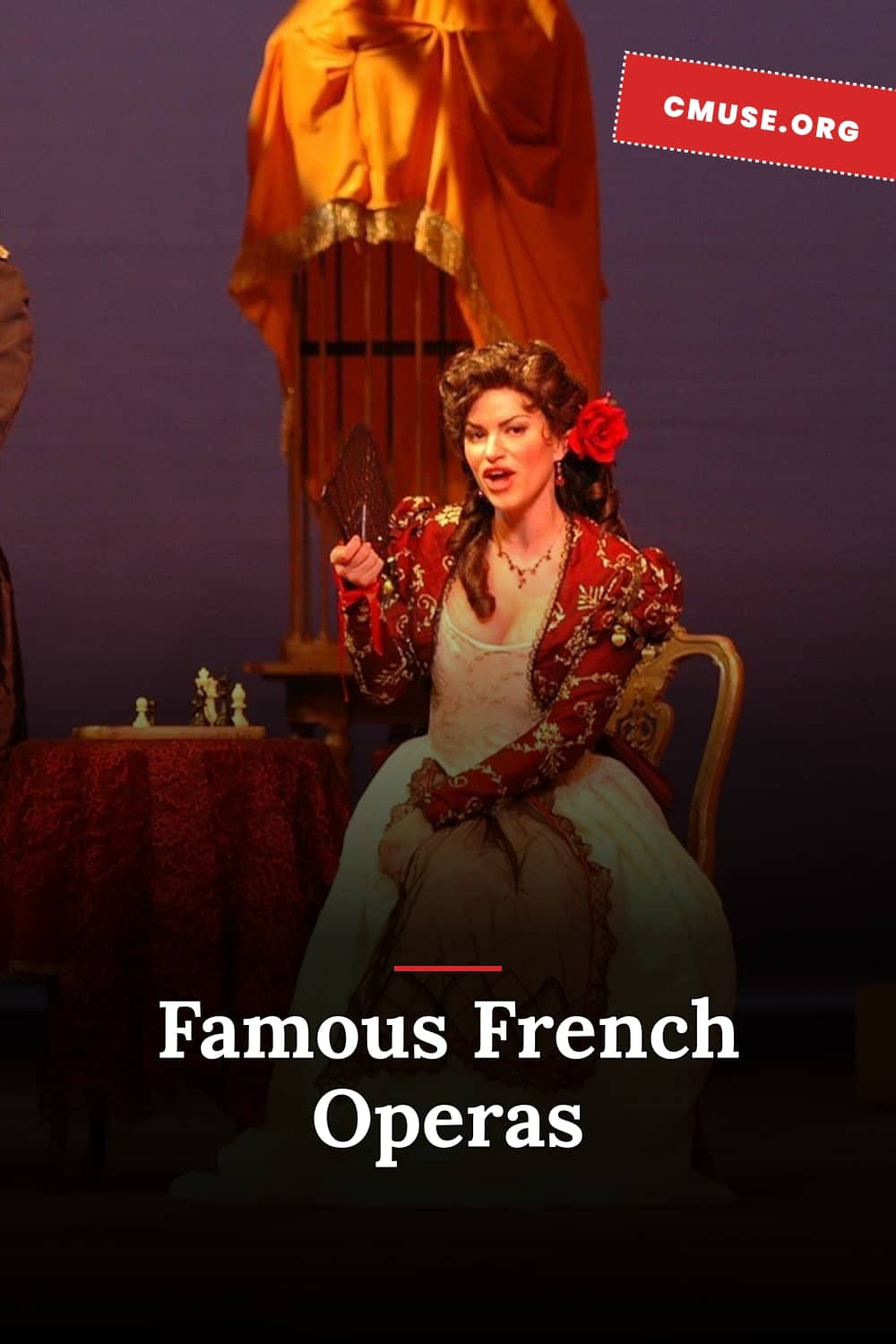
French opera occupies a special corner of the art form. It is grand yet intimate, melodramatic yet witty, and it has shaped how the rest of the world thinks about passionate singing on stage. From the glittering halls of the Paris Opéra to provincial theaters that still pack in crowds, these works carry centuries of national pride, revolution, love affairs, and orchestral color.
What makes a French opera feel French is harder to pin down than it seems. You hear it in the elegant declamation that sits somewhere between speech and song, in the ballets that were once mandatory, and in a certain lightness that refuses to take itself too seriously even when the plot ends in tragedy. The list that follows takes you through ten landmark pieces that define the tradition.
Each one changed the game in its own way, and each still rewards a fresh listen or a night at the theater.
Ten Landmark French Operas to Discover
1. Bizet’s Carmen
The first great pillar most newcomers encounter is Bizet’s Carmen. Premiered in 1875 at the Opéra-Comique, it scandalized audiences with its realistic portrayal of smugglers, factory workers, and a woman who refused to be owned. The music swings between sensuous habanera rhythms and bright marching choruses that somehow make bullfighting sound like a village fair.
Carmen matters because it dragged opera out of myth and into the street without losing its melodic allure. The tradeoff is that the title role has been over-sung and over-interpreted, yet when a singer truly inhabits the part the theater still crackles with danger.
2. Gounod’s Faust
Next comes Gounod’s Faust, a work that turned Goethe’s philosophical poem into a heartbreaking love story audiences could hum on their way home. The garden scene, the jewel song, and the soaring trio in the final act became instant classics. For decades it was the most performed opera in the world, and you can see why.
Gounod understood exactly how to write for the French voice, giving the tenor heroic lines that feel noble rather than strained. Its staying power proves that a story about selling your soul can still feel intimate if the melodies are this seductive.
3. Meyerbeer’s Les Huguenots
If you want pure spectacle, nothing beats Meyerbeer’s Les Huguenots. This 1836 grand opera runs nearly five hours and demands seven leading singers of international caliber. The plot, set against the 1572 St. Bartholomew’s Day massacre, builds to a finale so brutal that modern directors still flinch.
Meyerbeer piled on choruses, ballets, and orchestral effects the way other composers add spice. The result is exhausting and magnificent. It defined an entire era of Parisian taste for size and historical sweep, and its influence can be heard in everything from Verdi to Hollywood film scores.
4. Offenbach’s The Tales of Hoffmann
Offenbach’s The Tales of Hoffmann offers something completely different: a fever dream wrapped in waltzes. This opéra fantastique follows a poet’s three disastrous love affairs with mechanical doll, Venetian courtesan, and dying singer. The barcarolle alone has floated through countless commercials and wedding playlists, yet in context it feels heartbreaking.
Offenbach died before finishing the score, which means every production is essentially a new edition. That unfinished quality mirrors the story’s own sense of longing. It is the perfect gateway opera for anyone who thinks they dislike opera but love a good ghost story set to music.
5. Saint-Saëns’s Samson and Delilah
When French opera turns political, few works hit harder than Saint-Saëns’s Samson and Delilah. Biblical in subject but very much of its time, the 1877 score gave the Paris Opéra one of its most seductive arias in “Mon coeur s’ouvre à ta voix.” The bacchanale that opens Act Three still sounds riotously exotic. Saint-Saëns was a conservative composer who somehow produced one of the sexiest operas in the repertoire.
The piece rewards listeners who pay attention to its orchestral detail as much as its vocal lines. It also reminds us that French composers could be masterful at turning sacred stories into very human dramas.
6. Massenet’s Manon
Massenet’s Manon is the one that makes you fall in love with a character and then hate yourself for it. Based on the same 18th-century novel that inspired Puccini’s later version, Massenet’s 1884 treatment feels lighter on its feet and more Parisian. The heroine’s gavotte and the lovers’ duets in the garden have an irresistible charm that slowly curdles into tragedy.
Massenet had an almost clinical understanding of what the voice can express at every dynamic level. That precision lets Manon’s moral slide feel both inevitable and heartbreaking. If you only know the Puccini, this earlier French cousin is worth meeting.
It trades raw passion for elegance and gains something delicate in the exchange.
7. Debussy’s Pelléas et Mélisande
Debussy’s Pelléas et Mélisande stands alone like a cathedral in fog. Premiered in 1902, it rejects almost every convention that came before it. There are no big arias, no showy high notes, and the orchestra often whispers rather than shouts.
The story, drawn from Maeterlinck’s symbolist play, is deliberately vague. You never quite know who is lying or what anyone truly feels. That uncertainty is the point.
Debussy found a new way for music to trace the movements of the unconscious, and the result still sounds modern more than a century later. It is not an easy first opera, but once it clicks you realize how much other works had been holding your hand.
8. Ravel’s The Child and the Spells
Ravel’s The Child and the Spells is the shortest work on this list and possibly the most charming. Written in 1925, it follows a naughty child who breaks his toys and furniture only to watch them come alive and scold him. The music darts between fox-trots, waltzes, and a famous duet for two cats that is somehow both hilarious and ravishing.
Ravel scored it with the precision of a watchmaker. Every instrument has a specific job, and the whole thing clocks in at under fifty minutes. It proves that French opera can be intimate, funny, and profound without needing a tragic heroine or a massive chorus.
Children adore it. Adults leave wondering how something so slight can feel so complete.
9. Berlioz’s The Trojans
Berlioz’s The Trojans is the epic that almost wasn’t. Completed in 1858, it was considered unperformable in the composer’s lifetime. The score stretches across two evenings and calls for more than twenty solo roles plus massive choral forces.
When it is finally staged well, the arrival of the Trojan Horse and the final immolation of Dido rank among the most shattering scenes in all opera. Berlioz poured everything he knew about Virgil, Shakespeare, and orchestral color into this masterpiece. Its neglect for decades says more about theatrical cowardice than about the quality of the music.
Today it stands as perhaps the grandest achievement of French Romanticism, a reminder that scale and sincerity can still move us when handled by a genius.
10. Poulenc’s Dialogues of the Carmelites
Finally we reach Poulenc’s Dialogues of the Carmelites, a 20th-century work that feels both ancient and urgently modern. Set during the French Revolution, it follows a young noblewoman who joins a convent just as the Terror begins to close in. The final scene, in which the nuns walk one by one to the guillotine while singing a Salve Regina that is brutally cut short each time, remains one of the most effective pieces of theater ever set to music.
Poulenc, once known for light-hearted wit, found a spare and devastating voice here. The opera asks hard questions about faith, fear, and grace without ever preaching. It is the perfect capstone to any tour of French opera because it shows the form still evolving, still capable of surprising us with its moral seriousness and theatrical power.
These ten works trace a line from revolutionary spectacle to quiet spiritual crisis. They prove that French opera is less a single style than a continuing conversation between composers, audiences, and the restless French spirit. Some pieces dazzle with color and size.
Others slip under your skin with half-spoken truths. All of them remind you why live opera, despite its expense and occasional absurdity, still matters. The next time you have the chance to see one of these scores performed, take it.
You will leave the theater humming a tune you cannot quite name and thinking about human beings in a slightly kinder, slightly wiser way. That, in the end, is exactly what these composers were hoping for.