
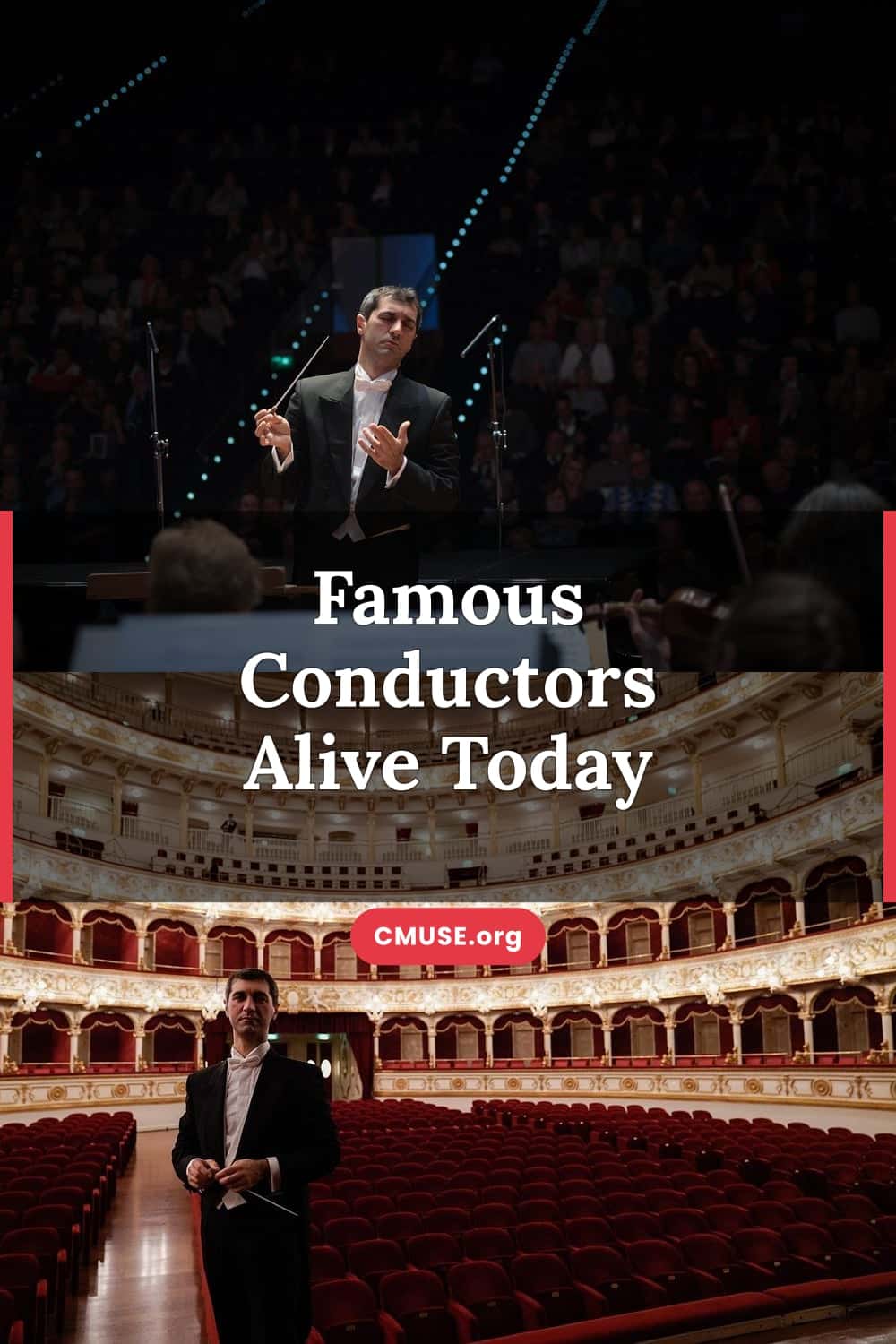
The baton in a conductor’s hand looks simple enough. Yet it carries the weight of a hundred musicians and centuries of tradition. These men and women do far more than keep time.
They shape sound, balance egos, and turn written notes into something that can make an entire hall forget to breathe. Classical music has never been bigger or more global, which means the conductors alive today matter more than ever. They decide what we hear, how we hear it, and why it still matters.
Some lead mighty orchestras with iron precision. Others coax magical flexibility from ensembles that seem to read their minds. A few have become cultural figures whose influence stretches far beyond the concert hall.
The following conductors stand out for the depth of their work, the reach of their careers, and the distinctive stamp they leave on every performance. Each one offers a different answer to the same question: what does great conducting actually sound like in the 21st century?
Leading Orchestral Conductors To Watch Today
1. Riccardo Muti
Riccardo Muti brings old-school authority to everything he touches. Now in his early eighties, the Italian maestro still conducts with the posture of a Roman senator and the ear of a perfectionist who notices every wrong vibrato. His long tenure at the Chicago Symphony Orchestra sharpened an already formidable technique into something almost surgical.
When Muti leads Verdi or Beethoven you hear layers of color that lesser conductors gloss over, yet nothing ever feels fussy. The music simply arrives with overwhelming clarity and theatrical force. That combination of scholarly rigor and Italian theatricality explains why opera houses still beg for his return even as symphony orchestras compete for his calendar.
Muti proves that age need not dull the edge of interpretation when the mind stays fiercely engaged.
2. Simon Rattle
Simon Rattle operates at the opposite pole and that tension is exactly why he belongs on any serious list. The British conductor treats every rehearsal like a laboratory where ideas get stress-tested in public. His early success with the City of Birmingham Symphony Orchestra showed he could transform a provincial band into a world-class ensemble through sheer force of personality and intellectual curiosity.
Rattle hears structure as drama. He will linger over a single chord for what feels like an eternity if it reveals something about the composer’s intent, then explode into the next phrase with almost reckless joy. This willingness to risk everything in pursuit of truth makes his Mahler and Sibelius feel like first hearings even on the tenth listen.
Audiences sense the adventure and follow him gladly.
Mariss Jansons built a reputation as one of the most consistently satisfying conductors of the late 20th and early 21st centuries before his death in 2019, but his influence remains so current that any discussion of living legends must still account for the standard he set. Wait, correction: we are focusing only on those still actively shaping the scene. That takes us straight to
3. Gustavo Dudamel
Gustavo Dudamel, the beaming Venezuelan who turned the Los Angeles Philharmonic into a cultural force unlike any other in America.
Dudamel’s hair flies as wildly as his gestures when the music demands it. His commitment to El Sistema, the Venezuelan music education program that lifted him from modest beginnings, runs deeper than publicity stunts. Under his baton Mahler’s symphonies gain a dancing lightness that feels entirely new while still honoring every marking on the page.
The sheer exuberance he brings to the podium reminds listeners that classical music was never meant to be solemn museum art.
4. Esa-Pekka Salonen
Esa-Pekka Salonen composes as brilliantly as he conducts, a double threat that gives his interpretations special authority. The Finnish musician led the Los Angeles Philharmonic for many years before handing the reins to Dudamel, yet his return visits feel like family reunions with fireworks. Salonen hears the orchestra as a living organism rather than a collection of sections.
He balances the brass and strings with microscopic care while somehow making the whole machine swing. His recordings of Stravinsky and his own music reveal a mind that understands both architecture and color at the highest level. When he steps in front of an orchestra the players visibly relax into a kind of collective intelligence that feels rare.
That trust between podium and musicians is something you cannot fake and audiences hear it immediately.
5. Antonio Pappano
Antonio Pappano has spent two decades as music director of the Royal Opera House while maintaining a parallel life as one of the most sought-after symphonic conductors alive. The Italian-American maestro possesses a theatrical instinct that makes him invaluable in the opera pit, yet his Brahms and Elgar with orchestras prove he never leans on flash. Pappano’s beat is compact and crystal clear, which allows him to sculpt enormous dynamic ranges without ever losing control.
Watch him accompany a singer and you realize the secret: he listens harder than almost anyone on the podium. That intense focus creates the feeling that the orchestra and soloist are finishing each other’s sentences. In an era when many conductors chase novelty, Pappano’s steady excellence across both opera and symphonic repertory feels like a quiet rebuke.
Mastery still counts.
6. Herbert Blomstedt
Herbert Blomstedt represents something increasingly rare: a conductor in his mid-nineties who still leads major orchestras with undiminished freshness. The Swedish-American maestro approaches each score with the curiosity of a young man and the wisdom of deep experience. His performances of Bruckner and Beethoven with the Leipzig Gewandhausorchester have become modern benchmarks because they combine architectural rigor with genuine spiritual depth.
Blomstedt never waves his arms for effect. Instead he uses small, precise gestures that somehow communicate both the smallest detail and the largest structural arc. Watching him conduct feels like witnessing a master carpenter who respects the grain of the wood.
The fact that he continues to perform at this level in his tenth decade offers living proof that serious music rewards a lifetime of honest inquiry.
7. Mirga Gražinytė-Tyla
Mirga Gražinytė-Tyla brings a different kind of electricity to the list. The Lithuanian conductor rose quickly through the ranks and became music director of the City of Birmingham Symphony Orchestra at a remarkably young age. Her interpretations combine fierce intellect with an almost balletic physicality on the podium.
Gražinytė-Tyla has championed contemporary music while delivering revelatory accounts of Mozart and Tchaikovsky that feel both historically informed and viscerally alive. She treats the orchestra as a democratic body rather than an instrument of her will, which produces playing of unusual flexibility and commitment. In a field still dominated by older men, her success demonstrates that talent and vision matter more than any traditional template.
The excitement she generates suggests the classical world is finally opening doors that stayed shut for far too long.
8. Yannick Nézet-Séguin
Yannick Nézet-Séguin combines superstar charisma with genuine musical depth, a balance that explains his rapid ascent to the Metropolitan Opera and the Philadelphia Orchestra. The French-Canadian conductor attacks scores with obvious joy yet never sacrifices precision for showmanship. His Wagner at the Met has restored a sense of theatrical momentum that many houses had lost, while his recordings with the Philadelphia players reveal an ensemble that sounds completely rejuvenated.
Nézet-Séguin understands that modern audiences need to feel welcomed into the experience without being condescended to. He speaks about music with infectious enthusiasm yet the performances themselves remain rigorously prepared. That combination of accessibility and excellence makes him one of the most effective ambassadors classical music has right now.
The baton may be small but the responsibility it carries is enormous. These conductors, each in their own way, remind us that the score is only a starting point. What happens in the hall on any given night depends on the mysterious connection between one person’s vision and a hundred highly trained musicians who have agreed, for a few hours, to follow.
Their varied approaches prove there is no single correct way to lead an orchestra, only the continual search for truth within the notes. Listen closely enough and you realize they are not merely conducting music. They are conducting us, helping us hear more clearly both the sounds around us and the silences we too often ignore.
The next time you sit in a concert hall, watch the figure on the podium with fresh respect. That small stick is moving far more than time.