Exam Grade Weighting Calculator
Blend performance, scales, sight-reading, aural, theory, and jury rubric marks into one music exam result.
| Preset | Performance | Technical | Sight / Aural | Theory / Jury |
|---|---|---|---|---|
| ABRSM Grade 5 Practical | 60% | 14% | 26% | 0% |
| Trinity Grade 8 Recital | 66% | 12% | 17% | 5% |
| RCM Level 6 Practical | 58% | 14% | 18% | 10% |
| College Jury Rubric | 45% | 10% | 10% | 35% |
| Conservatory Entrance | 55% | 10% | 10% | 25% |
| Band | Typical Range | Music Exam Meaning | Next Review |
|---|---|---|---|
| Distinction | 87% and up | Secure, polished, stylistically clear | Refine nuance |
| Merit / Commended | 75% to 86.9% | Strong command with small slips | Raise weakest test |
| Pass | 60% to 74.9% | Core requirements met | Stabilize technique |
| Below Pass | Under 60% | Rebuild high-weight categories | Target fundamentals |
| Category | What It Measures | Common Weight | Fastest Score Lever |
|---|---|---|---|
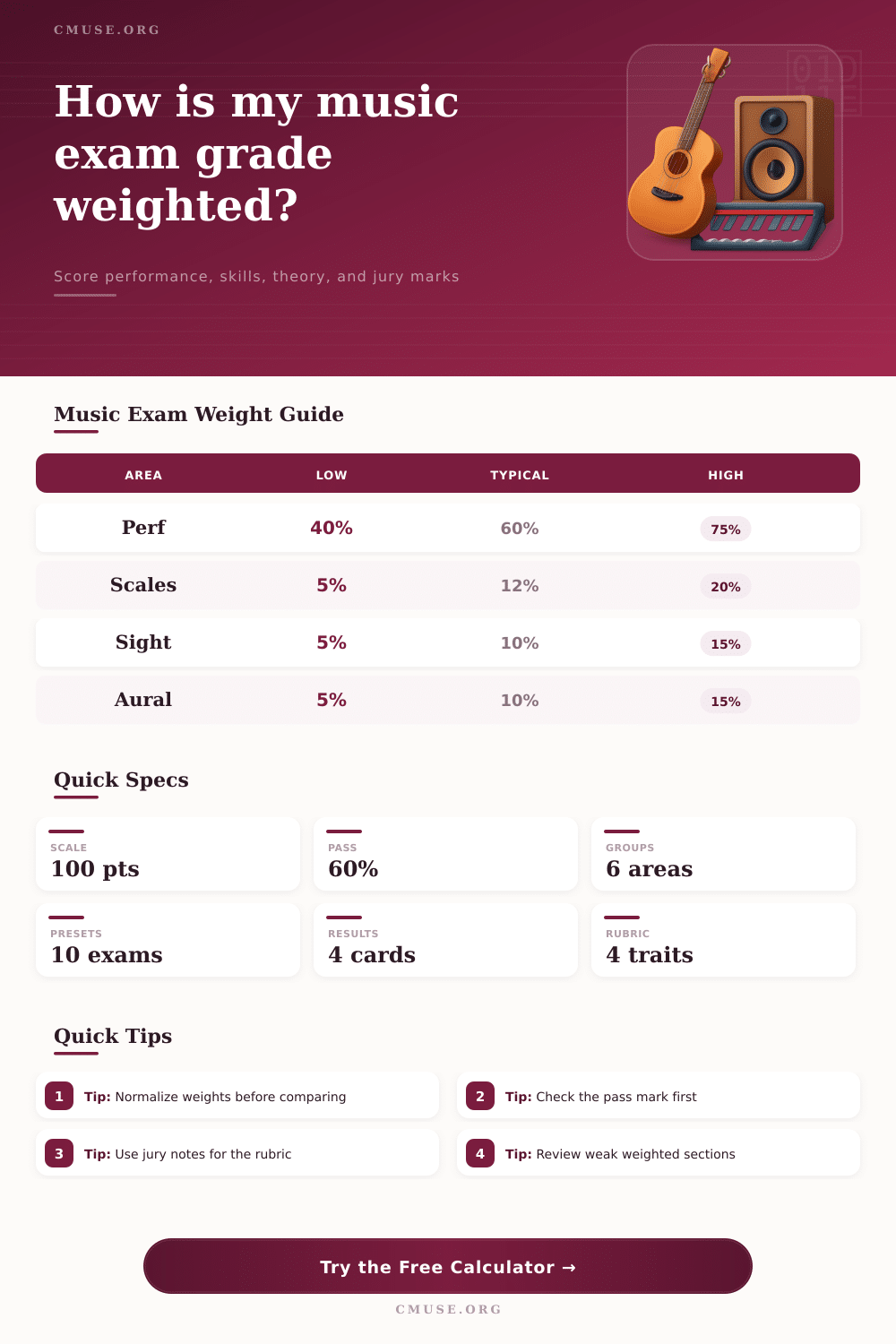
| Performance | Pieces, style, continuity | 45% to 75% | Secure transitions |
| Scales | Technical vocabulary | 5% to 20% | Even pulse |
| Sight-Reading | Fluency under pressure | 5% to 15% | Keep rhythm moving |
| Aural | Ear, pulse, memory | 5% to 15% | Sing intervals daily |
| Theory | Notation and concepts | 0% to 15% | Fix key signatures |
| Jury Rubric | Panel musicianship score | 0% to 35% | Balance tone and style |
| Rubric Trait | 90% Signal | 75% Signal | 60% Signal |
|---|---|---|---|
| Technique | Clean, relaxed control | Minor uneven spots | Basic accuracy holds |
| Tone | Centered, expressive sound | Mostly consistent tone | Usable but variable |
| Interpretation | Convincing style choices | Clear phrase direction | Some musical shape |
| Presence | Professional and focused | Recovered from slips | Completes program |
When preparing for an exam, whether you are wanting to pass or not, there is only one goal: To pass. However, passing is seldom just one number. It is more likely to be a combination of marks from different parts: sight reading, scales, aural tests, and a final piece. Each section has its own weighting towards the overall mark.
Once you enters the relevant marks into the calculator above it will do the maths for you. That way you know which weak area might be balanced out by your strong ones. The key here is simply to understand what is realy being tested.
How Exam Marks Are Counted
For many practical examinations, the bulk of the marks are given towards main pieces. Often these represent over 50% of the overall mark; after all, this is where your music making skills comes to life. These are the pieces you’ve spent months preparing and you know like the back of your hand; so, it makes sense that all this work would play heavily into the outcome. You can get away with a low score in the technical exercises if your repertoire’s on fire! The weight of performance section will help cushion any poor showing elsewhere.
In contrast, there is the technical work: scales, arpeggios etc. These tend to be the lighter part of the examination but more important for future development. If your pieces is strong then a poor score here will not necessarily fail you, but it points toward something that needs improvement at its foundations. Perhaps you have a high weighted score but a low technical score, which reveals an imbalance in your skills.
This is where the table below on the page comes into play. It shows how much each section count toward the total score. This helps you see where it makes the most sense to focus your practice time.
Statistically speaking, sight-reading and aural tests can be far more problematic than their worth. Often weighted at a modest ten percent each in many systems, they are typically not the part of the exam that could potentially damage your chances. If everything else is good then a poor showing in the sight-reading will lose you a couple of percentage points at most.
What students fear about these components is that they are unpredictable. The examiner may ask an unfamiliar interval or play a piece of music you have never seen before. You cannot do anything to prepare for these things, so they seem much bigger in the student’s mind than their actualy effect on the final result.
You should also consider higher level examinations and University Juries. Here the panel’s impression, or the jury rubric can hold considerable weight. It isn’t just about the accuracy of notes but also musicianship, tone quality and even stage presence. This is where you’re making an argument for importance of the music. To address this with the calculator, you can alter how much each element weighs up towards final grade. If the overall artistic impression holds more importance to your exam board than the perfect execution of every single note then you can raise that weighting in the calculator.
Keep in mind that there are real world threshold settings to consider. Sixty percent isn’t necessarily the pass line for everything, and you may need to get at least a certain mark in particular areas regardless of your average. For instance, although a student might have got an overall percentage of 90 percent, if their marks were below a set minimum in any of the scales, then they would of failed. This is one reason it’s so useful to check exactly what your examination body requires before you assume that a weighted average can be used alone. You can adjust the credit given for each bonus point or penalty mark individually. This lets you model that sort of situation.
Crucially though, it’s not about hitting a number. It’s about seeing where you’re strengthening your ability and where you’re weak. If there is a high score in ‘performance’ and a low score in ‘technical’, that is a worrying split. It might indicate that you are passing exams without building the skill to handle harder works later on. Perfect technique paired with a flat performance could mean that although you are technically fine, you aren’t playing with any musicality. You get instant feedback on those compromises, and each grade becomes a diagnostic tool for your upcoming practice sessions.
This also alters preparations. When you know how your mark has been built then it’s no longer a case of being afraid to fail but rather strategically planning how to succeed. If the math doesn’t care about your nerves, then why do you? That’s when you begin to think strategically about which notes are most important instead of just being afraid of missing one.
After all, the math isn’t concerned with your fear. The math is concerned with the distribution of effort and the scores that result. And that is what knowing the distribution enables: you can control the outcome. You choose what to focus on based off what really moves the needle. That’s the true worth of learning to break down the grade before the examiner opens their mouth.