Euclidean Rhythm Calculator
Build evenly distributed pulses across steps, rotate the pattern, add accents, and map the result to musical time.
🎵Rhythm Presets
⚙Pattern Inputs
Step Grid
📊Calculated Spec Grid
📘Euclidean Rhythm Reference
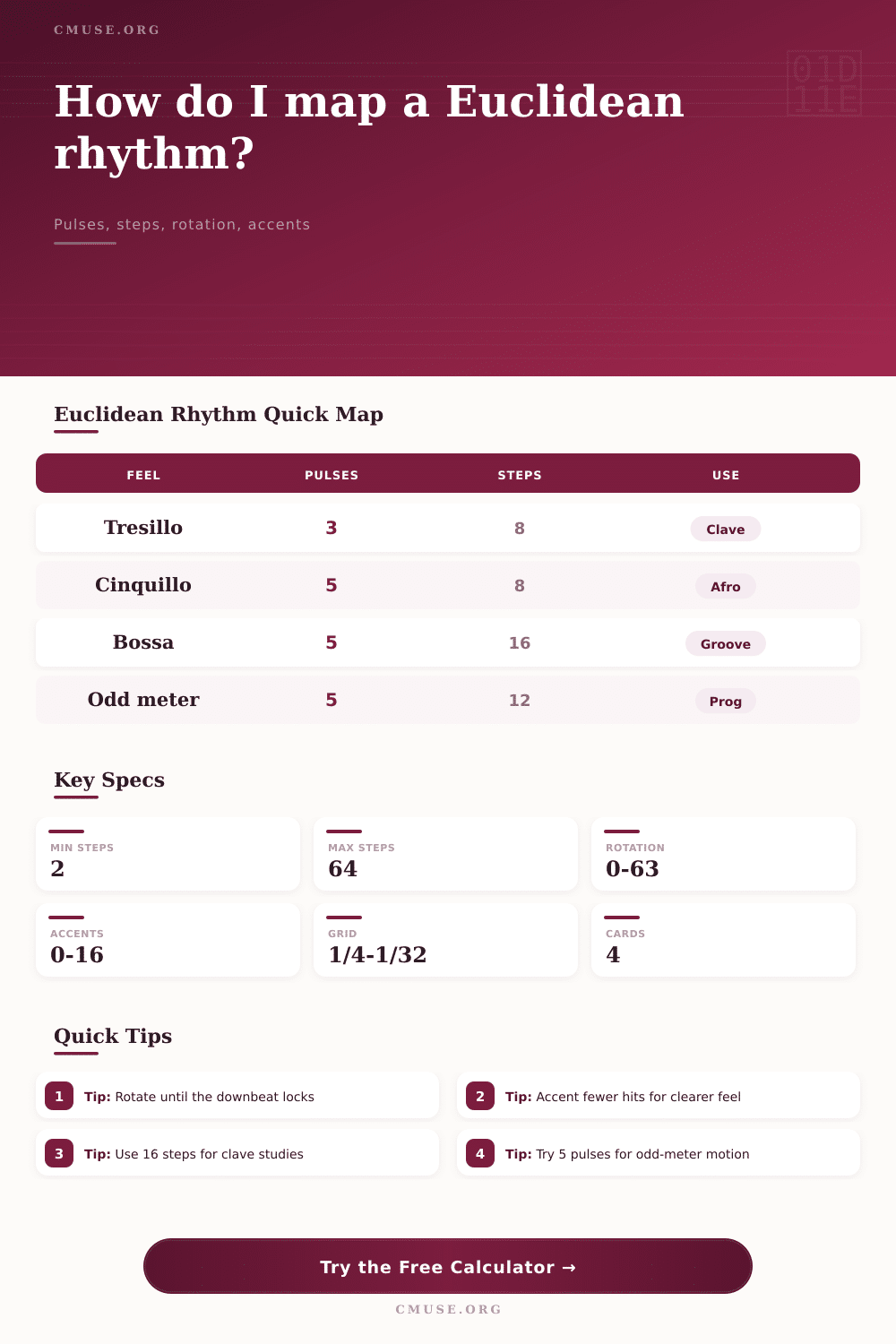
| Preset | Pulses / Steps | Typical Mapping | Musical Use |
|---|---|---|---|
| Tresillo | 3 / 8 | 8th-note 4/4 cell | Afro-Cuban, pop clave outline |
| Cinquillo | 5 / 8 | 8-step phrase | Afro-Caribbean syncopation |
| Bossa cell | 5 / 16 | One 4/4 bar of 16ths | Guitar, rim, clave-style comping |
| Aksak study | 5 / 12 | 3-beat grouped grid | Uneven meter sketching |
| Steps | Subdivision | 4/4 Span | Useful For |
|---|---|---|---|
| 8 | 8th notes | 1 bar | Tresillo and short clave fragments |
| 12 | 8th triplets | 1 bar triplet feel | 12/8 bell patterns and 3-group studies |
| 16 | 16th notes | 1 bar | Bossa, techno, funk, and sequencer grids |
| 32 | 16th notes | 2 bars | Long polymetric loops and evolving phrases |
| Density | Feel | Accent Idea | Arrangement Role |
|---|---|---|---|
| 10% - 25% | Sparse | Accent the first hit only | Bell, click, low drum cue |
| 26% - 45% | Open groove | Accent 2 or 3 hits | Clave, hat, pluck, rim pattern |
| 46% - 65% | Busy but readable | Accent every other hit | Shaker, arpeggio, texture layer |
| 66% - 90% | Dense | Use accents as phrase anchors | Rolls, fills, fast ostinatos |
| Time Signature | Common Step Grid | Auto Group | Mapping Note |
|---|---|---|---|
| 4/4 | 16 or 32 | 4 | Four 16th-note groups per bar |
| 6/8 | 6 or 12 | 3 | Two dotted-quarter beats |
| 7/8 | 7 or 14 | 2 | Try 2+2+3 or 3+2+2 phrasing |
| 12/8 | 12 or 24 | 3 | Four triplet groups per bar |
💡Pattern Tips
The sound is a rhythm that somehow rings true but doesn’t come from any known place. It might be in West African drum circle, in an ancient Medieval chant, or even in a techno track. At first, the rhythm seem lopsided, then it seems perfectly balanced by ear. That’s because it’s Euclidean Rhythm.
It is a series of patterns that distributes pulses as evenly as possible over a given set of steps. The result is a natural flow that sounds organic and never like something was mechanically created. Most musicians discover these groove instinctively, but now you can plot them out precisely.
What Is Euclidean Rhythm?
Here’s the thing, it’s just distribution. Let’s say there are five hits in a piece that fit into an equal number of empty spaces (16). What you would like to do is distribute them evenly. They should not be too far apart from each other, but also not spaced so closely that they seem awkward. So how does the computer do this? How does it put the pulses down on timeline? Well, it doesn’t randomly space them out. Instead, it places one pulse, skips a certain number of steps, and places another pulse, repeating this pattern until all are placed.
In fact, applying concept of exactness to time helps explain the appeal of these types of rhythms such as the bossa nova guitar pattern or the tresillo. These is mathematically optimal solutions to the challenge of distributing equally. The resolution of your grid is determined by how many steps define the pattern when you begin to build it out. If you have eight steps, that’s going to feel like an eighth note. But if you have sixteen, now you’re getting into the intricacies of syncopation, while thirty-two steps allow for micro-timing details that add texture without cluttering the main beat.
If you have thirty-two steps, you’ve got texture, but not so much clutter as to lose the main pulse. You can switch back-and-forth between these grids and see character shift of a given pulse count as it changes resolution. Five pulses over eight steps sounds direct and driving. That exact same five pulses spaced over sixteen steps sounds complex and airy. It is density relative to frame.
This is where it gets interesting. The base Euclidean algorithm usually starts at an offset. This means the hits do not necessarily land on the downbeat. We have an expectation in music that there will be some sort of relationship to the bar line. Rotating a pattern shifts each hit forward/backward by a defined number of steps, enabling you to keep internal spacing logic but realign your accent to the first beat of the measure. You go from being displaced to locking in with the rest of the band.
Without any accents, the grid is flat… But accents create hierarchy. They are what give the Euclidean pattern its muscle; they are the skeleton. Not everything need to be hit equally hard. In fact, choosing which hits to accent strongly can totally transform the feel or even perceived meter. An example: Would you feel different about a five-hit pattern that was accented on one and three versus two and four? This is where the calculator marks out those choices in a distinctive way so you can try the effect of dynamic variation on the groove without having to load it into your sequencer.
What we know about Euclidean rhythms is that they spring up independently through cultures because they are born out of simple physical limitations of speech and movement. If a group of people dance together or clap their hands then by nature they’ll tend towards even spacings between beats. It’s a mathematical convergence that holds true in Electronic Dance Music as it does in Balkan Folk Dances and Byzantine music. The power of this is that it provides composers with a strong structure that crosses genres. Take the logic from one culture and apply it to another with interesting consequences.
One of the places many producers trip up is by attempting to jam complex rhythms into traditional time signatures. Instead of forcing the pattern into a beat count that doesn’t fit, consider where the pattern aligns within the bar. For instance, a pattern that contains seven pulses in 12 steps may not cleanly divide into four-four. It could form a complete section in seven-eight. Or, it could provide an interesting polymeter with a solid kick drum pattern. Consider also if this pattern repeats each measure or spans several bars as part of a longer phrase. Knowing its cycle length will aid in this decision.
These calculators take the guesswork out of rhythmic theory. They let you explore distributions you may or may not think of intuitively while staying true to the math that makes grooves sound right. You’re able to work on large grids and odd pulse counts without getting lost. What’s produced is no longer just an abstract set of data points, but rather ready-to-use rhythmic cells that add intention and clarity to your musical creations.
Begin with a simple distribution, align it in time and let the even spacing do the heavy lifting for your groove. You should of tried this earlier.