Error Rate Per Repetition Calculator
Measure mistakes per rep, clean streak strength, tempo pressure, fatigue risk, and whether a passage is ready for faster practice.
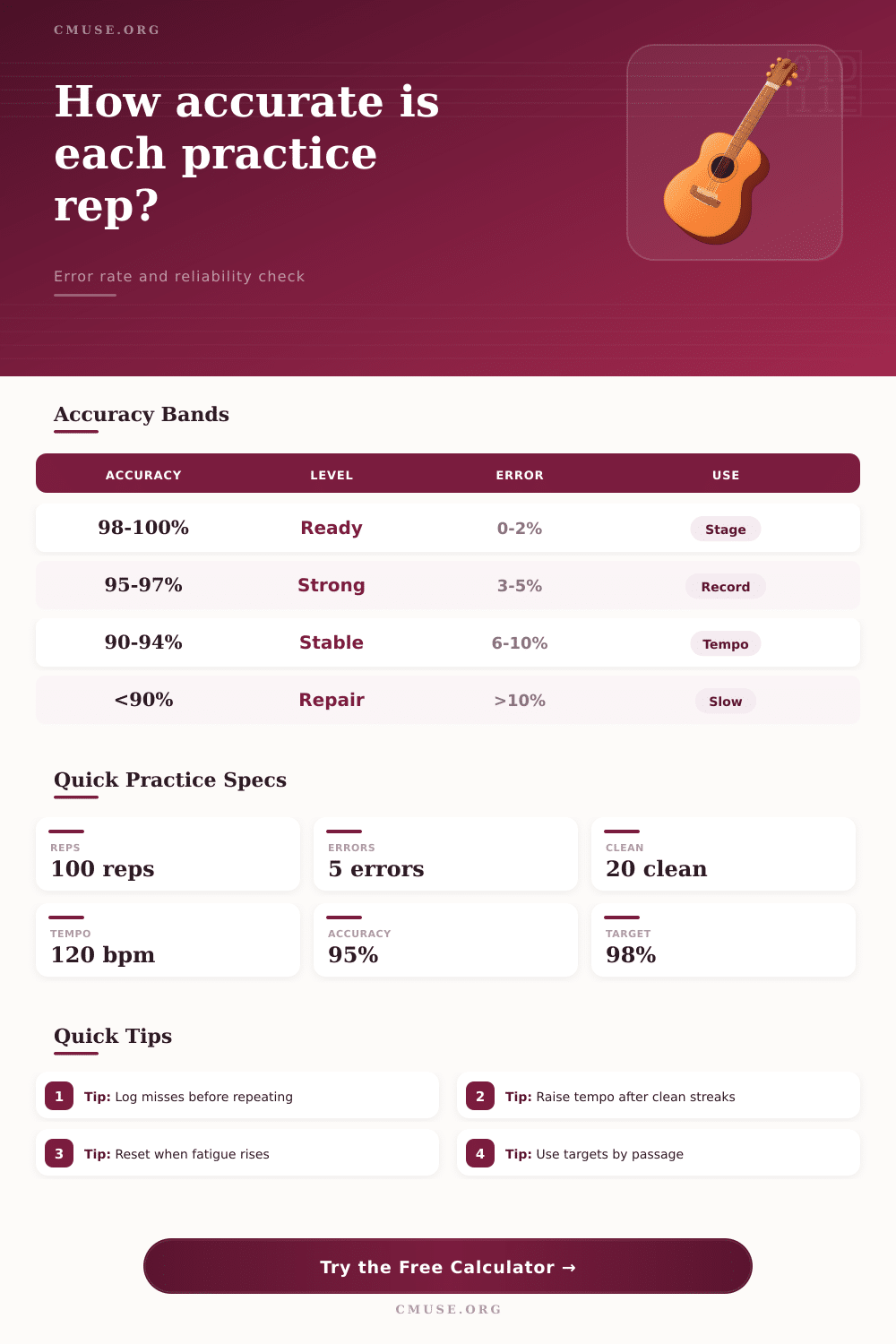
| Accuracy Band | Error Rate | Practice Meaning | Next Action |
|---|---|---|---|
| 98% to 100% | 0 to 2 per 100 reps | Performance-ready consistency | Test at goal tempo or in full context |
| 95% to 97.9% | 2.1 to 5 per 100 reps | Strong but still error-prone under pressure | Add clean streak targets before raising speed |
| 90% to 94.9% | 5.1 to 10 per 100 reps | Useful learning zone for repeated correction | Slow tempo and isolate the trigger note or motion |
| Below 90% | More than 10 per 100 reps | Pattern is not reliable yet | Reduce difficulty, shorten the loop, or reset fingering |
| Factor | Low Load | Medium Load | High Load |
|---|---|---|---|
| Passage difficulty | 1.00 easy pattern | 1.10 to 1.22 technical | 1.36 to 1.50 audition risk |
| Fatigue rating | 1 to 3 supports learning | 4 to 6 watch repeat errors | 7 to 10 split sets or stop |
| Tempo pressure | 0% to 25% controlled | 30% to 60% moderate stress | 65%+ exposes weak habits |
| Clean streak share | 30%+ strong retention | 15% to 29% workable | Under 15% unstable |
| Tempo Ratio | Pressure | Reliability Expectation | Practice Use |
|---|---|---|---|
| Under 70% of goal | Low | Accuracy should be very high | Build motion shape and clean resets |
| 70% to 84% of goal | Moderate | Small misses are useful data | Raise tempo only after repeatable streaks |
| 85% to 94% of goal | High | Errors often reveal true bottlenecks | Alternate slow reps with near-goal checks |
| 95%+ of goal | Performance | Accuracy target should be strict | Use fewer reps and longer recovery breaks |
| Scenario | Typical Reps | Target Accuracy | Clean Streak Goal |
|---|---|---|---|
| Slow scale cleanup | 60 to 100 | 98%+ | 25 clean reps |
| Technical passage loop | 80 to 160 | 95% to 98% | 20 clean reps |
| Audition excerpt check | 30 to 80 | 98%+ | 12 clean full passes |
| Late-session fatigue test | 40 to 90 | 93% to 96% | 10 clean reps after rest |
Benchmarks assume counted reps with mistakes logged immediately, not estimated after the session.
Sometimes, you’ll find yourself playing something just right in practice and then you stumble when it matters. More often than not, it’s not a lack of ability. Instead, it’s an inability to accurately assess reliability. You are prone to thinking you’re skilled if you can hit a note one time…or two times…and so on. What happens in-between get missed. But tracking how many times you make a mistake for each repetition changes your perspective. It makes vague frustration real, actionable information.
When you plug in your log of mistakes and reps, the calculator (above) crunches numbers for you. No more guesswork about whether it’s time to advance. There are two key inputs. You need to track not only mistakes, but also how many times your clean runs has been error-free in a row. Clustering errors in certain locations can make accuracy appear strong. But a brief history of flawless lifts suggest that luck might be working in your favor. That’s something you don’t want.
Why You Should Track Your Practice Mistakes
Every mistake you make, when tired, becomes a multiplier on top of itself. Pushing yourself too far into the red causes your mind to stop correcting mistakes and begin to reinforce them. This is why it’s good to keep track of not only tempo pressure but also fatigue level. Poor habits form when the tempo are fast and you are tired. Grinding in hopes it’ll build endurance. Instead it builds inconsistency. By tracking this, the tool can help untangle variables: how much of your error rate is due to exhaustion versus pushing too fast?
Most players never find this sweet spot between performing and learning. Being around ninety-five to ninety-eight percent accurate hits the spot. Below that, it’s discovery. Above that, it’s polish. Anything else is practising mistakes at full speed. That’s hard to reverse later on. These bands are clearly shown in reference table on the page. So you can always have an idea of what band your practice falls into.
When beginners practice, they gets hung up on starting at last speed. The metronome becomes the finish line and not a diagnostic device. To master this takes time…slow time. Make sure you start from a complete stop before you add the motion back. Accept boredom for accuracy. Stop if you’re off. You should of not keep going just because there are seconds left on the song.
When was the last time you had an issue learning a challenging chord change or run? Did you break it down and work on it until it became automatic? Or did you continue plowing away until you accidently stumbled onto something that worked? In the moment, I guess it seems like it’s productive. But when push came to shove, it never really held water. There has to be some sort of clean repetition that allows you to trust your playing. You can’t trust what you don’t measure.
But doing so strips emotion out of the process report card. Are you playing good? Bad? Nope. You’re taking data points, which will show you what’s going on. Is it a finger dexterity problem? Is it a rhythmic gap? Is it mental fog because you’ve taken too many sets in a row? The numbers will let you know all this. There is no ego here, just mechanics.
Before repeating that section again for the hundredth time, or turning up the metronome to play faster, check the streak length. Is it long? Speed it up just a little. Short? Slow it down. Log honestly, keep the loop tight. When it’s performance day and your nerves is hammering on you, the future you will thank you. Verifying that you owned those notes ensures they will be available.