Enharmonic Equivalent Calculator
Compare pitch classes, key-spelling preference, and octave placement to find the most musical respelling.
🎵 Preset Spellings
📊 Enharmonic Inputs
📈 Spell Grid
📖 Reference Tables
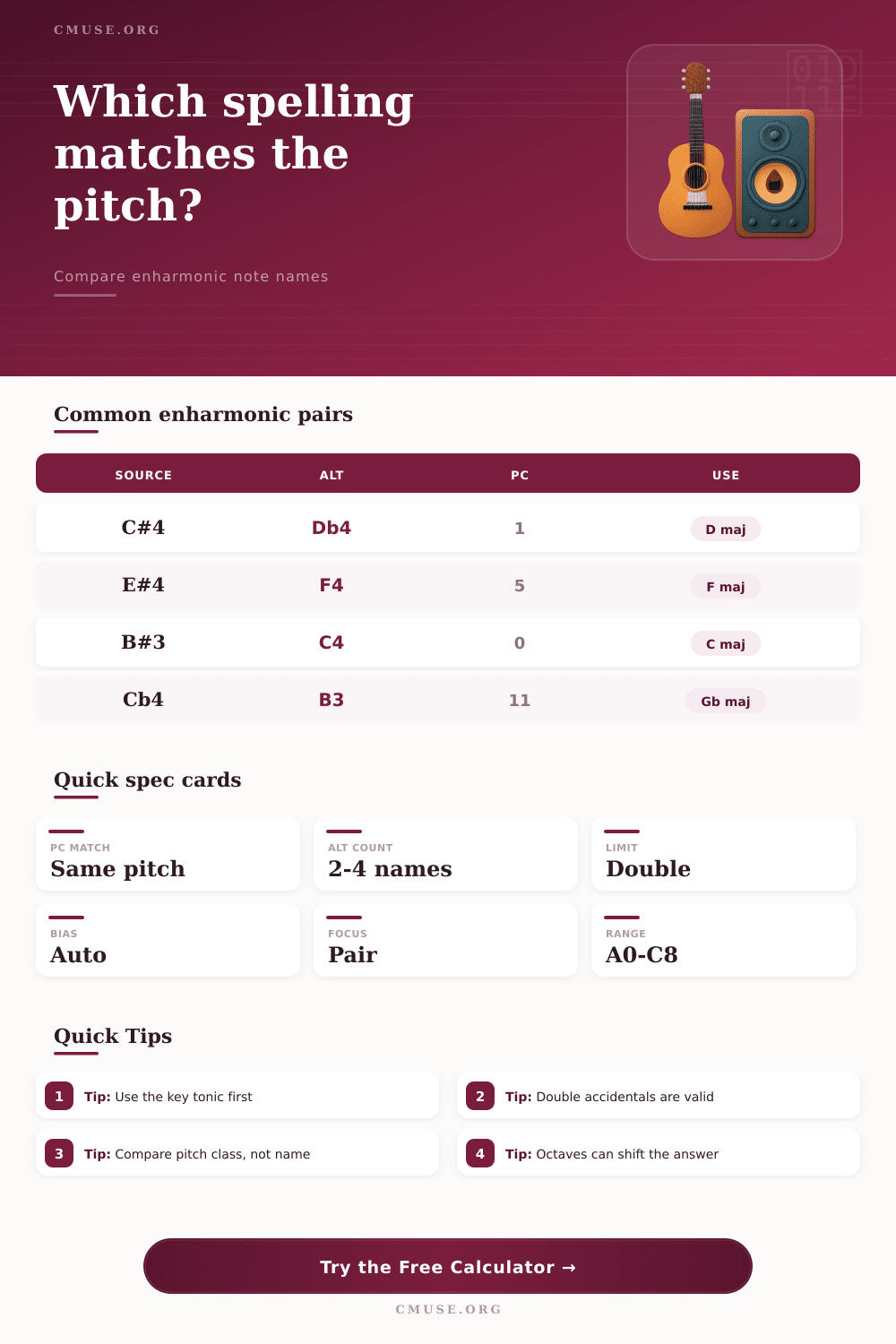
| Source | Alt | Pc | Use |
|---|---|---|---|
| C♯ | D♭ | 1 | D major |
| E♯ | F | 5 | F major |
| B♯ | C | 0 | C major |
| C♭ | B | 11 | G♭ major |
| Anchor | Alias | Pc | Use |
|---|---|---|---|
| B♯ | C | 0 | Tonic lift |
| E♯ | F | 5 | Lead tone |
| C♭ | B | 11 | Flat key |
| F♭ | E | 4 | Low key |
| Key | Tonic | Bias | Notes |
|---|---|---|---|
| Major sharp | D, A | Sharp | F♯, C♯ |
| Major flat | B♭, E♭ | Flat | B♭, E♭ |
| Minor sharp | E, B | Sharp | F♯, C♯ |
| Minor flat | D, G | Flat | B♭, E♭ |
| Interval | Spell | Alt | Use |
|---|---|---|---|
| Unison | P1 | A1 | Same pitch |
| Second | m2 | A1 | Step apart |
| Tritone | A4 | d5 | Split read |
| Octave | P8 | d9 | Class wrap |
Enharmonic equivalence are the idea of using different note names to represent the same pitch. Each musical pitch has multiple name, and these different name are called enharmonics. For instance, C# and Db is two different names for the same musical pitch.
C# and Db represent the same sound when played for a listener. However, the name of the note that should be used is dependent upon the musical context in which the song exist. Because a musical octave contain twelve different semitones, each musical pitch can have more than one name.
Same Pitch, Different Note Names
For instance, the same pitch as F has two different names: F and E#. The same is true for C and B#. These different name for the same pitch are not considered mistake in musical notation. Yet, the note name that musicians use for musical notation can have an impact in the readability of that musical notation. If the note that is chosen for musical notation does not fit within the musical key, the musical notation will be more difficult to read.
However, if the note that is chosen for musical notation fits within the musical key, musicians who read musical scores will find the musical notation more easy read. One of the most important factor in determining which note should be used for musical notation is the musical key in which the music is written. If the composer writes the music in the key of D major, the note of C# should be used because it is part of the major scale that range from D to D. However, if the music is written in the key of Bb major, the note of Db should be used because it is one of the note of that major scale.
In addition to the musical key for which music is written, the mode of the music is another important factor in determining which set of note name should be used for enharmonic equivalence. Modes utilize accidentals as part of their characteristic sound. For example, melodic minor scale utilize a single sharp or single flat note.
Additionally, some modes use double accidentals, such as double sharps (# #) or double flats (b b). Double accidentals are more difficult to read than single accidentals. However, the composer only use double accidentals in instances in which a single sharp or flat is already being used for another note in the scale. The use of triple accidentals in musical notation is quite rare.
Yet, whenever they is utilized, the reader should avoid them to prevent any visual confusion of the musical score. There are several method for deciding which note name will be used in musical notation. Some of these method include using the musical key to determine which note should be used, using the intervals between the notes to determine which note should be used, or using the pitch class of the note to determine which note should be used.
While each of these method will help to indicate which note should be used for musical notation, the note that is chosen based off the musical key is the most important. Additionally, the direction of the melody can also have an impact in which note name are used for enharmonic equivalence. For instance, if the melody move upwards in the musical score, sharps should be used to represent the notes within that melody.
Additionally, flats should be used for musical notes within melodies that move downwards in the musical score. This is due to the way in which the human eye scan the musical score. Intervals between the musical notes will also complicate the choice of which note should represent each pitch within the musical score.
For example, a tritone can be spelled in several different way depending upon the direction of the musical score. Other factors that should be considered when choosing which note names will be used for musical notation are to respect the original source of the music. For example, lead sheets use sharps instead of flats for notes like C# instead of Db.
This should not be changed unless the musical key require the change from sharps to flats or flats to sharps. In other instances, musicians should also be careful to avoid any octave slip. For example, the note of B#3 and C4 has the same pitch.
Yet, including both of these note name in the same melodic line may change the way in which the musicians minds perceive the music. In the end, the most important element in the consideration of which note should be used for musical notation is the musical context in which the music is written. If a musician desires to create a high score for the musical piece, the note name should be easy to read and easy to play.
The musician should choose the note name that best fit the musical family to which the song belongs. Additionally, the musician should choose the note name that minimizes visual noise for readers of the musical score. Furthermore, when the musician chooses the correct enharmonic for each musical pitch, the musicians who read the score will find it to be more easier to read and perform that particular musical score.
Youll find that if you study hard, it’s going to be naturaly easy. It could of been harder, but its simple. Actually, the moddern ways of learning makes it much more comfortabley.