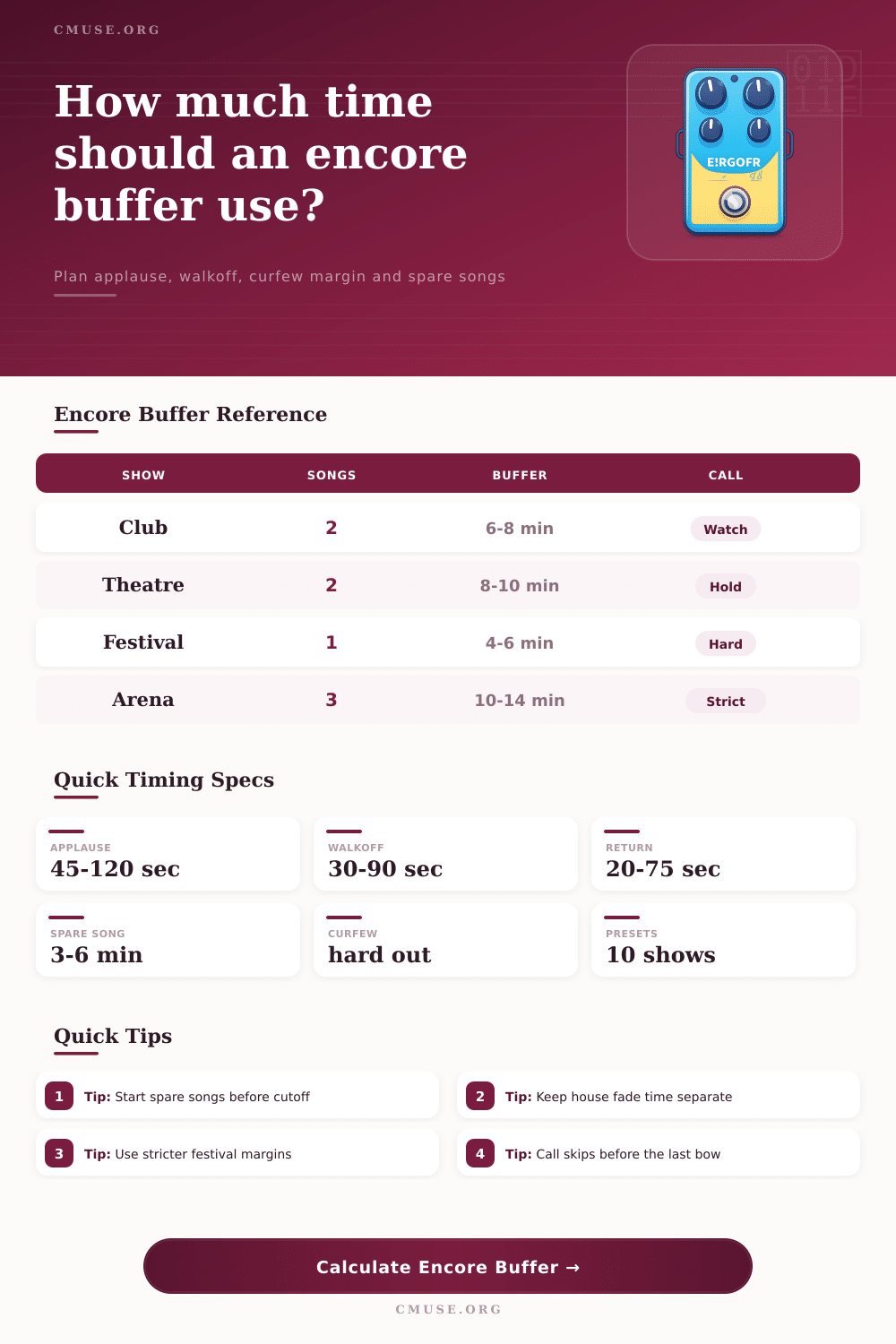
Encore Time Buffer Calculator
Plan a practical encore buffer from applause, walkoff time, band return, spare-song length, house-light cues, and hard curfew so the final call is clear before anyone walks back on.
Detailed Encore Timing Breakdown
Applause Before Walkoff
Walkoff And Return
Approved Encore Songs
Spare Song Package
| Timing Element | Included Time | Running Position | Call Note |
|---|
| Cue Area | Prep Window | Timing Risk | Best Buffer Use |
|---|---|---|---|
| FOH final fade and walkout music | 10 to 30 sec | Late applause masks the fade | Keep fade separate from song length |
| Monitor or IEM count-in reset | 10 to 25 sec | Band returns before click or cue is armed | Reserve return time before first note |
| Guitar or bass change | 25 to 60 sec | Spare song starts with wrong tuning | Add overhead to the spare song package |
| Drum stick, pad, or trigger reset | 15 to 45 sec | Encore count-off slips after walkback | Use a ready-check before the spare call |
| Guest vocal or horn walk-on | 30 to 90 sec | Entrance applause doubles the gap | Treat the guest cue as MC time |
| Lighting blackout and house restore | 15 to 40 sec | Curfew clock keeps running after last note | Leave house-light time in the final buffer |
| Show Type | Typical Encore | Applause And Walkoff | Planning Buffer |
|---|---|---|---|
| Club headline set | 1 to 2 songs | 2 to 4 minutes | 6 to 8 minutes |
| Seated theatre | 2 songs plus bows | 3 to 6 minutes | 8 to 10 minutes |
| Festival slot | 0 to 1 song | 1 to 3 minutes | 4 to 6 minutes |
| Arena headline | 2 to 4 songs | 4 to 8 minutes | 10 to 14 minutes |
| Broadcast or livestream | 0 to 1 song | 30 to 90 seconds | 3 to 5 minutes |
| Policy | Protected Holdback | Spare Song Rule | Common Final Cue |
|---|---|---|---|
| Club posted curfew | 90 seconds | Play only if full package fits | House music at curfew minus fade |
| Seated theatre house clock | 2 minutes | Keep bows from eating song time | Soft house restore after final bow |
| Festival hard-out slot | 3 minutes | Skip unless the call is early | Stage manager clears before line check |
| Arena curfew and crew call | 4 minutes | Protect load-out and transport | Blackout, walkout track, fast clear |
| Broadcast or livestream hard out | 5 minutes | No spare after cutoff warning | Producer count and final camera cue |
| Preset | Encore Plan | Usual Risk | Best Call Point |
|---|---|---|---|
| Club Two-Song Encore | Two medium songs after crowd swell | Applause runs long | Before the second song count-in |
| Theatre Standing Ovation | Bows, speech, two songs | Bows expand the return gap | At curtain-line return |
| Arena Curfew Hold | Three songs with long outro | Hard curfew and load-out pressure | Before the final anthem |
| Festival Hard-Out Slot | One short encore or none | Next act changeover | At stage manager five-minute call |
| Livestream Hard Out | One reprise plus credits | Producer clock cannot drift | Before credits roll |
In some ways, the encore is less of a musical number and more of a high-wire act: You’re playing it under time constraints imposed by another person. You’ve already done all your hits. The audience are yelling for more, yet you stand in the wings waiting to hear a cue. And that cue will depend on how many minutes until the venue shut down the show. It’s an uncomfortable instant when artistry bumps up against practicality.
Does this mean we has enough time for one more song? Or is it time to bring up the house lights? If you guess wrong, then you might cut off a killer moment, or face the wrath of security as you fail to make curfew. But what if the app crashes? What if there’s no power? Knowing how this works will save you.
How to Time Your Encore Perfectly
The big secret is, applause time is dynamic. It doesn’t stay the same. Sometimes it take three minutes in an arena; sometimes it lasts 40 seconds for a polite club audience. Variables change. Don’t budget your encore based off hope.
Create a buffer that factors in actual length of the songs you intend to perform plus the walkoff (how long it takes to get offstage), as well as any intentional silence you create backstage. The reason most touring bands blow it here: “Song length” means they assume a four-minute song lasts for just four minutes. But a song doesn’t last four minutes; it’s four minutes plus the count-in, the applause during the intro, whatever banter the frontman say beforehand, and then the audio fade-out at the end. And if you’re playing two encore? Double the overhead.
The thing breaks these out and lets you look at where time is escaping. It makes you realize that the return and the walkoff take real minutes away from rest of your time, so pretending they don’t exist is the quickest way to lose your profit.
The math gets harder due to venue policy. If the next act’s got gear and a crew waiting in the wings, there’s no negotiating your hard-out slot in the fest. You can’t bleed over into their changeover time. As table on the page spells out, the need for tighter buffers applies more to festivals than to flexible late-night club sets. In an arena situation, you may enjoy some leeway for curtain calls and bows. However, if a union rule or local law enters the picture, all such luxurius dissapears. Transport schedules or noise complaints will typically make curfew strict, and there’s no arguing with it at 11:05 PM on a Tuesday.
Where experience counts most is the choice of whether or not to play a spare song on the fly. When the audience go crazy for one more, it’s hard not to take ’em up on it (unless), of course, you’ve checked whether you’re willing to risk it. When time is tight, you start an extra track knowing that you may not be able to finish it properly. And thus begins the hurried exit or sudden blackout at show’s end.
To avoid such circumstances, a wise approach is to decide before the next-to-last note you intend to play. By this point, you’ll be well into the last scheduled song and too far gone to judge whether there’s room for an encore. It falls then to the stage plot coordinator and band manager to keep an eye on the clock at the finale.
Consider the buffer to be like enthusiasm insurance. The audience calls for more and they clap extra hard. When it’s time for them to go home, they hold off just a little while longer with those lights up. That’s energy your plan should of account for, but not break any laws about what the space can handle. Tweaking the “risk” slider on this tool will affect how much wiggle room you give yourself for such energy bursts. More conservative = everything runs exactly according to plan. Safer = somebody forgot to count us in or drop a guitar pick.
The result is ultimately a clean ending, one in which we feel it was earned, not rushed. The final bow should come when the energy is still high, not with the house lights up and you are cramming cables into bag. That’s why good timing can make it all a part of the show’s drama. It’s a logistical necessity but it becomes something else entirely.
We walk off, we wait, we return, we leave on our own terms. That is why getting that sequence right can feel the same at the end than it did at the start.