🎸 Electric Guitar String Tension Calculator
Calculate exact string tension in lbs & kg for any gauge, scale length, and tuning
| Tuning Name | String 1 | String 2 | String 3 | String 4 | String 5 | String 6 (Low) |
|---|---|---|---|---|---|---|
| E Standard | E4 329.63 Hz | B3 246.94 Hz | G3 196.00 Hz | D3 146.83 Hz | A2 110.00 Hz | E2 82.41 Hz |
| Eb Standard | Eb4 311.13 Hz | Bb3 233.08 Hz | Gb3 185.00 Hz | Db3 138.59 Hz | Ab2 103.83 Hz | Eb2 77.78 Hz |
| D Standard | D4 293.66 Hz | A3 220.00 Hz | F3 174.61 Hz | C3 130.81 Hz | G2 98.00 Hz | D2 73.42 Hz |
| Drop D | E4 329.63 Hz | B3 246.94 Hz | G3 196.00 Hz | D3 146.83 Hz | A2 110.00 Hz | D2 73.42 Hz |
| Drop C | D4 293.66 Hz | A3 220.00 Hz | F3 174.61 Hz | C3 130.81 Hz | G2 98.00 Hz | C2 65.41 Hz |
| Open G | D4 293.66 Hz | B3 246.94 Hz | G3 196.00 Hz | D3 146.83 Hz | G2 98.00 Hz | D2 73.42 Hz |
| DADGAD | D4 293.66 Hz | A3 220.00 Hz | G3 196.00 Hz | D3 146.83 Hz | A2 110.00 Hz | D2 73.42 Hz |
| String | Light (.009) | Regular (.010) | Medium (.011) | Heavy (.012) |
|---|---|---|---|---|
| High E (329.63 Hz) | 12.4 lbs / 5.6 kg | 15.4 lbs / 7.0 kg | 18.6 lbs / 8.4 kg | 22.1 lbs / 10.0 kg |
| B (246.94 Hz) | 12.3 lbs / 5.6 kg | 15.2 lbs / 6.9 kg | 18.4 lbs / 8.3 kg | 19.8 lbs / 9.0 kg |
| G (196.00 Hz) | 11.4 lbs / 5.2 kg | 17.5 lbs / 7.9 kg | 19.7 lbs / 8.9 kg | 22.4 lbs / 10.2 kg |
| D (146.83 Hz) | 18.8 lbs / 8.5 kg | 20.5 lbs / 9.3 kg | 25.4 lbs / 11.5 kg | 28.7 lbs / 13.0 kg |
| A (110.00 Hz) | 19.2 lbs / 8.7 kg | 24.8 lbs / 11.2 kg | 28.6 lbs / 13.0 kg | 32.1 lbs / 14.6 kg |
| Low E (82.41 Hz) | 18.0 lbs / 8.2 kg | 23.3 lbs / 10.6 kg | 31.0 lbs / 14.1 kg | 35.8 lbs / 16.2 kg |
| Total Set | ~92 lbs / 42 kg | ~117 lbs / 53 kg | ~142 lbs / 64 kg | ~161 lbs / 73 kg |
| Guitar Model Type | Scale Length | High E Tension | Low E Tension | Total Set Est. |
|---|---|---|---|---|
| Short Scale (Student) | 24.0" / 609.6 mm | 13.6 lbs / 6.2 kg | 20.5 lbs / 9.3 kg | ~104 lbs / 47 kg |
| Gibson (Les Paul, SG) | 24.75" / 628.6 mm | 14.4 lbs / 6.5 kg | 21.8 lbs / 9.9 kg | ~110 lbs / 50 kg |
| PRS Standard | 25.0" / 635.0 mm | 14.7 lbs / 6.7 kg | 22.3 lbs / 10.1 kg | ~113 lbs / 51 kg |
| Fender (Strat, Tele) | 25.5" / 647.7 mm | 15.4 lbs / 7.0 kg | 23.3 lbs / 10.6 kg | ~117 lbs / 53 kg |
| Baritone Guitar | 27.0" / 685.8 mm | 17.2 lbs / 7.8 kg | 26.1 lbs / 11.8 kg | ~131 lbs / 60 kg |
| Extended Baritone | 28.625" / 727.1 mm | 19.4 lbs / 8.8 kg | 29.3 lbs / 13.3 kg | ~148 lbs / 67 kg |
| String Material | Type | UW Factor (vs nickel) | Tone Character | Typical Use |
|---|---|---|---|---|
| Nickel Wound | Wound / Plain | 1.000x (baseline) | Warm, balanced | General electric guitar |
| Pure Nickel | Wound / Plain | 0.980x | Vintage warm | Blues, classic rock |
| Stainless Steel | Wound / Plain | 1.050x | Bright, sustain | Metal, hard rock |
| Cobalt Alloy | Wound / Plain | 1.020x | High output, bright | Active pickups, modern |
| Chrome Flat Wound | Flat Wound | 1.080x | Dark, smooth | Jazz, archtop |
| Phosphor Bronze | Acoustic-style | 1.060x | Bright, resonant | Acoustic-electric |
As far as strained are your guitar strings, that we call Electric Guitar String Tension. One measures it by pounds or kilos, and anyone that already played on some different guitars with different strings probably well understands what I talk about, you feel that moment.
The tension of strings seriously affects the sounds and the playing of your guitar. It creates the tone, affects how long notes sound, and totally changes how the strings feel under your fingers. If you turn the tension higher, everything becomes stiff, almost hard.
What Affects Electric Guitar String Tension
Drop it, and sharply everything loosens and bends. Really low tension? That can feel as if one would pick a rubber band.
But high levels give clear solid answer.
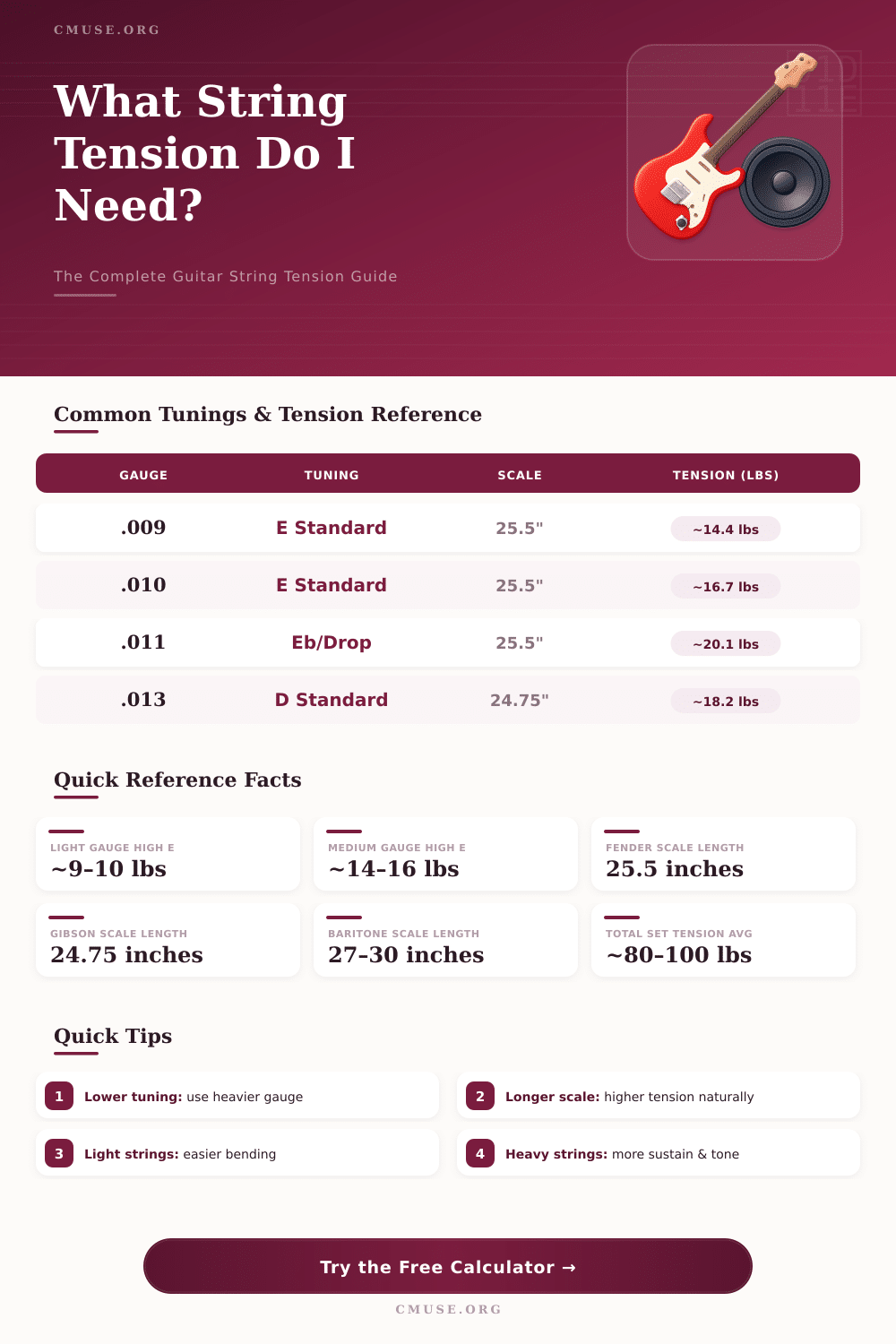
Three main things affect the real Electric Guitar String Tension, that includes: the mass of the string each inch, the scale length of your guitar and the tuning that it is tuned to. The scale length simply is the distance from the nut to the bridge. Guitars with shorter scale have naturally lower string tension.
Important reason to know here: same tesnion feels much more strong on longer scale, what commonly surprises many guitarists.
If one tightens a string, it raises the tone, while loosening drops it. If the tuner shows a too sharp note, you must loosen the string. Too flat?
Then tighten it. Commonly beginners mess up, because fresh strings stretch when one applies tension, so they require a bit of time to settle before they stay in tune.
A good starting spot for electric guitar is a set of.010 strings in standard tuning. Acoustic guitarists usually choose.011 or.012 sets for standard tuning. To drop the tension without resetting everything, you must use lighter strings, that is your only good option.
On acoustic guitar, heavy strings with that extra tension make the soundboard vibrate more hard, what notably expands the volume.
Online you find calculators for string tension, that help you create a set with equal tension for any guitar ore bass. The most string makers give charts with rough tensions for common scale lengths, for instance 24.75 inches or 25.5 inches. Interesting fact: different brands feel much more stiff than others, even if they have same gauge.
Acoustic sets are planned to have around 30 pounds of tension each string, what results in around 150% more than a typical electric guitar usually has.
For low tunings, like Drop C, Drop B or something similar (special string sets exist), so that the tension stays quite high and the sound clear. Standard sets commonly feel too loose in such tunings. Those heavy sets became very popular in modern metal music and similar styles.
Classical guitars are made for total tension of around 90 pounds through all six nylon strings. Strings with bad tension commonly have dull sound, what matters if you try to play intuning higher on the neck. If you keep the nuts oiled and right size, that helps everything stay stable, when tension is in play.