Eb Instrument Transposition Calculator
Convert between written and concert pitch for E-flat saxophones, clarinets, tenor horn, E-flat cornet, E-flat tuba, and other E-flat parts with octave, spelling, tuning, and range checks.
Choose a real E-flat instrument scenario, then adjust the written or concert note. The calculator uses the instrument's written-C sounding pitch, not a single generic interval, so alto sax, baritone sax, E-flat clarinet, and E-flat tuba land in the right register.
Transposition Breakdown
Written to Concert
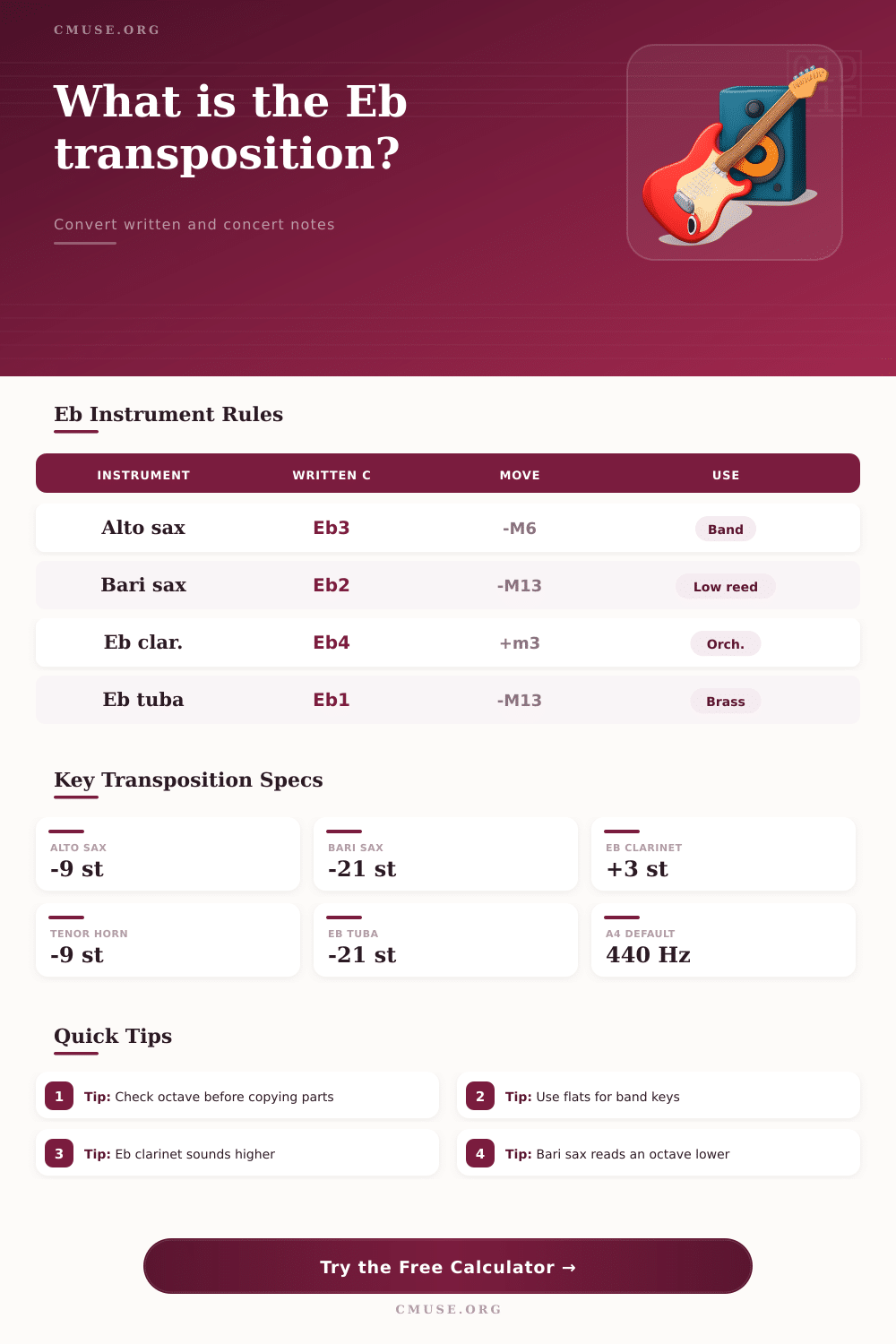
Add the instrument profile shift to the written MIDI note. Alto sax and alto clarinet use -9 semitones; baritone sax and E-flat tuba use -21.
concert = written + shift + octaveAdjust
Concert to Written
Reverse the same profile shift when preparing an E-flat part from a concert score or lead sheet.
written = concert - shift + octaveAdjust
Frequency
Frequency follows equal temperament from the selected A4 reference, then applies any cents offset entered for the source.
Hz = A4 * 2^((midi - 69) / 12)
| Instrument | Written C4 Sounds | Written to Concert | Concert to Written | Common Score Use |
|---|---|---|---|---|
| Alto saxophone in E-flat | Eb3 | Down a major sixth | Up a major sixth | Band / jazz |
| Baritone saxophone in E-flat | Eb2 | Down a major thirteenth | Up a major thirteenth | Low reed |
| Sopranino saxophone in E-flat | Eb4 | Up a minor third | Down a minor third | Color reed |
| E-flat soprano clarinet | Eb4 | Up a minor third | Down a minor third | Orchestra |
| Alto clarinet in E-flat | Eb3 | Down a major sixth | Up a major sixth | Clarinet choir |
| Contra-alto clarinet in E-flat | Eb2 | Down a major thirteenth | Up a major thirteenth | Low clarinet |
| Tenor horn / alto horn in E-flat | Eb3 | Down a major sixth | Up a major sixth | Brass band |
| E-flat soprano cornet | Eb4 | Up a minor third | Down a minor third | Brass lead |
| E-flat tuba / bass | Eb1 or Eb2 by notation | Usually down a major thirteenth | Usually up a major thirteenth | Bass line |
| Written Note | Alto Sax / Alto Clarinet Concert | Baritone Sax / Eb Bass Concert | Eb Clarinet / Eb Cornet Concert | Reverse Written From Concert |
|---|---|---|---|---|
| C | Eb | Eb one octave lower | Eb | A for alto, A lower for baritone, A for high Eb |
| Db / C# | E | E one octave lower | E | Bb or A# depending on key |
| D | F | F one octave lower | F | B for alto-family parts |
| Eb / D# | Gb / F# | Gb one octave lower | Gb / F# | C for alto-family parts |
| E | G | G one octave lower | G | Db or C# depending on key |
| F | Ab | Ab one octave lower | Ab | D for alto-family parts |
| F# / Gb | A | A one octave lower | A | Eb or D# depending on key |
| G | Bb | Bb one octave lower | Bb | E for alto-family parts |
| Ab / G# | B | B one octave lower | B | F for alto-family parts |
| A | C | C one octave lower | C | Gb or F# depending on key |
| Bb / A# | Db | Db one octave lower | Db | G for alto-family parts |
| B / Cb | D | D one octave lower | D | Ab or G# depending on key |
| Scenario | Starting Pitch | Calculator Direction | Expected Move | Practical Check |
|---|---|---|---|---|
| Alto sax reading written G4 | Written G4 | Written to concert | Concert Bb3 | Good middle-register ensemble pitch. |
| Concert C4 melody for alto sax | Concert C4 | Concert to written | Written A4 | Common arranger move for E-flat treble part. |
| E-flat clarinet written C6 | Written C6 | Written to concert | Concert Eb6 | High color line, verify range and intonation. |
| Baritone sax written low A | Written A2 | Written to concert | Concert C2 | Uses low-A baritone extension if available. |
| Tenor horn brass-band part | Written F4 | Written to concert | Concert Ab3 | Treble-clef brass-band notation follows alto-family rule. |
| E-flat tuba concert bass line | Concert Bb1 | Concert to written | Written G3 | Check local notation convention for octave. |
| Instrument | Practical Written Range | Extended Written Range | Concert Span Approx. | Register Note |
|---|---|---|---|---|
| Alto saxophone | Bb3 to F#6 | A3 to G6 | Db3 to Bb5 | Altissimo above written F#6 needs player approval. |
| Baritone saxophone | A2 to F#6 | A2 to G6 | C2 to Bb4 | Low A is common on modern baritone saxophones. |
| E-flat clarinet | E3 to C7 | E3 to G7 | G3 to Bb7 | Extreme upper notes are brilliant and exposed. |
| Alto clarinet | E3 to G6 | Eb3 to C7 | G2 to Bb5 | Best used for warm inner clarinet texture. |
| Tenor horn | F#3 to C6 | E3 to E6 | A2 to G5 | Brass-band parts usually read in treble clef. |
| E-flat tuba | E2 to C5 | C2 to F5 | G0 to Eb3 | Printed octave conventions vary by region. |
If you’ve ever had to re-score a piece of music, you know that arrangers sometimes spend a lot of time tweaking a single bar. This happens when they discover an alto saxophone passage is written in a range that sounds thin instead of warm. More times than not, this isn’t due to any careless approach to notation or a lack of good musical taste. It’s usually the result of not understanding how E-flat instruments interprets the written note into actual sounding note.
The bridge across this gap is called transposition. And it’s not enough to simply transfer the notes from your hand to another; there’s arithmetic involved in that process too. When you choose your instrument profile, the calculator does the math for you, relieving you of wondering if the next leap are up a major sixth or down.
How to Transpose Music Easily
When we see middle C being played on wind instruments, we understand that it is not actualy sounding at concert pitch. A C on an alto saxophone would be an E-flat below it; a C on an E-flat clarinet would be an E-flat higher up again. This difference creates two different families of transposition that work their way through the instrument’s range in opposite ways. Before you can rely on the maths, you need to be familiar with which of these families are yours.
To accommodate this, the tool is designed to store detailed profiles for each instrument type so that line for a baritone saxophone falls into intended lower register instead of floating uselessly around somewhere halfway down stave. It also separates out the tenor horn from the E-flat tuba even though they both has the same interval of transposition but live in very different acoustic realms.
Many players have always considered transposing a simple matter of counting semi-tones and neglecting the octave change. This leads to more mistakes when reading music than any other consideration when composing for bands. Transposing from a concert instrument to an Eb instrument is not simply changing the pitch; it is moving entire shape of melody to fit the new range of your instrument. Something that might feel comfortable in the right hand of a pianist becomes placed into the very top range of the alto saxophone if you don’t account for this octave shift.
The octave boundary is automatically checked by the calculator, alerting you to notes out of realistic playing limits that can be changed prior to printing out parts. Another small but important element is spelling. It’s no coincidence that flat keys are common in wind band music. This is largely due to the fact that flat signature keys sits comfortably alongside the accidentals of E-flat, A-flat, and B-flat instruments.
The eye does not like to see G-sharp written as an alternate spelling for alto sax when an A-flat is what you expect. It causes visual drag which slows down sight-reading at speed. The tool follows traditional engraving rules to provide spellings that match the expected key. It even offers alternatives if it feels necessary to deviate from the suggestion, such as when a piece require sharp-key harmony or more chromatic twists and turns. For standard repertoire, the defaults is often flatter and result in cleaner looking notation.
Even without the tools, it’s helpful to know the ‘why’ of the change. The goal was to create a smaller instrument with a wider bore. This would allow it to play in more comfortable registers and produce a rich tone that was lower pitched then what was used in concerts. All of these rules for transposition are dependent on this decision when designing the furnitures. If I know that an E-flat clarinet sounds a minor third above the written note, I also understand that the written part go up relative to concert pitch, unlike saxophones, which go down.
The beauty of the calculator is that it makes all of this conversion logic immediate, but understanding the direction saves your head from any mental blocks if you’re asked to arrange something live. Transposing by mathematical calculation is one thing, but practical performance needs require attention to not only the note but also its register. Even when correctly calculated a piece might be impossible to perform because it fails to take into account the natural ranges of the instrument. Also make sure that you always allow breathing spaces and technical sections within the notes produced by the converter.
To avoid stretched embouchures and dodgy fingerings, you can use the tool’s built-in range tables. These tables is useful for quickly cross-referencing commonly known ranges. Get the drafts right then pass them on to players who expect to recieve well-documented and idiomatic notation.
Transposing isn’t just a hard necessity but also a compositional decision that influences the sound of your piece. You’ll have more colour and balance at your fingertips once you are aware of how every instrument sounds when it’s played. Use the calculator for interval arithmetic; no counting semitones. Instead, concentrate on dynamics and phrasing.
Check the range. Trust the system. Let the music breathe in its natural home.