Early Decay Time Calculator
Estimate EDT from T10 measurements, decay slope, RT60, or room absorption data.
Early Decay Result
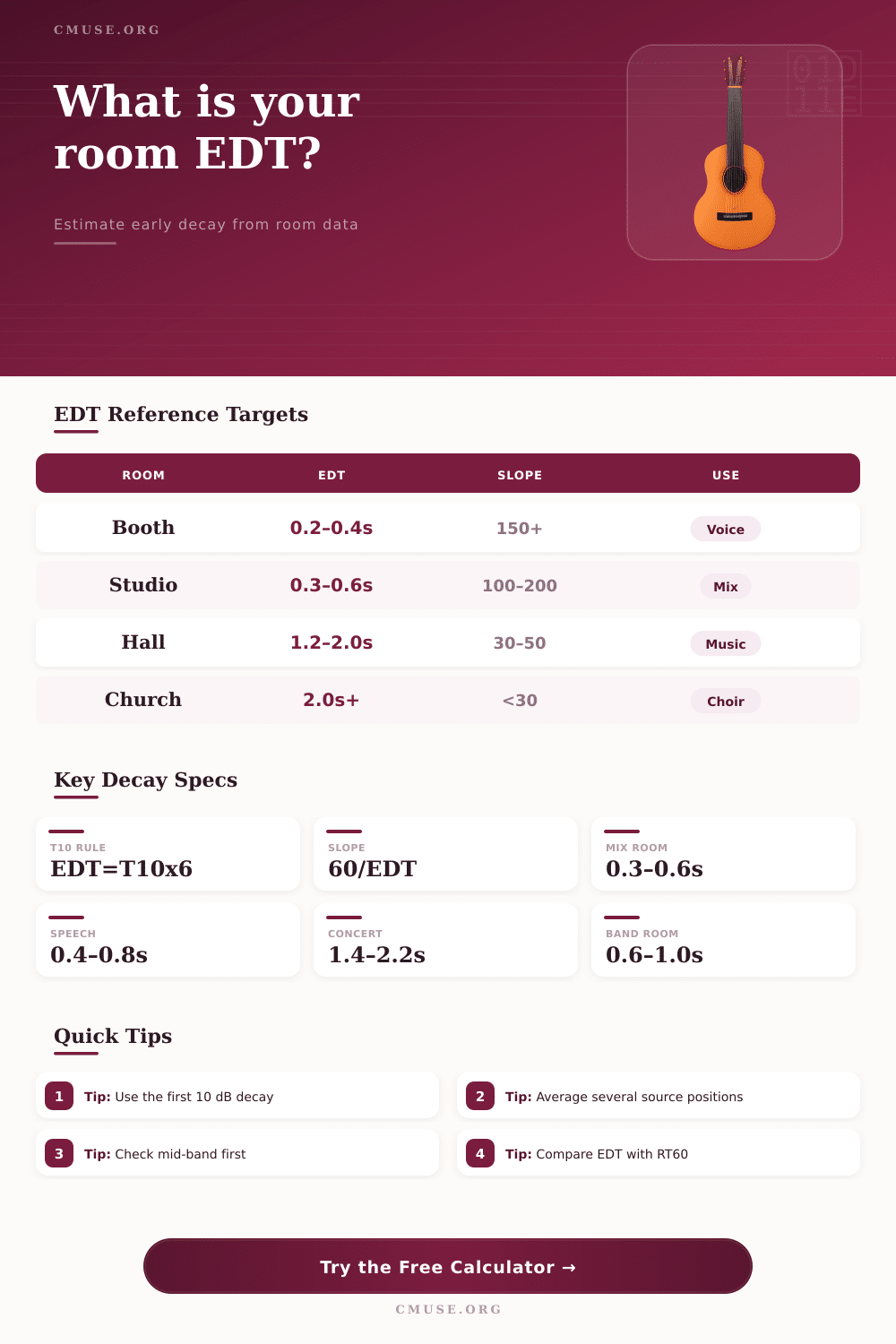
| Room type | Typical EDT | Equivalent slope | Common reading |
|---|---|---|---|
| Vocal booth / close speech | 0.20 to 0.40 s | 150 to 300 dB/s | Dry, immediate articulation |
| Control room / mix studio | 0.30 to 0.60 s | 100 to 200 dB/s | Focused imaging with short tail |
| Practice room / teaching room | 0.45 to 0.85 s | 71 to 133 dB/s | Comfortable speech and instruments |
| Ensemble rehearsal room | 0.60 to 1.10 s | 55 to 100 dB/s | Blend without excessive smear |
| Small recital hall | 1.20 to 1.90 s | 32 to 50 dB/s | Audible support and sustain |
| Method | Input needed | Formula | Best use |
|---|---|---|---|
| T10 measurement | Time from 0 to -10 dB | EDT = T10 × 6 | Impulse response or decay curve |
| Slope measurement | Early decay dB/s | EDT = 60 / slope | Analyzer slope readout |
| Known RT60 | RT60 and early ratio | EDT = RT60 × ratio | Comparing early and late fields |
| Sabine model | Volume and absorption area | RT60 = 0.161V/A | Quick room estimate in metric |
| Eyring model | Surface and average absorption | RT60 = 0.161V/[-S ln(1-a)] | More absorbent rooms |
| Scenario | Dimensions | Starting EDT | Purpose |
|---|---|---|---|
| Home studio | 10×12×8 ft / 3.0×3.7×2.4 m | 0.48 s | Mix checks and overdubs |
| Practice room | 8×8×8 ft / 2.4×2.4×2.4 m | 0.66 s | Solo instrument practice |
| Stage area | 20×16×12 ft / 6.1×4.9×3.7 m | 0.92 s | Amplified stage support |
| DJ booth | 6×4×8 ft / 1.8×1.2×2.4 m | 0.30 s | Headphone and monitor clarity |
| Recording booth | 5×5×7.5 ft / 1.5×1.5×2.3 m | 0.24 s | Close vocal capture |
| Band | What it reveals | Expected EDT trend | Check first when |
|---|---|---|---|
| 125 Hz | Modal buildup and bass decay | Often 1.2× to 2.0× mid-band | Low notes hang too long |
| 250 Hz | Warmth and low-mid density | Often slightly longer | Room sounds boxy |
| 500 Hz | Core speech and music balance | Primary target band | Setting a room target |
| 1 kHz | Vocal articulation | Close to mid-band target | Lyrics are unclear |
| 2 to 4 kHz | Presence and brightness | May shorten with soft finishes | Room feels sharp or dull |
Early decay time measure the initial part of a sounds decay within a room. Early decay time measures the length of time between the initial release of sound from a sound source within a room and the transition of that sounds decay into the later portion of its reverberations. Furthermore, early decay time is considered an important measurement of sound within a room due to the fact that early decay time dictate the way that a room feel to those within the room who are speaking or playing music within that area.
For instance, a vocal booth may have an early decay time that allows for the crispness of the consonants within speech, or a recital hall may have an early decay time that allow for the feeling of body in the note that is being played. Early decay time is different from measurements of late decay time, and there are reasons that this difference are important. For instance, while the late decay time within a room may have an acceptable measurement of its RT60 value, the room may feel incorrect to those within the space.
Early Decay Time: How Sound Fades in a Room and How to Measure It
Furthermore, musicians may experience issue with early decay time within a space due to the need for the musicians to hear their own performances, as well as the engineers of those performances due to the impact of early decay time upon the clarity of the center image. Early decay time is influenced by a variety of factors. For instance, the dimensions of a room and the bands that is evaluated within that room influence the calculation of the early decay time of that space.
More specifically, the dimensions of the room influence the volume of the space, the area of that volume, and the way in which the sound can reflect off of the surfaces of that room. Furthermore, the evaluation of specific bands within a room allow for the understanding of how some frequencies may linger in a room more longer than others. Finally, the calculation mode for early decay time can influence the calculation of that early decay time; it can be calculated from the direct measurement of the first ten decibels of a space, from the slope of the sound within a sound analyzer, from the adjusted measurement of the rooms RT60, or from the absorption estimate of the surfaces within the room.
Beyond these factors, the diffusion within a space and the amount of air loss within that space can also impact the early decay time of that area. For instance, a room with area of even absorption of sound can differ from a room with even absorption of sound but where sound reflect off of different surfaces within the space. Furthermore, if that room also has air absorption or air leaks within the space, those factors can also impact the early decay time of that area.
Both of these factors must be accounted for in the calculation of the early decay time within a space, as these adjustments will ensure the accuracy of early decay time calculations. Beyond the factors within a room, the factor of frequency within a room can also impact the early decay time within that space. For instance, 125 Hz within a room may have different modal characteristics then 2,000 Hz, leading to differences in early decay time at those frequencies.
Furthermore, it is recommended to check the mid-band of a room first, and then to evaluate how the low bands compares to the early decay time at the mid-band. For instance, a practice room may appear to be appropriate for guitar player, but testing for early decay time may reveal that the room has issue with the low frequencies of the guitar, leading to potential needed modification to that practice room. The usefulness of measuring early decay time is that that measurement can be compared to the use of that space.
For instance, a control room may require a lower early decay time than a choir rehearsal space. Reference table can be used to determine the various early decay times of spaces according to their use, and those reference tables allow for spaces to be evaluated to determine whether their early decay time is within the target zone for that type of use. Furthermore, if the early decay time is outside of the target zone, it is possible for either the early decay time of that space to be modified through the addition of sound-absorbing material, or the scattering of sound within the space can be changed.
Despite the fact that early decay time is often considered to be a secondary measurement of a room, it is important to consider early decay time to be a primary measurement of that area. For instance, the first ten decibels of sound create the impression of that space, and any issue with early decay time will not be fixed by subsequently adjusting the decay of sound within that space. Thus, early decay time should of been measured prior to any other calculation of that space to ensure that any correction are made to the areas that are closest to the sound source.
In order to measure the early decay time of a space, it is important to ensure that the space is measured with a clean impulse response and with a quiet noise floor. Furthermore, it is also important to measure early decay time at the averaged position within a space; the sound that is reflected off of the corners of a space may differ from the sound that is reflected off of the center of the space. Once the early decay time is measured, it can be compared to the target range for that space.
Thus, while the measurement of early decay time will be helpful in understanding the characteristic of a space, it will not be able to measure all of the variable of that space; early decay time does not account for the movement of the heads of the listener, for instance. However, it will provide a reliabl snapshot of the general way in which sound interact with the space.