Drum Volume Calculator
Calculate shell cylinder volume, usable air volume, drumhead area, vent behavior, and tuning references from real diameter, depth, thickness, and head data.
🥁 Named Drum Presets
Model: the calculator treats the shell as a cylinder, subtracts shell thickness to find internal air space, estimates head surface area, and references vent Helmholtz coupling plus simple air modes.
⚙ Shell, Head, and Tuning Inputs
📊 Live Volume and Tuning Breakdown
| Measure | Imperial | Metric | How It Is Used |
|---|---|---|---|
| Calculate to generate shell, air, head, and tuning rows. | |||
🧮 Drum Spec Snapshot
📝 Shell Material Reference
| Material | Typical Thickness | Density Reference | Damping Character | Calculator Use |
|---|---|---|---|---|
| Maple ply | 5.5-6.5 mm | 610 kg/m3 | medium | Balanced default for snares and toms |
| Birch ply | 5.0-6.5 mm | 670 kg/m3 | medium-low | Similar volume, slightly higher shell mass |
| Mahogany ply | 6.0-7.5 mm | 540 kg/m3 | medium-high | Warmer, lighter shell reference |
| Oak / ash ply | 6.0-8.0 mm | 740 kg/m3 | low-medium | Dense shell with strong projection |
| Acrylic shell | 5.0-6.0 mm | 1180 kg/m3 | low | Rigid, heavier cylinder wall reference |
| Brass snare shell | 1.0-1.5 mm | 8500 kg/m3 | medium | Thin metal shell with high mass |
| Steel snare shell | 1.0-1.2 mm | 7850 kg/m3 | low-medium | Thin shell, bright response reference |
| Aluminum snare shell | 1.2-2.0 mm | 2700 kg/m3 | medium-high | Lower metal shell mass and dry response |
🥁 Common Drum Volume Reference
| Drum Size | Inside Diameter Assumption | Internal Volume | Head Area | Typical Role |
|---|---|---|---|---|
| 13 x 3 piccolo snare | 12.92 in | 393 in3 / 6.4 L | 133 in2 | High, quick snare response |
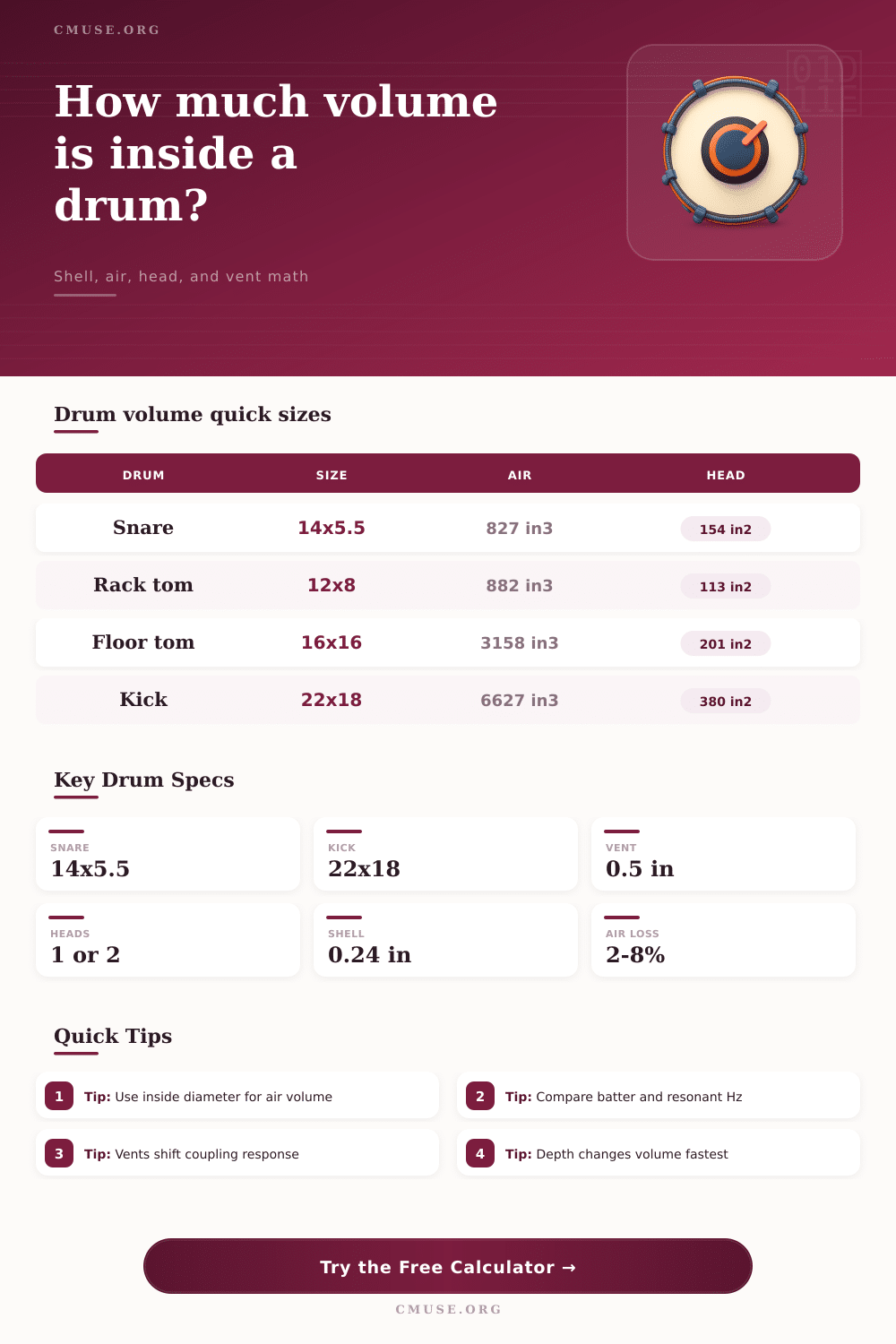
| 14 x 5.5 snare | 13.53 in | 792 in3 / 13.0 L | 154 in2 | General studio snare |
| 12 x 8 rack tom | 11.53 in | 835 in3 / 13.7 L | 113 in2 | Middle rack tom |
| 16 x 16 floor tom | 15.53 in | 3027 in3 / 49.6 L | 201 in2 | Low tom voice |
| 18 x 14 bass drum | 17.53 in | 3379 in3 / 55.4 L | 254 in2 | Jazz bass drum |
| 22 x 18 bass drum | 21.53 in | 6557 in3 / 107.5 L | 380 in2 | Modern rock kick |
🎵 Tuning and Resonance Reference
| Drum Role | Batter Head Range | Resonant Head Range | Useful Ratio | Volume Cue |
|---|---|---|---|---|
| Snare drum | 220-400 Hz | 300-500 Hz | reso 1.1-1.5x | Small air volume, fast pressure rise |
| Small rack tom | 150-260 Hz | 170-300 Hz | reso 1.0-1.2x | Short depth keeps decay compact |
| Floor tom | 80-150 Hz | 85-170 Hz | near matched | Large volume supports lower sustain |
| Bass drum | 45-90 Hz | 50-110 Hz | reso 0.9-1.3x | Port and damping dominate coupling |
| Concert tom | 110-260 Hz | single head | open shell | Air mode is less trapped |
🔊 Vent, Port, and Air Coupling Reference
| Opening Type | Diameter | Area | Typical Use | Calculator Meaning |
|---|---|---|---|---|
| Small shell vent | 0.25 in | 0.049 in2 | Snare and tom pressure relief | Minor Helmholtz effect |
| Common vent | 0.50 in | 0.196 in2 | Many snares and toms | Moderate pressure bleed |
| Large vent | 1.00 in | 0.785 in2 | Dry snare or specialty shell | Higher coupling frequency |
| Kick port | 4.00 in | 12.57 in2 | Microphone access and low-end control | Strong bass drum air opening |
| Kick port | 5.00 in | 19.63 in2 | Large front head port | Shorter sustain, more beater focus |
📋 Comparison and Spec Grid
| Preset | Shell Size | Approx Air Volume | Head Area | Best Reading |
|---|---|---|---|---|
| 13x3 Piccolo Snare | compact snare | about 6 L | 133 in2 | Very fast response, little trapped air |
| 14x6.5 Deep Snare | deep snare | about 15 L | 154 in2 | More body than standard snare depth |
| 12x8 Rack Tom | medium tom | about 14 L | 113 in2 | Balanced tom voice and sustain |
| 16x16 Floor Tom | low tom | about 50 L | 201 in2 | Low tuning support from large volume |
| 22x18 Rock Bass Drum | large kick | about 105 L | 380 in2 | Port and damping strongly shape feel |
Drum makers and players must consider the volume of air that is trapped inside of a drum shell because the volume of air that is trapped inside of the shell impacts the movement of the drum heads and the resulting sound of the individual drums. The volume of air that is trapped inside of an shell will determine the speed at which the air pressure within that shell builds and dissipates, which impacts the feelings of the player of the individual drums. As a result of being able to calculate that volume, the drummer can make decisions regarding the setup and play of the individual drums.
To calculate the volume of air that is trapped within the shell, the drummer must provide to the calculator the diameters of the shell, its depth, the thickness of its shell, and the details regarding any vents that is included in the shells. The thickness of the shell impacts the volume of the shell, as reducing the outer diameter of a shell will also reduce the internal diameter of that shell and its internal volume. For instance, a thick maple shell will contain less air then a thin brass shell of the same outer diameter.
How to Measure the Air Inside a Drum Shell
Furthermore, a thick maple shell will provide less space for air to fill within that shell. As a result, a thick shell will impact the movement of the air within the shell. Furthermore, the number of heads that are included with the shell and the tuning of those heads will also interact with the air that is within the shell.
In shells with two heads, for example, the diameter of the shell is the distance between the two heads, and the drummer can enter each of the pitches of the heads into the calculator. The calculator will display the difference in pitch between the two heads in units of cents. The size and location of the vents in the shells will impact the way that air moves within the shell.
For example, a snare shell may have a small vent that allows for a small amount of air to escape from the shell, while a kick shell may have a large port that changes the way in which the heads interact with the remainder of the drum room. The calculator uses the size of the vents and the calculated volume of air within the shell to calculate the Helmholtz frequency that results from the opening of the vents. While the calculator is helpful to drummers in that it provides a starting point for the drummer in setting up the drums, the calculator does not replace the need for the drummer to listen to the drums.
The material of the shell will also impact the air that is within the shell. For instance, a heavier material will add more mass to the shell structure itself. Within the calculator, a reference table lists the thickness of the shells and the damping characters of various materials.
For instance, each table allows the drummer to compare a maple shell with an acrylic shell. Each material will impact the movement of the air within the shell. Furthermore, while the raw volume of air that is contained within a maple shell and an acrylic shell may be the same, the different materials will impact the movement of that air.
Drum shells are not perfect cylinders; they contain bearing edges, snare beds, and various hardware. Each of these elements takes up space within the shell. For instance, a strainer, muffling rings, or a pillow may occupy space within the shell that would otherwise contain air.
Using the field within the calculator for entering the displacement of such hardware will ensure that the drummer dont have to guess at the amount of air that is within their shell. Furthermore, damping materials that is included within the shell, such as cotton or foam, will also take up space in the shell. The drummer can enter the damping percentage into the calculator to visually determine the amount of air that will remain within the shell after the damping is applied.
The depth of a shell has a more significant impact upon the volume of air within the shell then the diameter of the shell. Adding two inches of depth to a 16-inch tom shell will have a greater impact upon the volume of air within that shell than adding two inches of diameter to a 16-inch tom shell. This additional depth provides the air within the shell with more room to move, which is one of the reasons in which vintage kick drums often have a larger sound than their diameter would suggest.
The calculator makes visible to the drummer the relationship between depth and the volume of air within the shell. The calculator is most useful when used to compare two different options for the drum setup. For instance, if a drummer changes a tom from a rack tom to a floor tom, the calculated pitch of the shells will change.
Furthermore, increasing the number of vents on a snare kit will change the coupling frequency of the snare. Therefore, these calculations will provide a starting point for the drummer to establish the setup of their kit. However, these calculations will not replace the feel of the kit that the drummer will experience.
Instead, these calculations will remove the guesswork for the drummer in establishing their kit. Many drum players may believe that the volume of air within a shell is a fixed number that relates to the size of the shell. However, the volume of air within the shell changes with various parameters of the shells, such as thickness, number of vents, damping materials, and the number of heads that is attached to the shell.
The calculator make it possible for the drummer to measure the changes to the volume of air within the shells.