Drum Tuning Interval Calculator
Compare batter and resonant head pitches, target intervals, lug-to-lug spread, shell size, head choice, and drum type for repeatable drum tuning notes.
Choose a named drum setup, then refine the head pitches and lug readings from your tuner. The calculator reports the current head interval, target correction, lug turn estimate, shell range fit, and tuning consistency.
Drum Tuning Breakdown
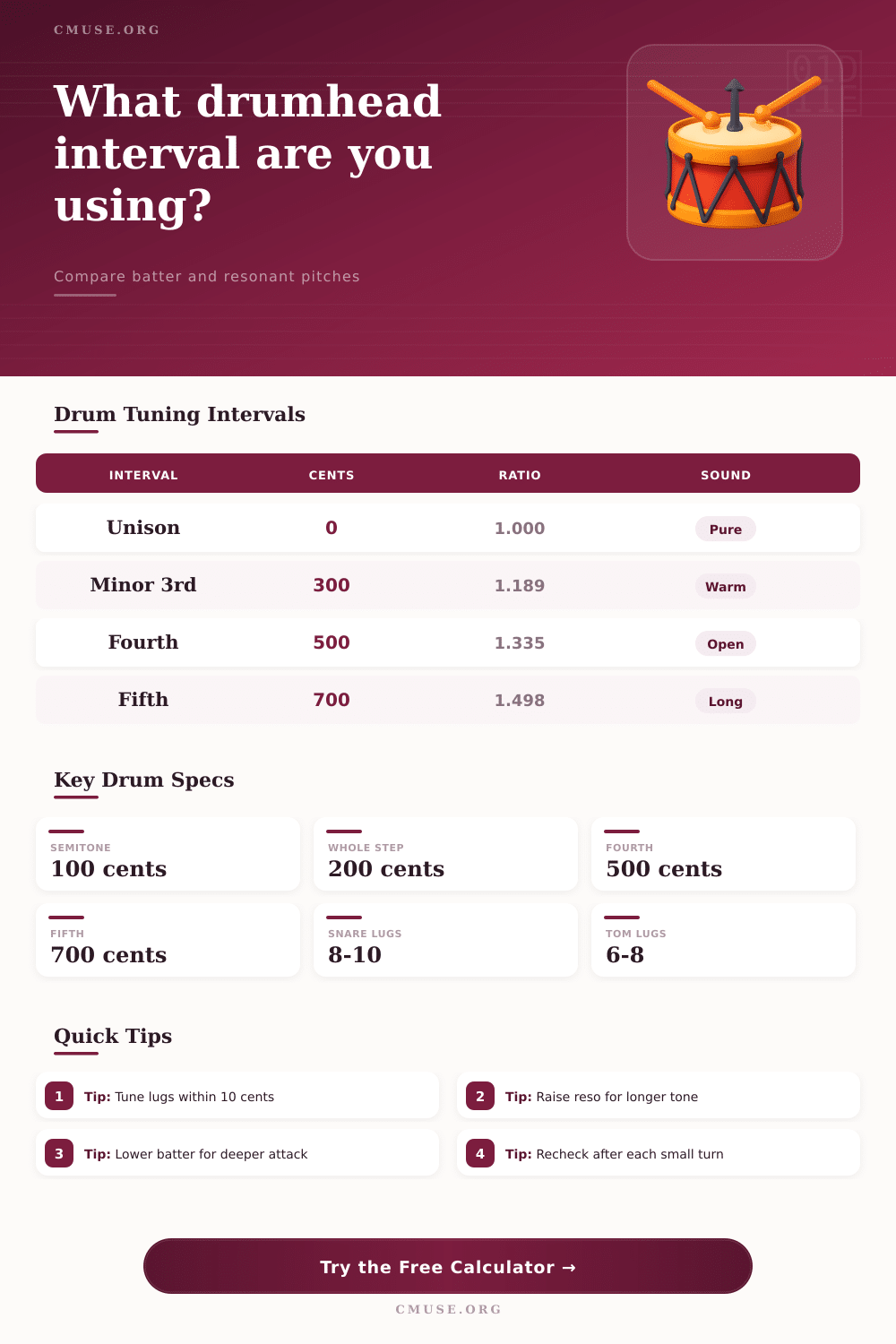
cents = 1200 x log2(resonant Hz / batter Hz)target Hz = batter Hz x 2^(target cents / 1200)eighth-turns = cents error / key sensitivityspread average = (batter spread + reso spread) / active headsOne equal-tempered semitone
Whole-step head interval
Minor-third resonant lift
Perfect-fourth open tom interval
Perfect-fifth long sustain interval
Tight lug matching target
Small drum key adjustment step
Common lugs per drumhead
| Interval | Cents | Frequency Ratio | Typical Drum Result | Best Use |
|---|---|---|---|---|
| Resonant lower by half step | -100 | 0.9439 | Shorter decay with a downward pitch bend | Dry backbeat |
| Unison heads | 0 | 1.0000 | Strong fundamental with centered resonance | Balanced tone |
| Resonant higher by half step | 100 | 1.0595 | Slight lift and cleaner sustain | Controlled toms |
| Resonant higher by whole step | 200 | 1.1225 | Open tone without an extreme pitch rise | Studio toms |
| Resonant higher by minor third | 300 | 1.1892 | Pronounced attack and singing decay | Jazz toms |
| Resonant higher by perfect fourth | 500 | 1.3348 | Bright response with strong note separation | Snare crack |
| Resonant higher by perfect fifth | 700 | 1.4983 | Long, lively resonance with quick rebound | Open floor tom |
| Drum | Common Size | Batter Pitch Range | Resonant Relationship | Practical Note |
|---|---|---|---|---|
| Snare drum | 13-14 in | 180-400 Hz | Unison to fourth above | Higher reso supports crisp wire response. |
| Rack tom | 8-13 in | 100-260 Hz | Unison to minor third above | Small toms tolerate wider intervals. |
| Floor tom | 14-18 in | 55-150 Hz | Unison to fifth above | Higher reso can lengthen the bloom. |
| Kick drum | 18-24 in | 35-90 Hz | Lower, unison, or lightly higher | Porting and muffling shorten sustain. |
| Concert tom | 8-18 in | 75-280 Hz | No resonant head | Judge the batter note and lug spread. |
| Marching snare | 13-14 in | 350-800 Hz | High tension, close matching | Small lug errors become very audible. |
| Lug Spread | Consistency Rating | Suggested Action | Listening Effect | Use Case |
|---|---|---|---|---|
| 0-5 cents | Very tight | Leave the head balanced | Clean note and even decay | Recording or close tuning checks |
| 6-12 cents | Tight | Small touch-ups only | Stable pitch with natural movement | Most kit drums and live work |
| 13-25 cents | Usable | Match opposite lugs in pairs | Slight wobble or uneven sustain | Fast stage retuning |
| 26-40 cents | Loose | Reset the low and high lugs | Noticeable warble in the note | Fresh head seating or rushed setup |
| Over 40 cents | Unstable | Back off and retension evenly | Pitch drop, choking, or buzz risk | Major retune needed |
| Preset | Drum Size | Batter / Resonant | Target Interval | Tuning Goal |
|---|---|---|---|---|
| Snare Crack Fourth | 14 x 5.5 in | 220 Hz / 293.7 Hz | 500 cents | Bright backbeat with quick response. |
| Fat Backbeat Snare | 14 x 6.5 in | 185 Hz / 207.7 Hz | 200 cents | Lower body with clear wires. |
| Jazz Rack Tom Lift | 12 x 8 in | 147 Hz / 174.6 Hz | 300 cents | Open note and singing decay. |
| Rock Rack Tom Punch | 13 x 9 in | 123.5 Hz / 138.6 Hz | 200 cents | Controlled attack for amplified kit. |
| Floor Tom Fifth Bloom | 16 x 16 in | 82.4 Hz / 123.5 Hz | 700 cents | Long, open floor tom sustain. |
| Kick Low Thump | 22 x 16 in | 55 Hz / 61.7 Hz | 200 cents | Deep center with short decay. |
Most drummers think about tuning as just wondering how far to turn the knob to make it sound right. Fair enough, you may get away with it for some time. However, you’ll find that when you’re out on stage your drums sounds muddy, or in the studio they’re thin. It’s not often that head itself is at fault here, but more the relationship between them. Two very different membranes works together as one acoustic system. Where each membrane sits in relation to the other determine the character of the drum.
Plug in your lug readings and corresponding head frequencies into calculator above and it will do all the math for you. It’ll tell you exactly what number of turns away your resonant head is from your desired interval and then translate that into actualy turns using your drum key. This is important because we’re often left guessing with our ears as to how close we’ve gotten to a minor third or perfect fourth. With this tool, you take the guesswork out of those micro-adjustments and are able to focus more on sound instead of mechanics.
A Better Way to Tune Your Drums
Think of the batter head as the voice and the resonant head as the room the voice lives in. With a pure note, unison tuning has the two heads at exactly the same note. This result in the drum making its pure, basic tone with maximum sustain. It’s commonly applied to jazz where clarity is most important. But when you raise the resonant head quite high, you are now introducing overtones, giving the sound complexity and extending its decay. With a floor tom, this can give it a long tail and fill out a mix played on a perfect fifth interval. So, it isn’t simply about pitch but the whole textural difference of the sound.
Most home tuners fail here. They may be able to get their center pitch right, but then one of the lugs is on B3 while the other is on C4. This variation is what causes the warble or wobbly pitch. It kills sustain and is the reason why tuning feel impossible. The lug spread is tracked by the calculator and will alert you if you find that the difference in your highest and lowest lugs is more than ten cents. Usually tighter is better. However, sometimes, it’s okay to not have perfect uniformity for live performance. In a live performance environment, that twelve-cent spread vanishes in the mix. However, in a recording booth, that now becomes an issue.
They also make thicker heads that are different than response to being tightened down. A double-ply clear head will respond differently to tightening then a single-ply coated head. You will feel each turn of the lugs differently because it takes more force to reach the same pitch. Changing out the head type without changing the way you tune them will make your old intervals feel wrong. This is why the tool asks for head type and it will adjust the estimated number of cents per turn accordingly. This will keep you from over-tightening cause you thought you had a thin head but you had a thick one.
Your gear is also affected by temperature and humidity. Humidity makes wooden shells expand, which slightly drops the pitch. Cold temperatures make heads stiff, which raises the head pitch. Tuning at home in the winter then playing outside in summer means that your kit will be drifting. The calculator has environmental inputs for this so can help you estimate the shift that is happening. It can’t prevent the effects of physics but it can provide a base line expectation for how far off you may of to go when you arrive.
Numbers aren’t everything, but once you know where you’re going with one of these things you can obsess over ’em. Before you do that, though, determine whether you want an open jazz tone or a dry backbeat. Next, choose the tool most likely to get you there quickly. The preset buttons are starting places for typical scenarios like punchy rack tones and cracky snare fourths. They’re maps, not rules. Find your way using those maps, and tweak from there till it feels right in your hands.
The drum and the player talk to each other. The calculator allows you to speak in the language of intervals. It converts intention into action. As you realize that subtle adjustments in the resonant head influence the total voice, you quit fighting the drum and begin to form it. That perspective change is greater then all the tuner apps combined.
And then there’s this; you no longer spend time guessing but designing sounds intentionaly… Making a chore a creative process.