Drum Shell Calculator
Estimate shell finish area, air volume, blank length, and shell mass for maple, birch, metal, or hybrid drum builds.
🥁 Shell Presets
🔧 Shell Inputs
📊 Shell Material Spec Grid
📑 Reference Tables
| Drum | Size | Air Vol | Use |
|---|---|---|---|
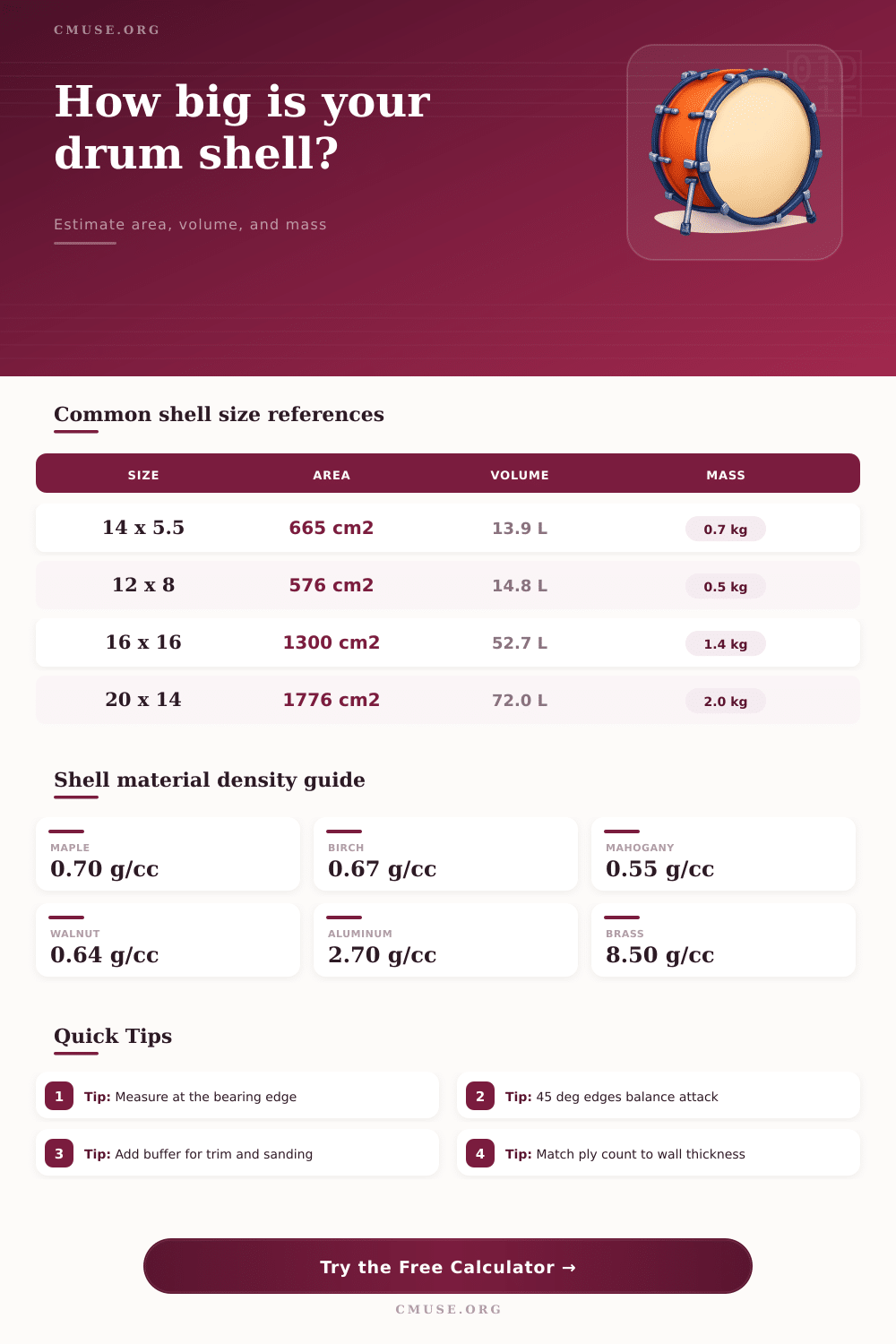
| Snare | 14 x 5.5 | 13.9 L | Backbeat |
| Rack Tom | 10 x 8 | 14.8 L | High tom |
| Floor Tom | 16 x 16 | 52.7 L | Low tom |
| Kick | 20 x 14 | 72.0 L | Compact kick |
| Material | g/cc | lb/ft3 | Note |
|---|---|---|---|
| Maple | 0.70 | 43.7 | Balanced |
| Birch | 0.67 | 41.8 | Focused |
| Mahogany | 0.55 | 34.3 | Dark |
| Brass | 8.50 | 530.0 | Heavy |
| Plies | Thick | Build | Response |
|---|---|---|---|
| 5 | 0.18 in | Thin ply | Open |
| 6-7 | 0.22 in | Light ply | Bright |
| 8-10 | 0.30 in | Mid ply | Balanced |
| 12+ | 0.40 in | Heavy ply | Punchy |
| Angle | Setback | Vent | Effect |
|---|---|---|---|
| 30° | Short | 0.50 in | Broad |
| 35° | Med | 0.75 in | Balanced |
| 45° | Equal | 1.00 in | Classic |
| 60° | Wide | 1.25 in | Sharp |
To build a drum, it is necessary to calculate specific dimensions and properties of the materials that is used. These dimensions and material properties will determine the sound and characteristics of the finish instrument. The dimensions and material properties to consider include the dimensions of the shell, the material used for the shell, the methods for constructing the shell, and the angle of the bearing edge of the drum head.
The dimensions of the shell are the most important factor in the design of the drum. The dimensions of the shell will determine both the pitch and the resonance of the shell. The diameter of the shell will determine the fundamental pitch of the shell.
How Drum Shell Size and Material Affect Sound
Larger diameters will create pitches with lower frequencies, and smaller diameters will produce pitches with higher frequencies. The depth of the shell will impact the resonance of the shell. Deeper shells will either stretch out the resonance of the shell or shorten that resonance.
For these factors, builders often use a depth to diameter ratio of 1:1 for tom-toms to allow those toms to sing through the musical mix. Another factor relate to the shell that impacts the sound is the thickness of the walls of the shell. Thicker shell walls will deaden the overtones in the shell, creating a tight sounding shell.
Thin walls will allow the shell to have more sustain with its tones. Another factor that builders must consider in building a drum is the type of material from which the shell is construct. Not only will the type of material impact the weight of the shell, but it will also impact the air volume within the shell.
Materials with different densities will create different sounds. Maple, for instance, has a density of 0.70 grams per cubic centimeter and creates warm tone with its vibrations. Birch has a slightly lower density at 0.67 grams per cubic centimeter and creates a brighter sound.
Mahogany has a lower density of 0.55 grams per cubic centimeter and creates deep low frequencies. Metals have different densities, as well. Aluminum has a density of 2.70 grams per cubic centimeter and creates a crisp sounding shell.
Brass has a density of 8.50 grams per cubic centimeter and creates a heavy sounding shell. Because denser materials take up more space within the shell, denser materials will decrease the internal air volume of the shell. The air volume within the shell will impact the length of time that a note resonates from the shell.
The methods for constructing the shell will also alter the properties of the shell. Shells can be made from ply, stave, or block methods. Ply shells are made by wrapping the logs of wood and are the most efficient construction methods because they create minimal waste.
Stave shells are made from vertical pieces of wood. These stave shells add a 6% seam factor to the diameter of the shell. Block shells are constructed from solid pieces of wood and are approximately 10% thicker than ply and stave shells.
The angle of the bearing edge of the shell will impact the way that the head of the shell contact the shell. A 45-degree bearing edge angle allows for even contact between the head and the shell. A 30-degree angle creates a broader sweet spot on the heads of the shell.
A 60-degree angle will allow for a sharper attack of the snare or tom-tom heads but will create hot spots on the shells. The last mathematical factor related to the construction of the shell is the addition of a vent hole to the shell. The vent hole will allow for tuning of the airflow of the shell.
Determining the dimensions of the shell requires the determination of the length of the blank. The blank is the sheet of wood that will be bent into a circle to form the shell. In calculating the length of the blank, it is necessary to add a 10% trim buffer to account for sanding of the edges of the blank.
The finish area of the shell will determine how much paint or wrap will be necessary to coat the shell. Determining the mass of the shell will allow for prediction of its weight when completed. There are a variety of mistakes that can be made in the building of a drum.
For instance, if the walls of the shell are made too thin to allow for improved sensitivity of the shell to vibrations from the heads, the walls may warp when the heads are tensioned. If the length of the blank is calculated without allowing for the 10% trim buffer for sanding of the edges of the blank, there may not be enough wood to cut the blank for the construction of the shell. Finally, care must be taken in the placement of the vent hole on the shell.
If the diameter of the vent hole is too large (for example, larger than 5% of the area of the cavity within the shell), the air within the shell can become choked and the sustain of the tones will be lost. However, if the vent is too small (smaller than 1% of the area of the cavity within the shell), the breath of the shell can become restricted. Both formulas and calculations will be necessary to build the shells and each factor will play an important role in the sound that is created.
Nevertheless, it is also important to test the prototypes of the shells to determine exactly how each type of wood and dimension will resonate when the drums are played.