Drop Tuning Calculator
Find new string notes, lowest-string frequency, cents and total tension change for any drop or lowered tuning
Pick a tuning to auto-fill the per-string semitone shifts and calculate instantly. Standard 6-string base is E2 A2 D3 G3 B3 E4.
Negative = lower the string. Presets fill these for you, or set your own. The lowest string is the 6th (Low E).
Per-String Breakdown
| String | Standard | New Note | Shift | New Hz | Tension Δ |
|---|---|---|---|---|---|
| Run the calculator to fill this table. | |||||
| Tuning | 6th | 5th | 4th | 3rd | 2nd | 1st |
|---|---|---|---|---|---|---|
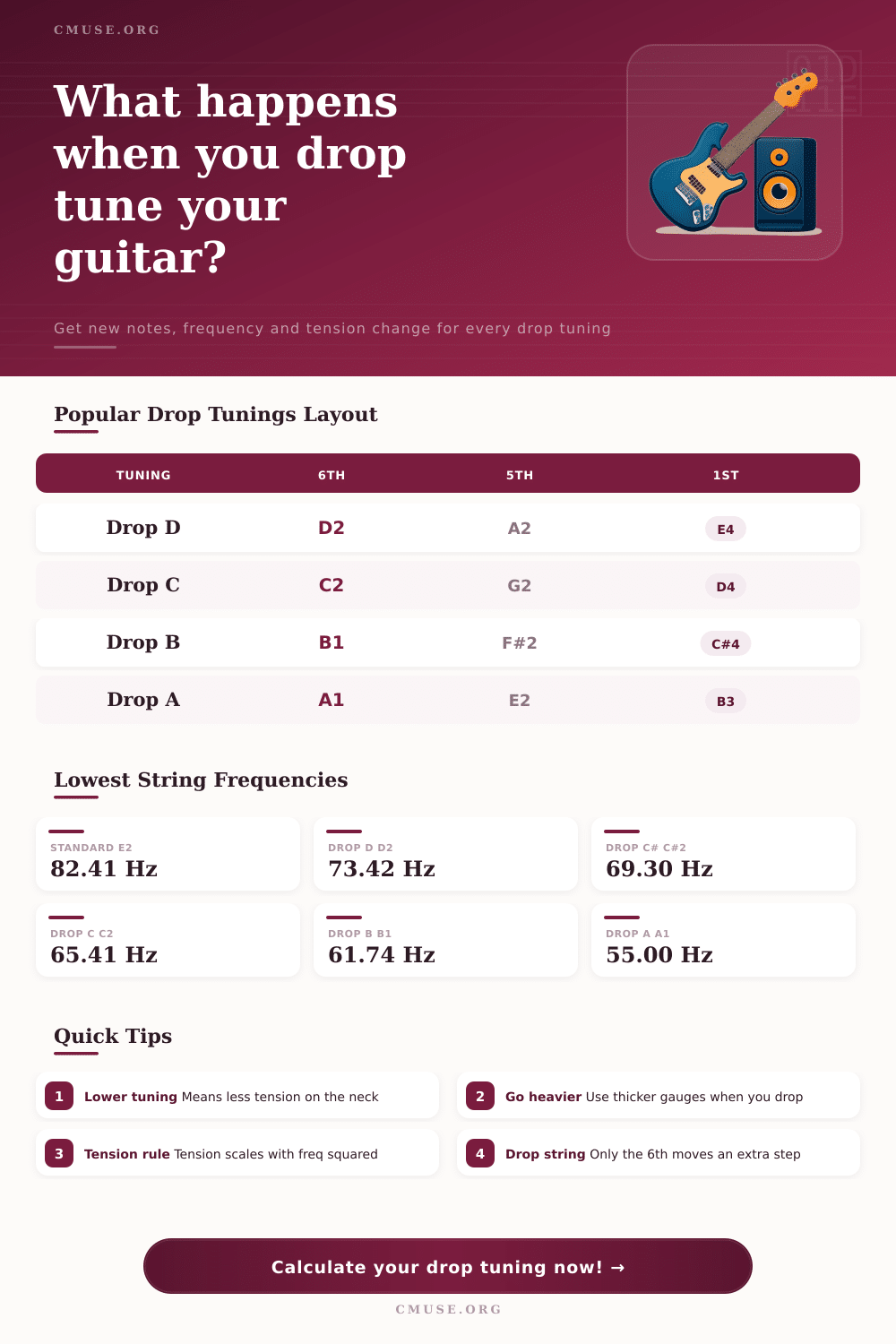
| Standard E | E2 | A2 | D3 | G3 | B3 | E4 |
| Drop D | D2 | A2 | D3 | G3 | B3 | E4 |
| Eb Standard | D#2 | G#2 | C#3 | F#3 | A#3 | D#4 |
| D Standard | D2 | G2 | C3 | F3 | A3 | D4 |
| Drop C# | C#2 | G#2 | C#3 | F#3 | A#3 | D#4 |
| Drop C | C2 | G2 | C3 | F3 | A3 | D4 |
| Drop B | B1 | F#2 | B2 | E3 | G#3 | C#4 |
| Drop A | A1 | E2 | A2 | D3 | F#3 | B3 |
| Double Drop D | D2 | A2 | D3 | G3 | B3 | D4 |
| DADGAD | D2 | A2 | D3 | G3 | A3 | D4 |
| Note | Freq (Hz) | MIDI | Semitones Below E2 |
|---|---|---|---|
| E2 (Standard) | 82.41 | 40 | 0 |
| D#2 / Eb2 | 77.78 | 39 | -1 |
| D2 (Drop D / D Std) | 73.42 | 38 | -2 |
| C#2 (Drop C#) | 69.30 | 37 | -3 |
| C2 (Drop C) | 65.41 | 36 | -4 |
| B1 (Drop B) | 61.74 | 35 | -5 |
| A#1 / Bb1 | 58.27 | 34 | -6 |
| A1 (Drop A) | 55.00 | 33 | -7 |
| Semitones Down | Freq Multiplier | Pitch Drop | Tension Drop |
|---|---|---|---|
| 0 | 1.0000 | None | 0.0% |
| -1 (half step) | 0.9439 | 1 semitone | 10.9% |
| -2 (whole step) | 0.8909 | 2 semitones | 20.6% |
| -3 | 0.8409 | minor 3rd | 29.3% |
| -4 | 0.7937 | major 3rd | 37.0% |
| -5 | 0.7492 | perfect 4th | 43.9% |
| -7 | 0.6674 | perfect 5th | 55.4% |
Starting from standard tuning, first loosen the low E string by a whole step into Drop D tuning. It gets darker and heavier sounding; you can play power chords with just one finger, and you can strum them to. It’s a pleasant change because it has a big impact based off minimal effort.
When you drop even further than Drop C, say, then physics starts to push back against you. Strings is now floppy; they go out of tune easly. The neck want to bow, making it hard to play accurately. To get it right you need to know how to set your instrument up properly, about string gauge, tension and pitch.
Why You Need Heavier Strings for Drop Tuning
But it’s really very simple mechanics. Tension in a guitar string create a specific note. Release some of that tension and the pitch drop. The calculator takes care of math for us. Changing semitones changes the frequency, which in turn changes tension. So what happens if we go from standard tuning of E to Drop B? It tell us exactly how much tension has been released from the neck.
Firstly, as guitarists, we are not normaly aware of the combined effect of dropping more than just one string. If I drop an individual string, the neck becomes a little looser. But if I drop them all six then I have lost about twenty percent of total tension that holds the neck rigid. What happens next is that the guitar is slack and buzzes on each fret. It will also go out of tune while you are playing unless you keep strumming.
When switching to new drop tuners, people too often keeps their original set of string gauges. Drop C sounds like rubber bands with a set of strings meant for Standard E. Don’t merely turn up the truss rod till its screaming. You want more string. Heavier gauge strings has greater mass per unit length so they let you hit those low notes with comparable tension. Imagine you have a suspension bridge and remove some weight from the cables, adding counterweights strengthens the structure. Swapping out the low E for a fifty nine or even a sixty two brings back the snap and clarity needed for accurate picking. The table on the page show how each downward step makes the frequency lower and gives a frame of reference as to why you’re going to need the thicker wire.
Interestingly enough, this equation also involves scale length. At the same pitch, a longer scale place more tension on a string than a shorter one does. So if you’re used to playing a Fender, which is around twenty-five point five inches, and pick up a Gibson-style guitar that’s roughly twenty-seven inches, you’ll notice a marked difference in string tension in standard tuning. Drop tune, though, and that additional length becomes your friend. It aids in keeping the low-end tight while still allowing for the use of fair gauges that don’t choke off the bending abilities on those higher strings. If you’re saddled with a short-scale instrument, however, you’ll have to be even more aggressive with your string choice to prevent that mushy undefined low end. It is the silent killer of extreme tunings.
As you lower your pitch, you change how the string stretches as you press it against the fret. The compensation points shifts when you drop down a couple of steps. Your guitar will play in tune open but sharp when fretted high on the neck. Adjusting the saddle positions backwards fixes this mistake. It takes some time but is difference between having your guitar playing like a pro or a bit sloppy.
The calculator shows you how many cents the pitch has shifted from original, so you can anticipate these changes and know when to adjust the compensation points. Otherwise, you could of being wasting hours trying to get your tuning spot on
Ultimately, it’s all about control. It’s not just an attempt at sounding heavy. It’s the ability to stretch out the range of your instrument without compromising the voice and strength of your instrument. Once you know what tension drops will do for your set up, you’ll know which strings to use, how much neck relief to have, and get the right intonation. It won’t let you off easy with the math, but the reward is a deep ringing tone that is just not possible in standard tuning.
Master the tension, and the rest will follow.