Drop 3 Voicing Calculator
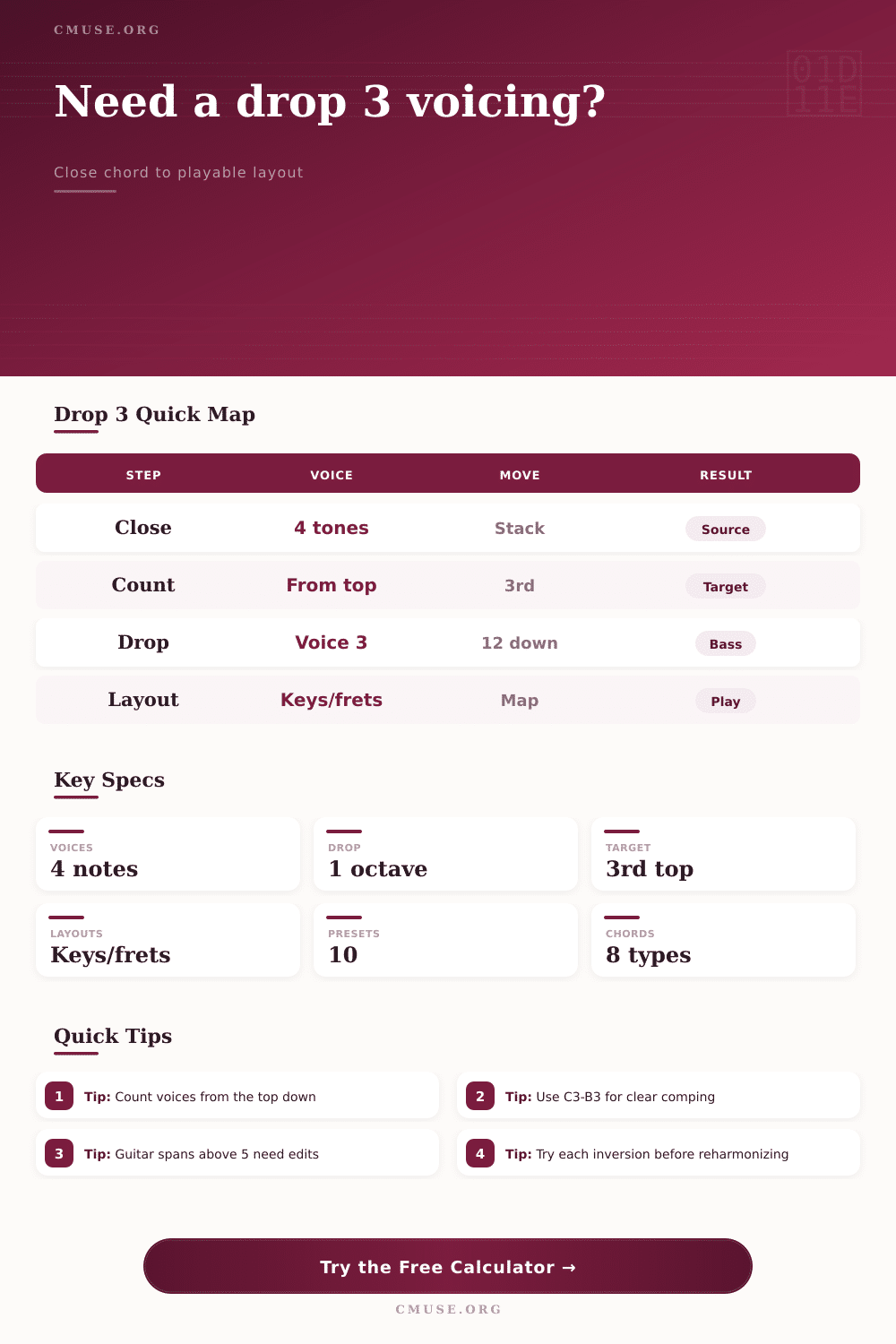
Transform a four-way close chord into a drop 3 voicing by lowering the third voice from the top, then map the result to piano keys or practical guitar strings.
Piano key order
Guitar layout estimate
| Source voice | Count from top | Drop 3 action | Typical musical role |
|---|---|---|---|
| Highest close tone | 1 | Keep in place | Melody or guide-tone color |
| Second from top | 2 | Keep in place | Inner chord color |
| Third from top | 3 | Lower by one octave | New bass or low inner voice |
| Lowest close tone | 4 | Keep in close register | Mid voice after the drop |
| Register setting | Bass range | Best use | Watch point |
|---|---|---|---|
| Guitar low | E2-B2 | Four-string comping and chord melody | Some keys need fretboard shifts |
| Studio comp | C3-B3 | Piano comping under singers or horns | Avoid crowding low left hand parts |
| Piano low | C2-B2 | Solo piano, stride color, broad pads | Close sevenths can sound muddy |
| Upper comp | C4-B4 | Thin texture, guitar upper sets, arranger pads | May lose the classic low drop 3 bite |
| Quality | Close formula | Drop 3 flavor | Common use |
|---|---|---|---|
| Major 7 | 1 3 5 7 | Open, polished, modern | Maj7 tonic and color chords |
| Minor 7 | 1 b3 5 b7 | Warm and stable | ii chords and modal comping |
| Dominant 7 | 1 3 5 b7 | Clear guide-tone pull | V chords, blues, turnarounds |
| Minor 7 b5 | 1 b3 b5 b7 | Lean and tense | Minor ii-V movement |
| Diminished 7 | 1 b3 b5 bb7 | Symmetric passing shape | Passing chords and approach chords |
| Rootless 9 | 3 5 b7 9 | Compact professional dominant | Piano left hand and guitar shells |
| Tuning | Open strings | Drop 3 strength | Common adjustment |
|---|---|---|---|
| Standard | E A D G B E | Most jazz grips translate directly | Skip a string when the bass is low |
| Drop D | D A D G B E | Low roots and fifths open easily | Recheck sixth-string fret names |
| All fourths | E A D G C F | Symmetric shapes across strings | Top two strings differ from standard charts |
| Piano map | Keys only | Exact octave output without fingering limits | Split wide spans between hands |
As a developing jazz pianist, you will eventualy reach a point where voicing chords in the closed position sound unprofessional. This isn’t necessarily because your finger placement is cramped but because it lack the wide sound heard in great recordings from the past. To overcome this mechanical challenge, there’s a theoretical solution called drop three voicings.
This help you stretch out the four different chord tones over a greater space without losing the harmony. It is based off a simple mathematical process practiced by all musicians who eventually learn it without even thinking about it. Begin with a four-note chord in close position (meaning the notes are all placed closely together in the same octave). Count down from the top note until you reach the third note. That is your third voice, then move that voice downwards one full octave.
How Drop Three Voicings Work for Jazz Pianists
The result is both resonant and open. It place the fifth or third of the chord in the bass area creating instant tension. This approach to voicing offer pianists such as Bill Evans his characteristic sound, with the right hand playing the melody and the left hand providing the harmony.
The calculator above take the mathematical work out of it for you. That’s because it converts abstract rules of voice-leading into practical fingerings. All you have to do is choose your chord type (quality) and its root note. The calculator does the rest by showing you which frets (for guitar) or keys (for piano) to play, depending on the range you want to hear.
For a guitarist who find certain chords a stretch too far along the fretboard this is great. It lets you know which string the dropped bass note is on so you can avoid any mud at the bottom end and it also ensures the melody note remains up front. So what does this mean? More than being able to identify a shape, it means understanding the input settings.
Your choice of register setting determines whether you use chord as a foreground statement or simply a background pad. Low register give warmth and foundation but runs the risk of doubling a bassist if there is one. High register sounds brilliant and clear but can be thin if not accompanied. By mapping out the notes across the keys (or string sets) the picture show you the trade offs involved. It shows what is likely to work best in a mix and whether that specific inversion will easily fit under your finger span on the instrument.
The choice of tunings also become a more useful feature for guitar players in particular. Standard tuning create unique intervals between strings that can make symmetrical shapes difficult to visualize. Tunings such as drop D or all-fourth tunings alter these relationships altogether. By doing this, the calculator update the fret positions to enable you to play the theoretical drop three voicing on whatever tuning you choose. It avoids the trap many people fall into when attempting to apply a piano voicing directly to guitar strings without taking into account their physical limitations.
Other chord types can be further explained with the help of reference tables on the page. Drop three voicings work well for dominant sevenths as the dropped note tend to fall either on the third or fifth of these chords, giving it a strong sense of pull towards resolution. Spreading minor sevenths like this bring warmth without the close clustering that can muddy the tonal direction. Diminished chords, naturaly symmetrical in construction, can work as some interesting passing-chords here if arranged in this open form.
It is not always about making something sound complicated for its own value but selecting the shape that best fulfills the harmonic purpose in the given song. I think we use this particular structure because of its effect on the ‘voice-leading’. By using drop three voicings you are able to travel smoothly from one chord to another as each voice move step-wise instead of jumping all over the piano.
The result is a clear harmonic thread which has an intended feel not a random one, it is the contrast between strumming a chord and weaving it into the fabric of the music. In the end, learning how to master drop three voicings is all about controlling your textural options. Suddenly, you don’t think in terms of a block of sound called a chord but rather a flexible structure you could of compress or stretch at will.
In jazz, these voicings provide the vocabulary to express the nuances of whether you’re playing guitar lines that double the melody, building a solo piano arrangement, or even comping behind a singer. Next time you reach for one of those cluster chord shapes, try dropping one of those voices down an octave and see if you notice what the space between the notes has to say that’s more better than the notes themselves.